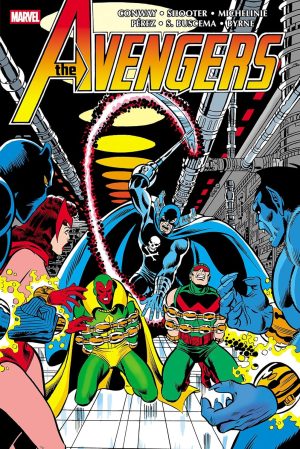
Review by Frank Plowright
Avengers Omnibus Vol. 5 is an object lesson about the importance of artists to a superhero comic. Despite being written during the 1970s, and perhaps because of that, there’s an awful lot to commend Steve Englehart’s stories. For the era they were consistently imaginative and pushed boundaries for being character-led. We have origin stories, superhero weddings, surprising new Avengers, the conclusion to a cosmic epic, the Avengers meeting Marvel’s Western stars in the 19th century, visits to alternate Earths, and Kang time and again. The opening battle with Zodiac and its results are ordinary, but even then feature interesting ideas such as the Avengers confiscating the Zodiac spacecraft for their own use.
However, as in the second half of Vol. 4, so much art is lacklustre. In terms of anatomy and proportions Bob Brown, Don Heck and George Tuska (sample art left) are old pros who know their away around a human figure, but layouts are so dull. Pages by Jim Starlin and early art from George Pérez have problematical proportions, perspective and anatomy, but sheer imagination provides power and presence through dynamic interpretation. Sal Buscema is a happy middleground, often providing layouts for the under-rated Joe Staton (sample art right), while the few stories entirely drawn by Dave Cockrum are the full package. He also immensely improves Brown when inking him, and even John Buscema’s pages look better for Cockrum’s care.
The content breaks down roughly into two halves. During the first Mantis dominates. She’s a mystery, and her eventual origin is conceptually strong and suitably mind-expanding. She came to the Avengers accompanying Swordsman, a reformed criminal with self-esteem issues, but is drawn to the Vision. As an android he’s largely logic based, but from somewhere deep within he’s reciprocated the Scarlet Witch’s feelings. Despite his maintaining a distance from Mantis, Wanda’s own insecurities are activated. Not all the associated dialogue rings true, which is strange as Englehart’s dialogue is generally commendable, but he efficiently builds the emotional turmoil toward a tragedy.
That’s just a prelude, though, to Englehart’s impressive establishment of much Marvel universe backstory combined with a pair of ambitiously conceived origins. The possibilities of Kang repeatedly attacking the Avengers from the future joins the two halves and once he’s dealt with, there’s an extended stay on the Earth occupied by the Squadron Supreme. Englehart builds on Roy Thomas’ joke of their being the Justice League in all but names and costumes, and begins the decades long tradition of their being misguided and manipulated.
What really makes this material work, though, is Englehart’s facility for establishing personalities. After reading for a while you could be quoted a random line of dialogue from a major character and take a good guess as to the source. The Beast, Black Panther, Hawkeye, Mantis, Moondragon, Scarlet Witch, Swordsman, Thor, Vision and Yellowjacket are all extremely well defined, leaving only Iron Man as slightly anodyne, which could be because he’s now so long been associated with the fast-talking movie version. A fill-in story by Tony Isabella is ordinary, and the point being made may have been valid in 1976, but now seems patronising.
Everything here has previously been available, most expensively spread over Marvel Masterworks: The Avengers volumes 13, 14 and 15, with Mantis’ story released in paperback as both The Complete Celestial Madonna Saga, and the shorter and better Celestial Madonna. Other portions are found as The Coming of the Beast and The Serpent Crown. Everything is found in black and white as Essential Avengers 6 and 7.