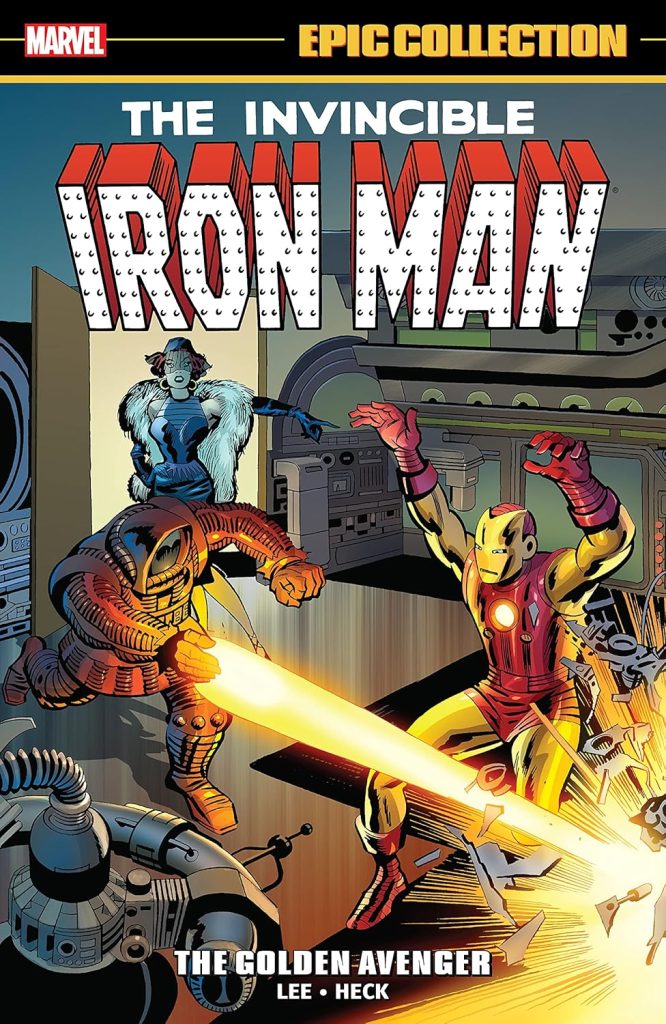

Review by Ian Keogh
All Marvel comics of the early 1960s are showing their age, but none are so rooted in both the clamorous tenor of their times and mediocrity than Iron Man. Yet the character was the earliest Marvel movie success, indicating Stan Lee’s concept was sound.
That concept was rich industrialist Tony Stark, a weapons specialist who’s showing off his product in Vietnam when he’s captured by the Viet Cong. With shrapnel from a wound edging ever closer to his heart, he’s placed with Chinese physicist Dr Yinsen, also being forced to work for the Viet Cong. Together they create an armoured chestplate to keep Stark’s heart beating, and eventually an armoured suit enabling his escape. Once back in the USA Stark modifies the suit and contrives the fabrication of Iron Man being his bodyguard.
So far, so good, and further strengths are the supporting cast of Stark’s attractive secretary Pepper Potts and former boxer, now chauffeur Happy Hogan, along with a convincing Mad Men-era representation of Stark as a man of power and influence. Thereafter numerous elements contrive to drag the feature down. The first is Lee only intermittently having time to write it, and rarely being inspired when he does. He resorts time and again to some form of Communist threat, but seems to have little idea what to do with Iron Man beyond. He sends Iron Man back in time to Cleopatra’s Ancient Egypt, into a subterranean civilisation and pits him against a succession of third-rate villains like the Melter, Mister Doll and the Scarecrow. Beyond that, numerous others script Lee’s plots, and all lack his lightness of touch with the dialogue.
Strangely, it’s some of the Communist villains who emerged from the morass to become characters of substance. The Black Widow, Crimson Dynamo and the Mandarin would all have long-running careers, as would the Widow’s catspaw Hawkeye.
Don Heck draws more than anyone else, and it’s long been revealed he didn’t enjoy drawing superheroes. Compare the elegance of the way Heck portrays Stark’s glamorous personal life to the stiffness of his superhero scenes. Steve Ditko should be forever credited for dispensing with Iron Man’s original bulky grey armour and replacing it with the more flexible red and gold version, variations of which have been used ever since, and Jack Kirby’s art has energy, but isn’t otherwise notable.
Iron Man really was the runt of the litter among the early Marvel titles, but if you must have it, this material has been reprinted numerous times. The gold standard is the first Invincible Iron Man Omnibus, presenting the pages in oversized hardcover. Both hardback and paperback versions of Marvel Masterworks: Iron Man Volume 1, Volume 2 and Volume 3 are available, and originally at the cheaper end of the scale, but now out of print is the black and white Essential Iron Man Vol. 1.