Review by Frank Plowright
The contribution of Roy Thomas to Marvel is inestimable. Beyond his work on core superheroes, let’s not forget he was also the man who persuaded the company to publish Conan, and then several years later Star Wars. As his career wound down in the early 21st century he concentrated on further adaptations, this time of classic literature, and they’re generally very good, with enough space over six chapters to ensure even long novels aren’t contracted too much. However The Man in the Iron Mask is a veritable brick of a book, a trilogy in itself, and while Thomas retains the essence, a considerable number of characters and subplots are discarded.
There’s latterly been more chatter about the number of uncredited collaborators and assistants Alexandre Dumas employed to maintain his prodigious output during the 1840s and 1850s, but whatever the truth, multiple novels produced during that period remain in print, which confirms popularity. There’s even a perhaps unwitting nod to that on Thomas’ part, although he at least credits Deborah Sherer and Freeman Henry for assistance.
The Man in the Iron Mask is actually the final of four volumes that began with The Three Musketeers, subsequently also adapted by Thomas and artist Hugo Petrus. D’Artagnan now heads the King’s Guard and his former comrades have retired. That doesn’t mean they ignore affairs of state, and despite his new position as a bishop, Aramis is extremely manipulative in service to an unseemly ambition. What plays out makes D’Artagnan extremely suspicious of his friends.
Dumas’ page-turning novels combine the court politics and intrigue of an earlier era with dashing and heroic figures, and frequently depend on the possible, but improbable. In this case it’s the discovery of the new young king’s hitherto unknown twin son.
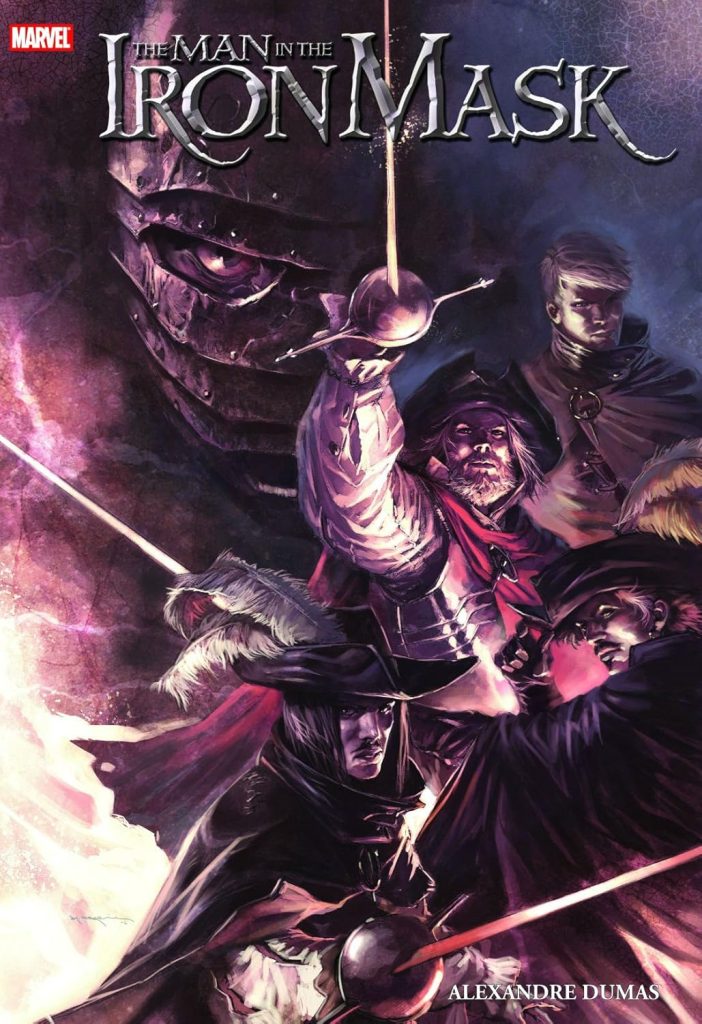
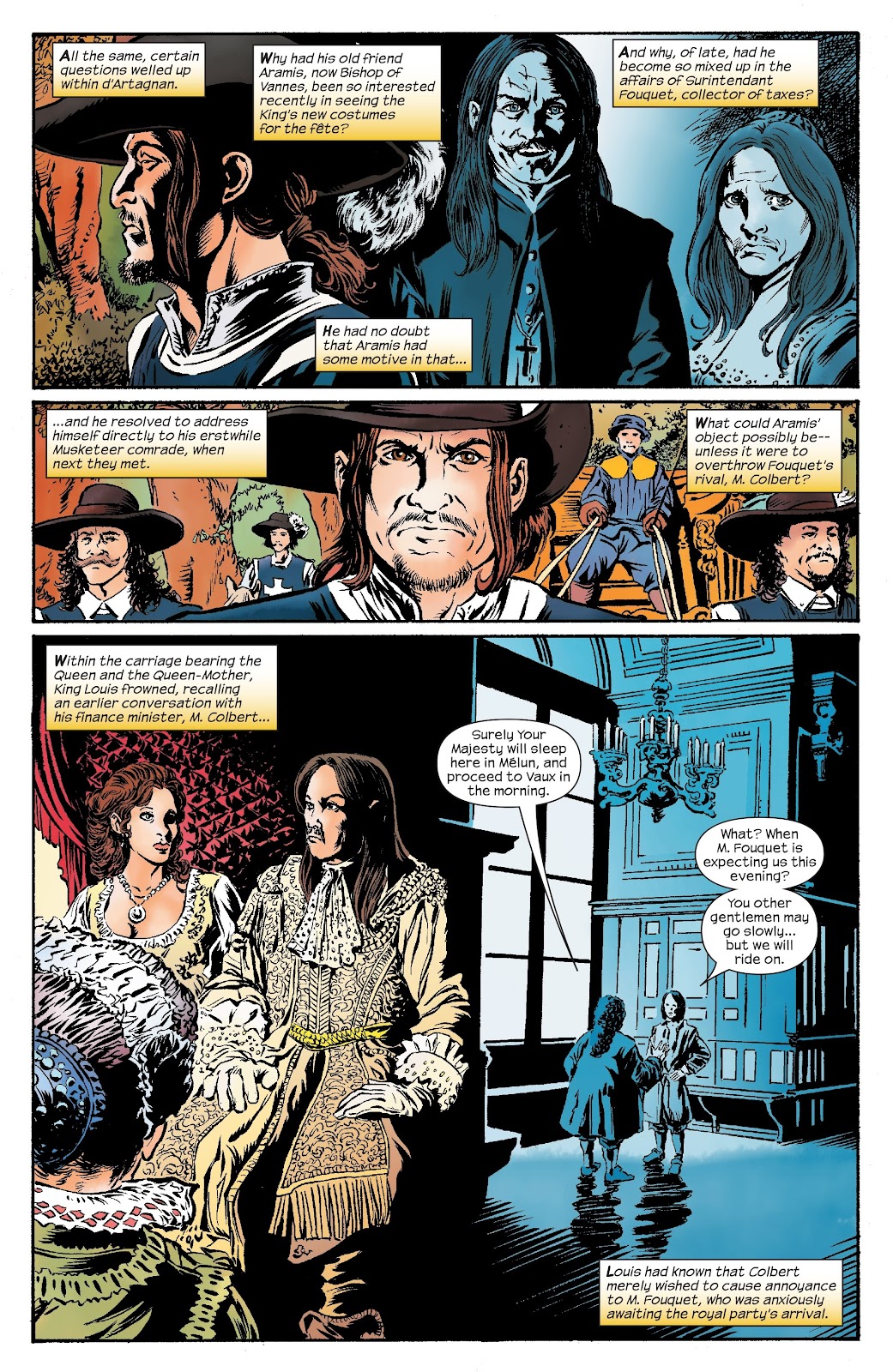
Petrus pours a lot of effort into his art. The people are convincingly clothed, the opulent surroundings convince, and he occasionally has the opportunity to shine further via reproductions of the type of art likely to be hanging in a royal palace. Especially notable is how Petrus illustrates an iron mask plain in design, and more in keeping with the times than some of the ornate film versions.
Considering it ends an epic succession of novels, Dumas is narratively brave as The Man in the Iron Mask is a tragedy far from a crowd pleaser for anyone who’s followed the fates of the Musketeers through their lives in print. Transforming one of his former noble heroes into a villain is a risk few authors would take, and there’s a continuing lack of sentimentality as matters play out. Thomas and Petrus bring it all to splendid life.
Concentration on the former Musketeers means characters important in the portions of the stories not adapted can seem introduced from nowhere when they do appear, and the epilogue ending is somewhat rushed. Put that to one side, this is a stirring and unpredictable adventure well transmitted.