
Review by Karl Verhoven
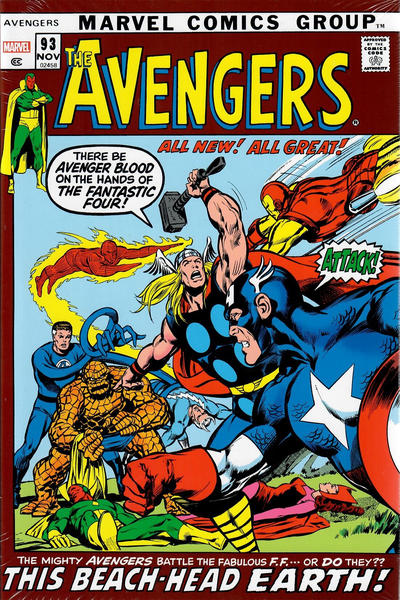
It’s almost incomprehensible that this Omnibus covers The Avengers from mid-1971 to early 1974, taking the series into its twelfth year, and yet it’s also the transition between only the second and third regular writers. Continuing from Volume 3, Roy Thomas is the in-place writer at the start.
Thomas gradually introduced more and more ambitious ideas, and his finishing year is generally considered his peak, accompanied by three of the era’s finest artists. First there’s nine chapters of the Kree-Skrull War, in which Thomas ties up loose threads from his cancelled Captain Marvel series by introducing galactic conflict with Earth in the middle. Cleverly, he also ties up threads from his Inhumans series. That, though, would be forgotten had he not further constructed a masterful SF plot involving the inexplicable, romance, tragedy and phenomenal action drawn mostly by Neal Adams (sample art left). At times the dialogue runs away from Thomas, but the ambition and execution still scores a bullseye, and the finale drawn by John Buscema is also magnificent.
If anything, though, the following three-parter is even better. It highlights real world themes of political unrest, shows the cause and ends with the Avengers invading Olympus, all drawn by Barry Windsor-Smith at his absolute peak. A collaboration with Harlan Ellison and the Avengers vs the Sentinels complete Thomas’ run, not the peaks of before, but still readable, and starting his career Rich Buckler’s art shows effort he’d seldom make again.
Even allowing for Steve Englehart being paired with less accomplished artists, he begins with a long run of material vacillating between mediocre and average. His comments attribute the quality to his attempting to write in the style of Thomas rather than following his own instincts by basing events around the characters. It’s only toward the end of this volume with the introduction of Mantis and the return of old enemy Swordsman that his individuality slips into place.
Would Englehart be given a year to find his muse today? Definitely not, yet the virtue of letting him find his feet eventually resulted in a memorable run, and if he’d been shunted off the title before he pitted the Avengers and the Defenders against each other how long would it have been before someone else came up with the idea of such a crossover? The Avengers/Defenders War is the best of his contributions to this Omnibus, the two teams manipulated into believing the other’s intentions are suspect, leading to a series of one on one encounters at points around the world. The Defenders are attempting to assemble sections of a device intended to restore the Black Knight to the living, and the Avengers believe their intentions aren’t as noble. “The God of Thunder shall endure no more!” indeed.
What diminishes much of Englehart’s work further is art primarily from Bob Brown (sample art right), poor fare indeed after Adams, Buscema and Windsor-Smith. There’s little imagination and what are intended as impact pages lack it entirely. He’s greatly shown up by Sal Buscema’s clarity and intuition when the Avengers take on the Defenders.
It’s not quite as simple as first half good, second half disappointing, but that’s not far from the truth. In addition to the collections highlighted above, these stories were previously available as Marvel Masterworks: The Avengers Volume 10, Volume 11 and Volume 12, and in black and white as Essential Avengers Vol. 4 and Vol. 5. The bulk are also found in the Epic Collection: Avengers/Defenders War, and remainder of Englehart’s Avengers run fills Vol. 5.