Review by Graham Johnstone
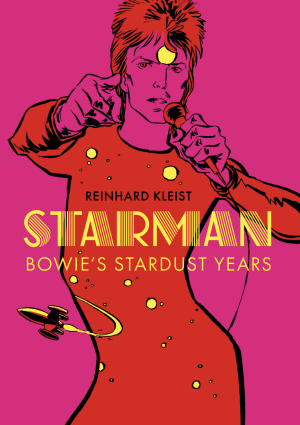
Reinhard Kleist’s Starman charted David Bowie’s early 1970s peak, ending with the ‘retirement’ of his Ziggy Stardust persona. This was less the ‘Rise and Fall’ of that album’s title, than rise and… jump off. Low: Bowie’s Berlin Years shows where he… (more later) ‘fell to earth’.
That’s a sound focus for a packed, but compact biography. However, Bowie’s post-Ziggy trajectory was more complicated, so Kleist includes flashbacks to an abortive musical, America, and addiction and arrest setting up Bowie’s Berlin journey from personal low to creative high.
We first see his PA finding him the Berlin apartment equivalent of his Haddon Hall commune. Bowie’s suitably-staged entrance shows an Oblique Strategies card saying “buy your own groceries”, which neatly encapsulates Bowie’s aspirations of escaping superstardom, and joining the avant-garde. Kleist acknowledges Bowie’s inspirations, Isherwood’s Berlin Stories, Expressionist art, and especially so-called ‘Krautrock’. Bowie brings fellow American refugee Iggy Pop, then imports producer Tony Visconti and electronics wizard Brian Eno, for his creative dream-team.
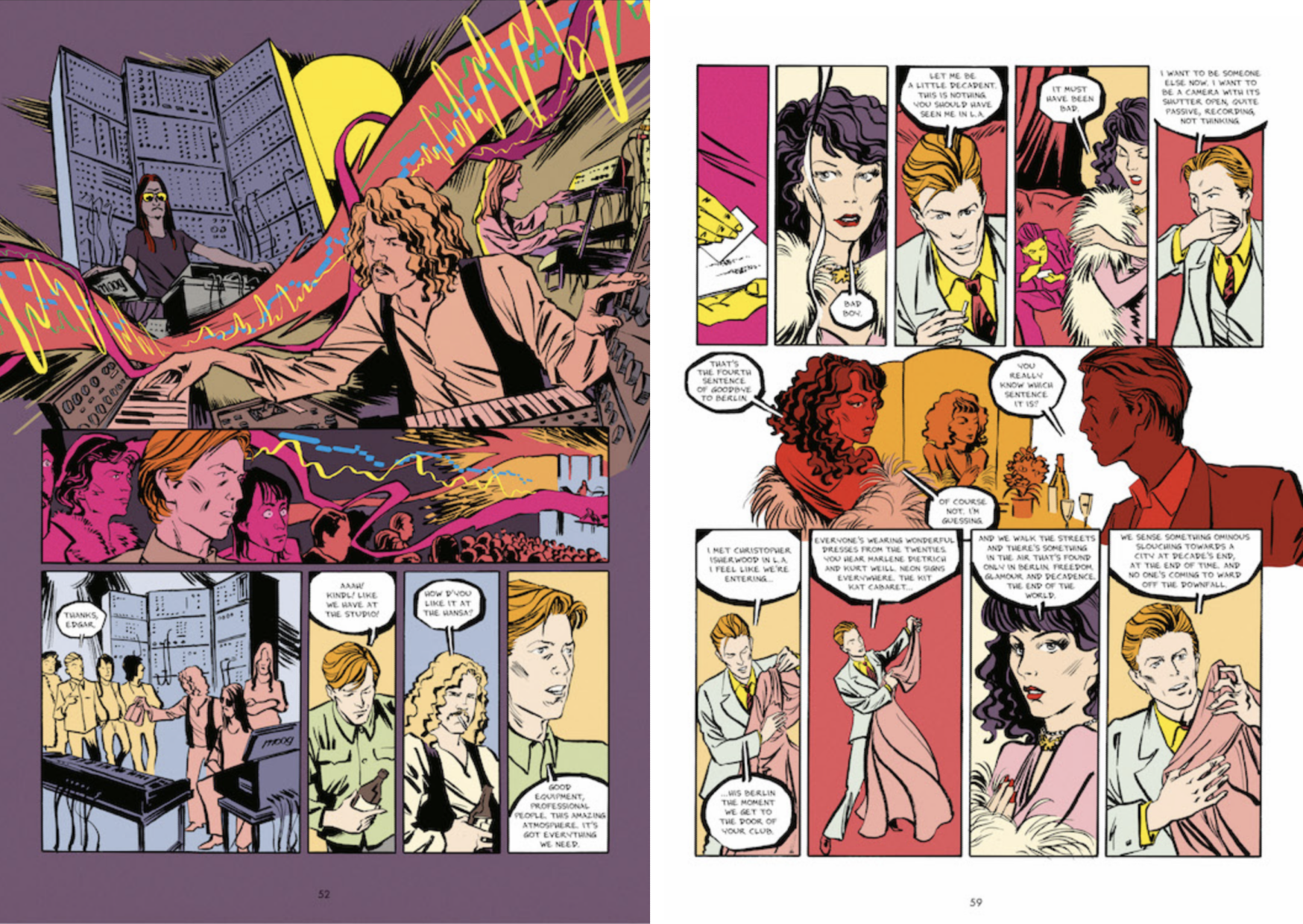
Kleist mostly carries the story in dramatised, richly layered, scenes. A housemates away-day for David and Iggy introduces East Berlin, inspires ‘The Passenger’, and softens-up Iggy to be moved out of the apartment. It’s a fine example of Kleist’s ability to weave place, process, and people, into punchy pages.
Hit single “Heroes” merits a longer scene. Robert Fripp, straight off a plane, is played an instrumental track and improvises his legendary guitar solo. Lyrics only emerge when David sees Visconti and ‘lover’ kissing at the Berlin Wall. Kleist adds less-known details, and graphic effects – like colours and shapes emanating from Fripp’s guitar. Bowie’s screen role as stranded alien The Man Who Fell to Earth, mirrors recurring themes, yet Kleist does little more than re-create the film, at unnecessary length.
Low illuminates the man behind the alter-egos. Key moments, like a meeting with schizophrenic half-brother, Terry, reveal an unguarded Bowie. His need to ‘Move On’ is well captured – his relationship with transgender cabaret artiste Romy ends gently, but that with star-maker wife Angie (oddly, ‘Angela’ here) less so. Bowie’s overdue rejection of Nazi imagery is triggered by neo-nazis attacking a local gay bar. This adds up to a convincing portrait of a famous yet little-known man.
The art is strongest on stage scenes, and poetic sequences, but Kleist enhances necessary conversations with expressive figures, dynamic angles, and lively brushwork. He conjures recording studios, limousines, and dressing rooms, without slowing the flow, and captures likenesses without caricature or photo-referenced stiffness. Colour palettes (aided by Thomas Gilke) vary from stage-lit primaries to various tints signalling flashbacks and scene changes, completing a powerful visual experience.
However, multiple time-shifts, combined with lack of captions (identifying dates and characters), may make it a demanding read. Some might recognise faces in a studio, yet still be wondering which Bowie or Iggy album they’re recording. Oddly, characters are often introduced later, as if Kleist had shuffled the completed scenes, to mirror Bowie’s use of the cut-up technique. Perhaps Kleist is enacting Bowie’s avant-garde methodologies, including Eno’s Oblique Strategies… ? Some readers may find this disorientating, yet it plausibly evokes the experience of pop fans first hearing the cryptic lyrics and otherworldly instrumentals of Low.
Kleist reprises Starman’s astronaut imagery (as Bowie did), for a finale narrated in his interrogative second person (“do you remember Major Tom?”), this time intercutting with ‘epilogues’ for the various characters – Lennon shot, Iggy finally a star. It’s a suitably tour-de-force ending.
This always fascinating, sometimes challenging, book captures both the detail and spirit of Bowie’s Berlin Years making Low, an absolute high.