Review by Ian Keogh
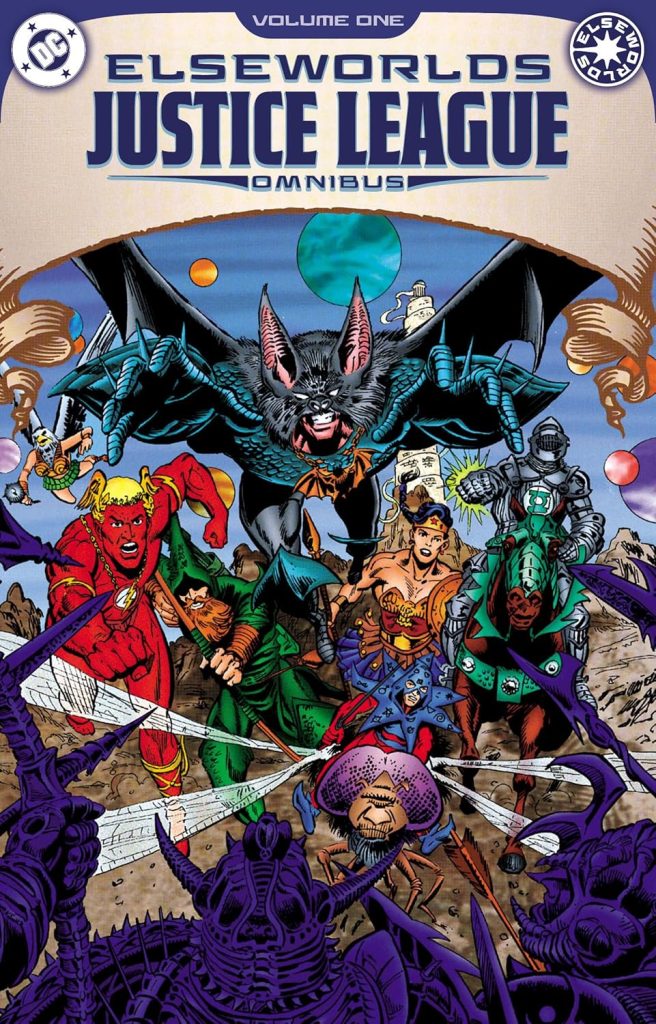
As DC and Marvel both habitually gather smaller collections into bulkier and more expensive packages, your assumption might be of the Justice League Elseworlds Omnibus merely repackaging previously issued paperback collections under the Justice League Elseworlds title. It doesn’t, instead gathering a selection of annuals, most from 1996 under the banner ‘Legends of the Dead Earth’ and unavailable in collections before. Neither were the six chapters featuring Kamandi, nor ‘League of Justice’.
Before readers became comfortable with a multiverse, alternate versions of DC’s core superheroes appeared under the Elseworlds title. The brief for most creating ‘Legends of the Dead Earth’ was versions of JLA heroes manifesting again in times of dire need at an unspecified time in the future. The tone varies from dystopian SF, through fantasy and humour to horror, and while the majority feature individual heroes, three really poor stories feature the full Justice League.
Despite pages from some notable artists early in their career like Phil Jimenez (Guy Gardner) and J.H. Williams III (Flash), most art is of its era, often plain ugly. Of the better inclusions David de Vries recasts the familiar Green Lanterns as Nazis, with some downright nasty moments, but Dean Zachary’s tortured art can’t bring it to life. A second Green Lantern outing has excellent art from both Quique Alcatena and Bill Willingham, but it’s the different moods of two Aquaman solo stories from Peter David and Ed Hannigan that really stand out as the ideal combination of creative and well drawn.
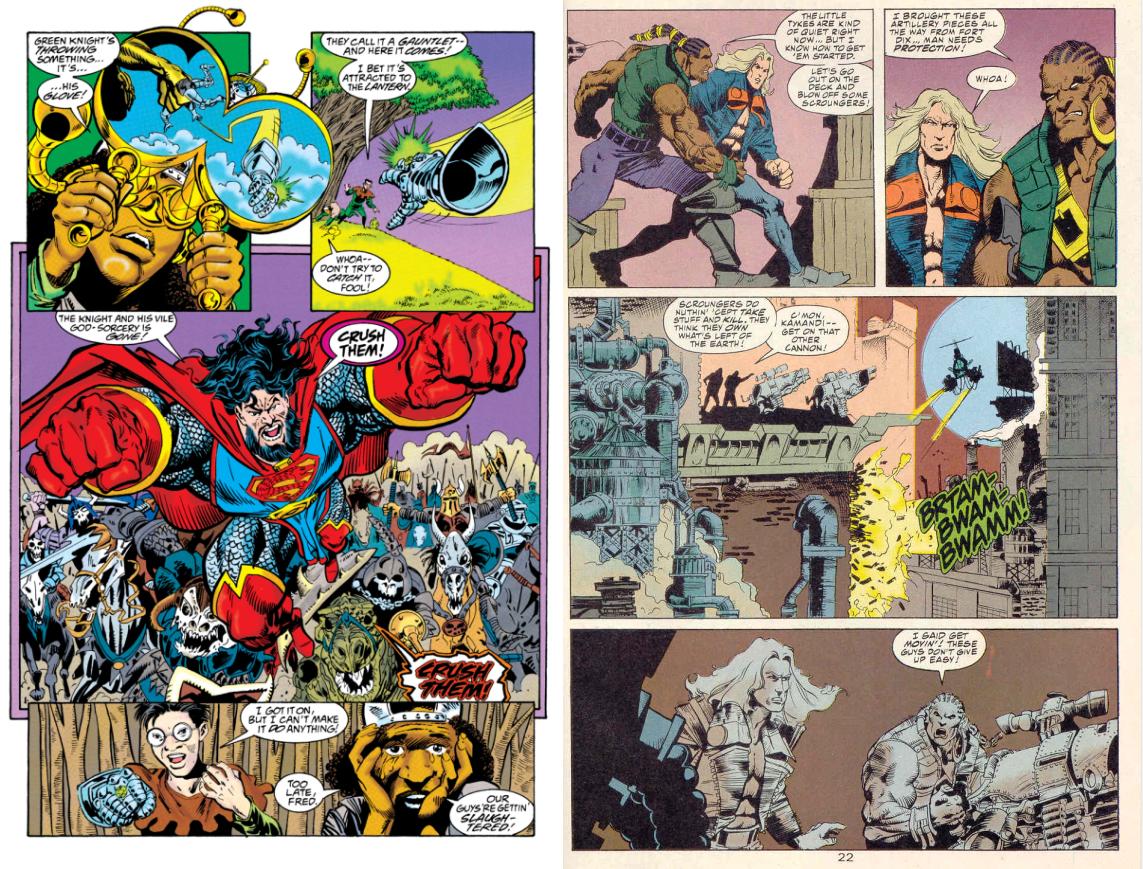
Hannigan writes and pencils ‘League of Justice’, re-imagining the heroes in a world where sorcery reigns. It’s visually imaginative (sample art left) as a few ordinary people from Earth attempt to overthrow the tyrant of a magical world, along the way meeting alternate versions of Justice League members. More fairy tale than superhero adventure, Hannigan plots and draws well, but over-writes.
‘At Earth’s End’ is presumably included as an Elseworlds tale that would otherwise be homeless, as the Justice League connection is tenuous. Tom Veitch reworks Jack Kirby’s Kamandi by having him emerge from a bunker after war tasked with killing the person who began that war. Artist Frank Gomez is better at drawing machinery and monsters than people. His men are bulky and the women ridiculously slim, but the art improves chapter by chapter. It’s true to the spirit of Kirby, and a decent episodic adventure with satirical moments, but why not include the bonkers sequel Superman: At Earth’s End?
That leaves two slabs of solid gold. The Golden Age and Kingdom Come were both highly acclaimed when individually issued. Follow the links for greater detail about them but they raise the overall quality ranking considerably. Both are magnificently drawn in very different styles, and both deal with a dystopian USA. Mark Waid and Alex Ross present a younger generation of superheroes lacking respect and protective instincts, and how events play out is witnessed by a pastor tasked with judgement. James Robinson and Paul Smith have a superhero’s World War II achievements enabling election as US president, but something’s not quite right. Both tales deserve their reputation and that their presence only drags the remainder up to average overall indicates how poor some of it is.