Review by Karl Verhoven
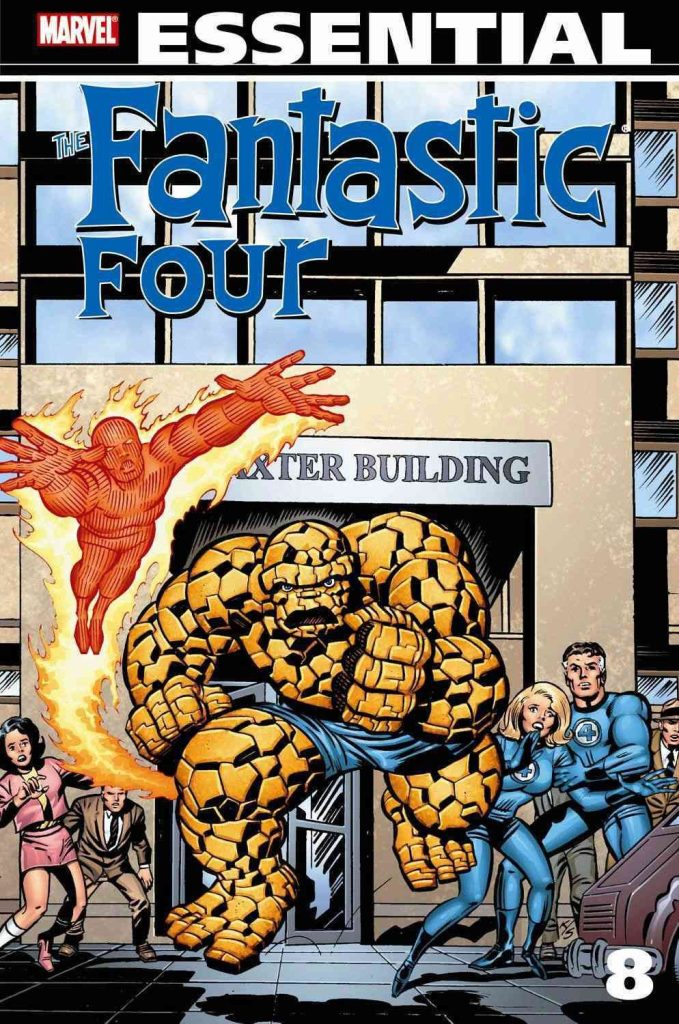
As seen by the number of writers and artists credited, this collection covers the Fantastic Four during a period of transition in the mid-1970s. Roy Thomas writes the bulk of the content, but blows hot and cold. From mid-1975 he was expanding the repertoire by including longer stories, and it’s perhaps no coincidence that most of his better work is over these, although that’s not a hard and fast rule. After a shaky start in Volume 7, there’s a concerted effort not to marginalise Invisible Woman, applying thought to her powers, and Thomas is always good with the Thing’s outwardly surly personality concealing an inner warmth. On the debit side his writing becomes increasingly wordy, bogged down with irrelevant explanations, and attempts to reconcile the Marvel of the 1970s with characters from earlier decades result in dull material.
Thomas at his best is exemplified in the opening four-parter and a whimsical one-off. The collection begins with a scene of the Thing being hunted down and seemingly killed by barbarian warrior Arkon on a flying dinosaur. The shock value is rapidly erased when the truth is revealed, but it’s a bold start that never loses momentum as Thomas investigates alternate worlds. His other undeniable triumph is letting the childlike Impossible Man loose in the Marvel offices: “Now that I understand what these “comic-book” things are… I want to you to make one about me!” Impossible Man mimics assorted heroes George Pérez buys into the joke with good portraits of Marvel staff and you could cut cheese with the creases in Stan Lee’s flares. The only downside here in black and white is there’s no knowing all Impossible Man’s imitations are green and purple.
The earlier return of Galactus pitting him against the High Evolutionary also has moments, but the quality isn’t sustained over five parts. Thematically it’s a reprise of the strong opener, except set on alternating planets. The return of the Frightful Four requiring a new member is also solid, but devolves into a meandering mess crediting five plotters and characterised by some wretched expository dialogue from Bill Mantlo.
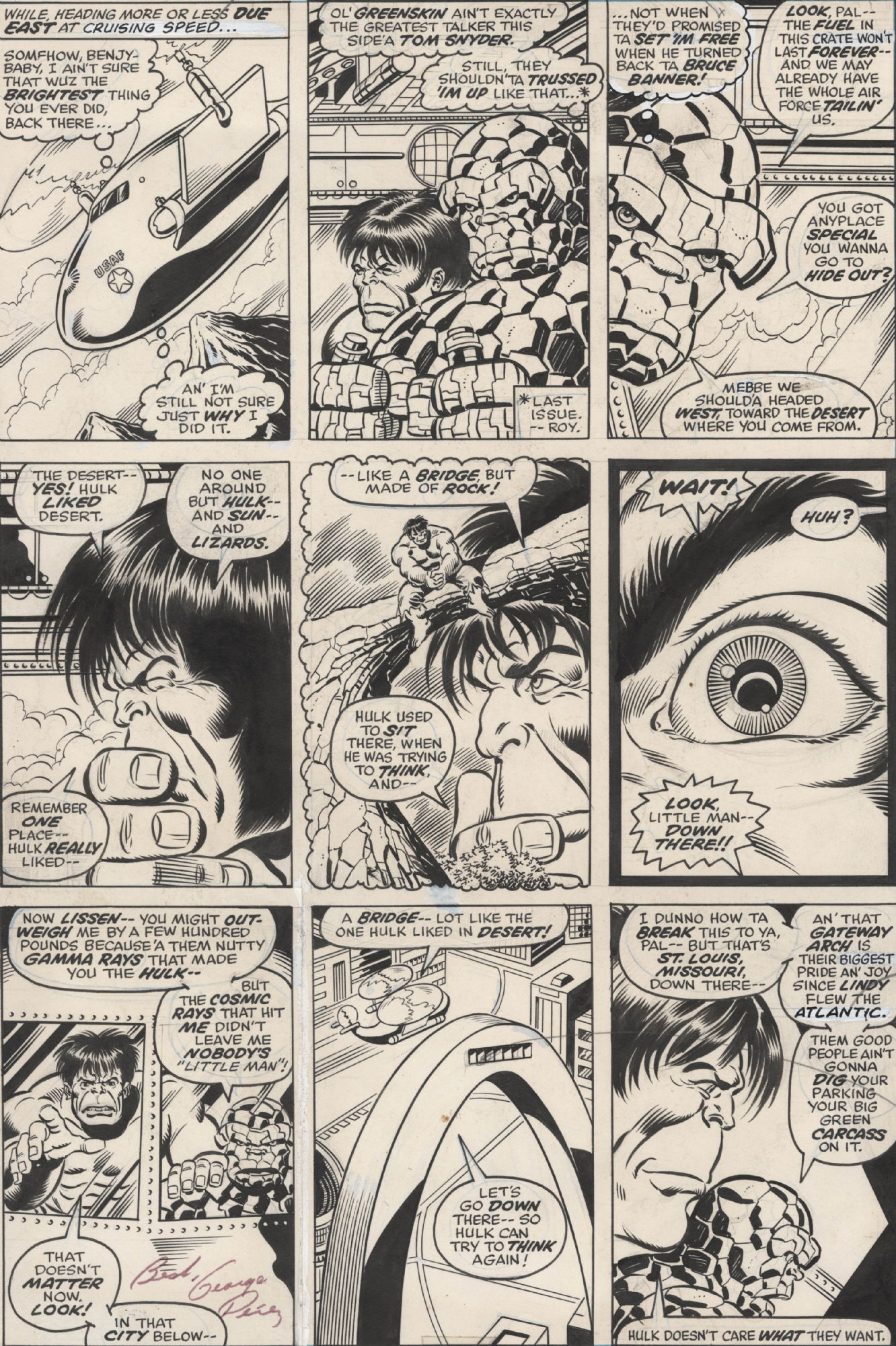
In addition to Pérez (sample page) there’s notable art from John Buscema, the usual solid work from Sal Buscema, and Rich Buckler pages also looking good if you discount his habit of swiping from Jack Kirby. Ron Wilson’s work wasn’t greatly admired at the time, but as inked by Joe Sinnott hindsight reveals viable action art.
Guest stars with a meaningful role include Luke Cage, Thundra, Tigra, the Liberty Legion, and the Hulk, but the only one halfway decently used is Marvel Boy in a flawed revival.
In more luxurious format this content is also found spread across Marvel Masterworks: The Fantastic Four Volume 16 and Volume 17, the relevant Epic Collection are The Crusader Syndrome and Counter-Earth Must Die, and a random guest-star heavy run was issued as Crusaders & Titans.