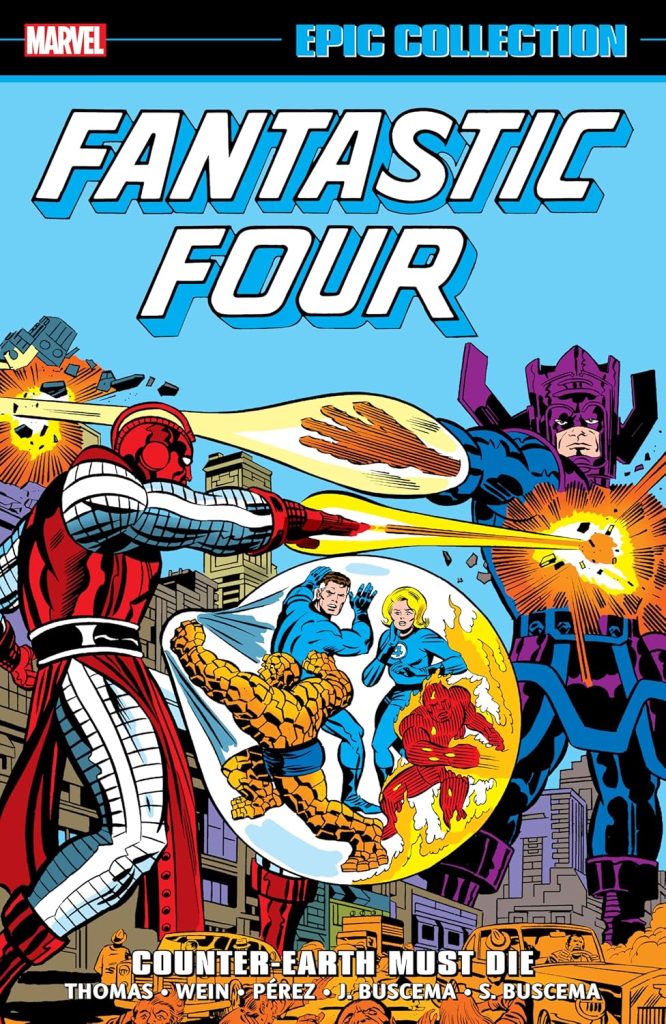
Review by Karl Verhoven
The mid-1970s was a period of considerable expansion at Marvel, and that took its toll on their earliest superhero title as attention was spread thin. Taking the era into account, little here is explicitly poor, but neither is there much of note. Counter-Earth Must Die chronicles a period of flux.
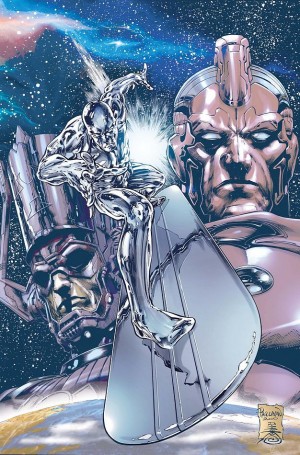
In The Crusader Syndrome Roy Thomas produced the longest Fantastic Four story to that time, extended over four chapters, and he tries again with the title story, which is ambitious in pitting Galactus against the High Evolutionary with the FF caught in the middle. Encompassing numerous planets, it’s strong in places, but never entirely gels. Thomas begins an even longer story, which starts well with the comedy of the Frightful Four attempting to recruit a new member, but degenerates into a slog with many other writers pitching in, each changing direction, and Bill Mantlo’s characters explaining to the audience especially poor. It’s a sad and presumably unplanned departure for someone responsible for some great FF stories.
Thomas’ best material involves the wacky Impossible Man, not a beloved character by any means, yet used well as a novel end to an epic, to satirise the Marvel offices, and again later by Len Wein, the other dominant writer.
Wein, thankfully uses far fewer words than Thomas, but is not above a heavy-handed explanation. He’s very good with the Stan Lee style of villain’s pomposity: “the witless fool has served his purpose! His sacrifice has enabled me to complete my preparations without interference”. It’s also notable that instead of relying on returning one old foe after another, Wein creates new enemies. The likes of the Eliminator, Nicholas Scratch and Salem’s Seven haven’t entered the ranks of all-time greats, but at least effort is evident, and Scratch did make the WandaVision TV show.
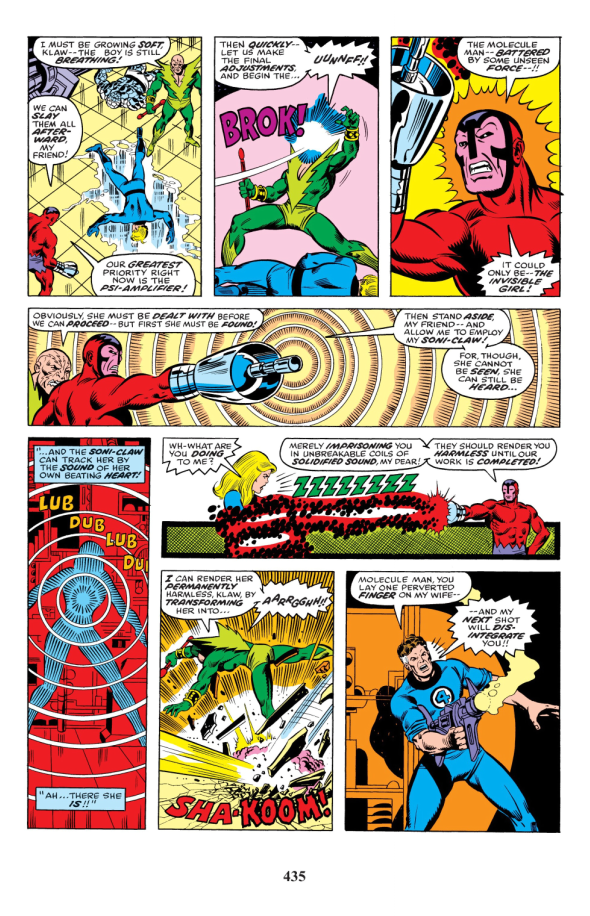
Any actual wonder to be found is in the progression of George Pérez into the complete superhero artist. He’d always been an enthusiastic workhorse, but having transferred from the Avengers to draw the FF he really pulls out all the stops, the layouts exemplary, the pin-ups inspirational and the sheer detail immense. The series cover tagline proclaimed it “The world’s greatest comic magazine!”, which in truth was a title lost years previously, but when Pérez is on the art at least it looks the part again. Drawing far fewer stories, John Buscema is also excellent, and Ron Wilson, not greatly loved at the time, produces a passable Jack Kirby homage when inked by Joe Sinnott.
This is a patchy collection with few highlights, but Pérez and Buscema drag it up to average. In hardcover these stories occupy Marvel Masterworks: The Fantastic Four Volume 16 and Volume 17, while in black and white the content spreads over Essential Fantastic Four Vol. 8 and Vol. 9. About the first half also forms the bulk of Fantastic Four: Crusaders & Titans.