Review by Lewis Savarese
Yes, Batman becomes a werewolf in Rodney Barnes and Stevan Subić’s Batman: Full Moon. This standalone title is part of DC’s Black Label imprint for mature audiences, those who prefer their Batman stories contain crass sexual references and ultraviolence. What starts off as an intriguing exploration of the magic versus science trope, gives way to a threadbare plot unable to investigate the moral ramifications presented within. Full Moon is at least an adequate showcase for Subić’s art, which is difficult to find in English-speaking markets.
Full Moon hews closely to the Universal Monsters version of lycanthropy as seen in 1941’s The Wolf Man. While fighting a werewolf loose on the streets of Gotham, Batman is bitten and eventually turns into a beast on the night of a full moon. Christian Talbot, the man afflicted by the lycan curse, is even named after Lon Chaney Jr.’s character in the 1941 film and similarly sports a pentagram symbol on his palm. Talbot’s sudden appearance in downtown Gotham is the result of experiments gone awry at Wayne Pharmaceuticals. We learn from Kirk Langstrom, who had been consulting for Wayne Pharma, that their weapons division was experimenting with magic using Talbot as a test subject. Batman enlists the services of Zatanna, his girlfriend, and her scornful ex-lover John Constantine to find a cure for lycanthropy using magic as he and Langstrom apply the scientific method.
Sprinkled among the werewolf fights, interludes in the impoverished Potter’s Den neighbourhood, and expository flashbacks regarding the Dark Realm, is an attempt to reckon with Batman’s hubris and wealth. Barnes casts Batman as a sceptic of the occult, unwilling to entertain mystical solutions to the lycan curse. Batman insists that lycanthropy is a virus, even though his sorceress girlfriend and zoologist colleague both agree that magical forces are at work. This makes Barnes’s examination of Batman’s arrogance compelling, but his critique of the Wayne fortune does not cohere. After Talbot and Batman in werewolf form wreak havoc in Potter’s Den, a denizen of the skid row chides Alfred when he offers them monetary compensation for the damages. At the conclusion Bruce Wayne makes an appearance in Potter’s Den to help out, which is presented as his act of contrition. However, Barnes does not scrutinise the weapons division of Wayne Pharmaceuticals that exploited Talbot, a man in search of a cure. At one point Langstrom implies that Bruce Wayne authorised this division of the company, a startling revelation that puts a damper on the redemption arc and goes wholly unaddressed.
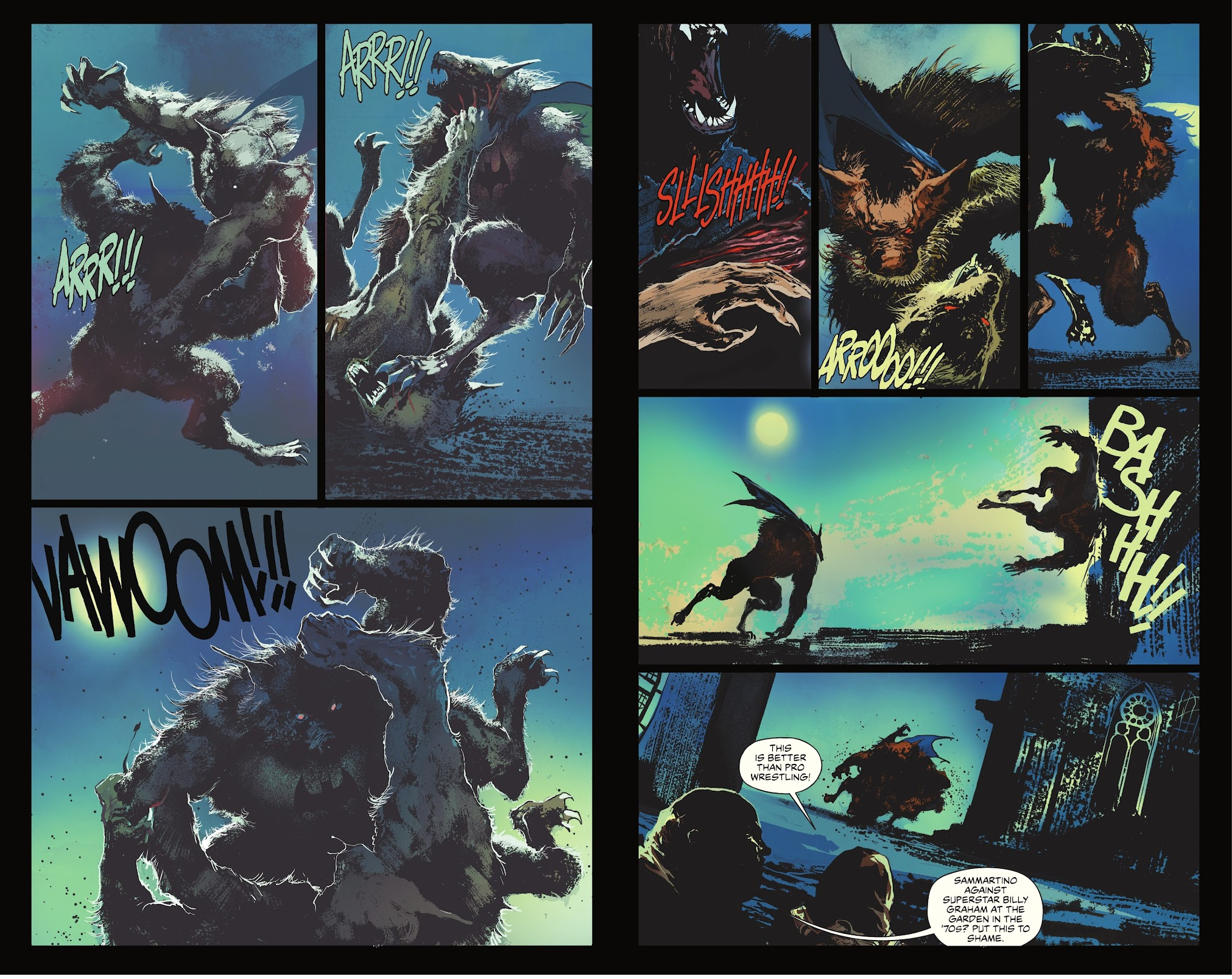
Many will pick up this volume for Subić‘s art, which does not disappoint. His painterly style is the perfect aesthetic for a Batman horror tale and he excels at depicting the brute strength and hulking mass of the werewolves, as they rend each other’s flesh with fangs and claws. Batman’s first transformation, in which his werewolf form rips open the Batmobile like a tin can, might be the most evocative image of the book. Subić is most inconsistent when rendering human faces, though. Zatanna, already made to endure sexual harassment from Constantine in every scene they share, looks wildly different from panel to panel.
Ultimately, the obligatory inclusion of occult secondary characters and glorious werewolf action cannot bolster the weak plot. Although this is a Black Label title for mature readers, Batman still exists in a fairytale world where he gets the girl and comes out on top.