Review by Frank Plowright
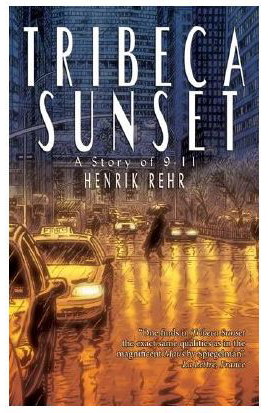
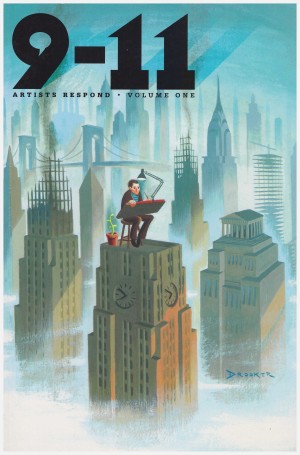
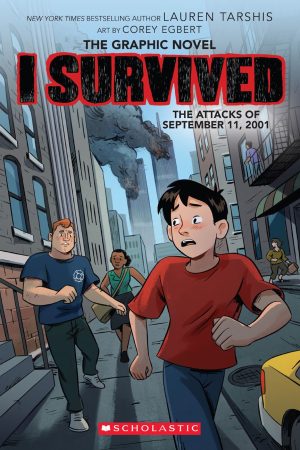
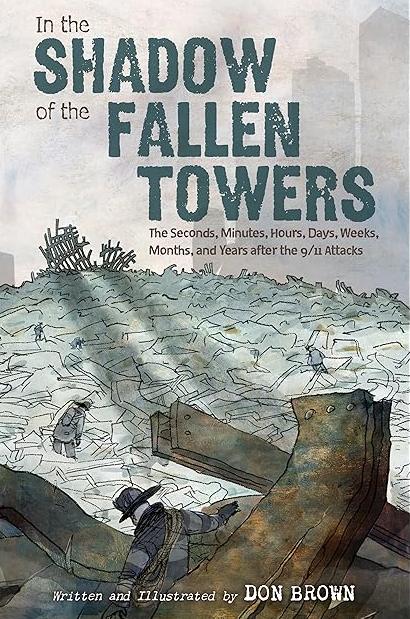
Several graphic novels have dealt with what happened in New York and Washington on September 11th 2001 when planes were weaponised and flown into buildings killing thousands. However, most were published relatively soon after the events, and Don Brown’s In the Shadow of the Fallen Towers has the benefit of greater hindsight, being published in 2024.
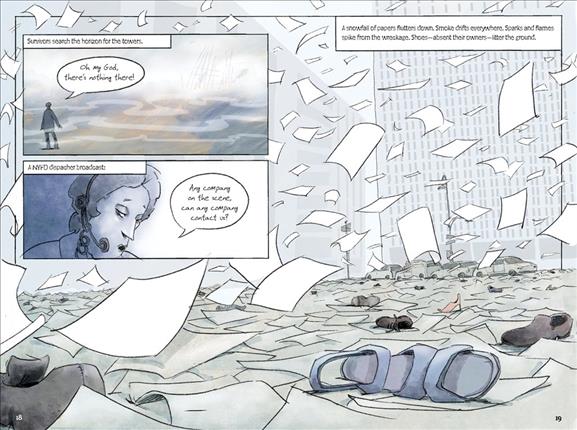
Brown has a long track record of compacting historical information into economically styled and informative graphic novels, and brings that technique to the topic of 9/11 and its aftermath. Simple, yet evocative art conveys moments rather than a comprehensive timeline, yet the important benchmarks are present and correct. Brown tells the story through people, naming individual fire officers and others while detailing their personal experiences. Some are buried beneath rubble, some flee by boat, and others undertake the grim task of attempting rescue when hope has all-but departed.
This method allows the telling of remarkable incidents not found in more comprehensive histories. Pasquale Buzzelli attempted to escape down one of the World Trade Center’s staircases, and was discovered alive atop a small peak in the collapsed rubble. Brown is able to draw evocatively what photographers were not present to capture. It’s a consistently humane presentation, Brown not hesitating to reveal the darker side of the faux-patriotic fervour whipped up in the immediate aftermath, such as a driver considering he’s defending his country by attempting to run down a young Pakistani woman. He also highlights the case of Abu Zubiydah, arrested, tortured and detained in Guantanamo Bay since 2003 on the flimsiest of evidence.
Some simplifications are inevitable in a book aimed at a younger audience, but as a primer giving an understanding of events In the Shadow of the Fallen Towers is exceptionally well researched and presented. In common with almost every other American produced book on the terrible events, however, there’s no attempt to investigate the resentments that might have prompted the attacks in the first place.