Review by Karl Verhoven
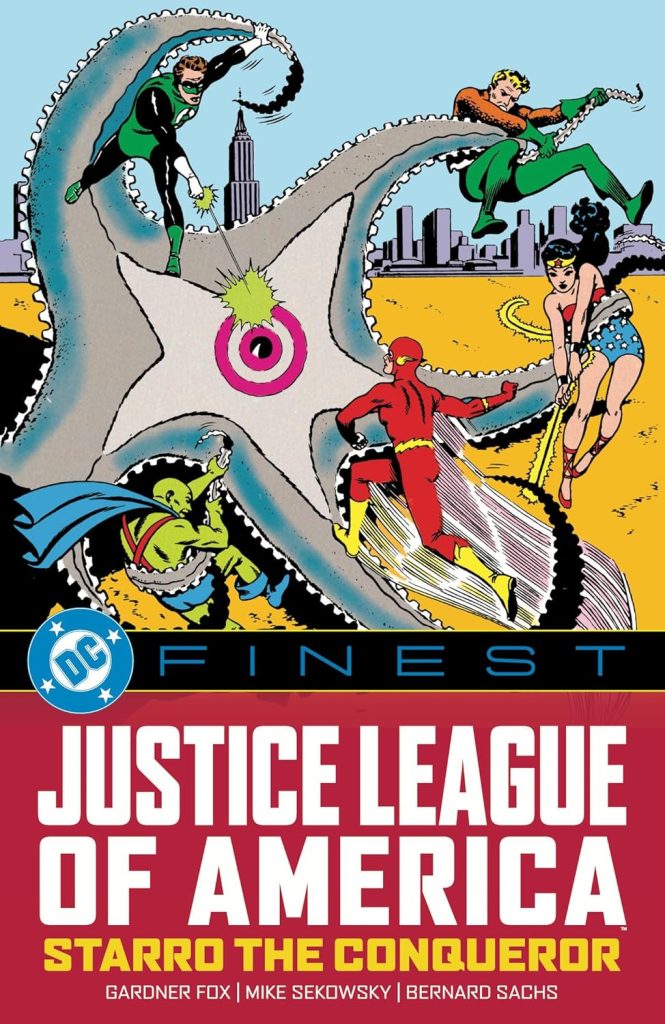
Spanning 1960 to 1963, Starro the Conqueror combines the first 22 Justice League of America adventures. They’re surely an acquired taste these days, resolutely old fashioned starring characters whose dialogue is interchangeable and drawn in a bizarrely quirky style. Furthermore we’re transported back to an era where although Batman and Superman were members from the start, the editors of their individual comics were able to restrict their presence on the basis that kids seeing them in the Justice League would be less inclined to buy them in their own comics. Welcome to early 1960s marketing theory.
As if all that isn’t handicap enough in the 21st century, writer Gardner Fox wrote the stories in the manner he wrote the Justice Society of America in the 1940s. He figured kids didn’t want to see the whole team in action until the finale, so constructed his plots to have them working on aspects of the same case solo or in pairs and only uniting right at the end.
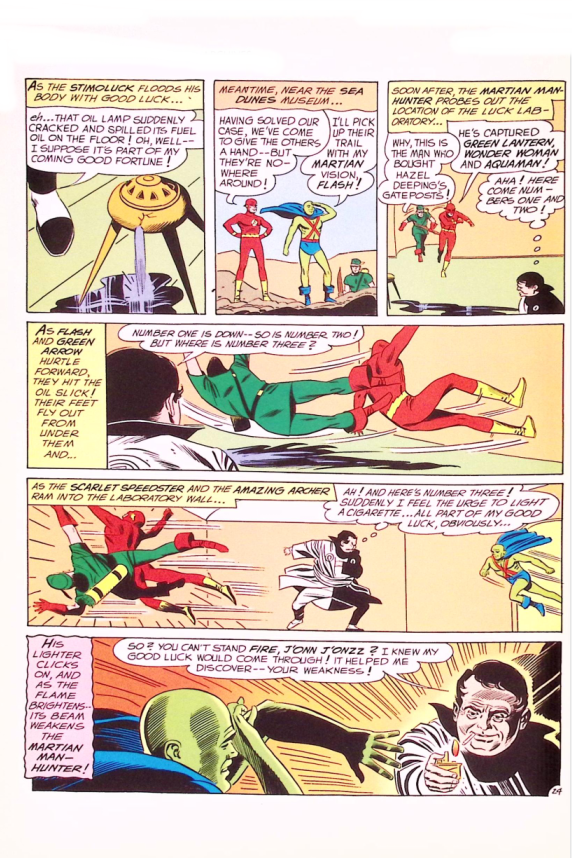
With the whiteness of the cast extending to every American seen, Green Arrow still in his surrogate Batman phase, and characters constantly explaining themselves (as seen on the sample page), blandness would be the order of the day were it not for Mike Sekowsky’s art. It was offbeat in the 1960s, yet utterly distinctive, and look beyond the strange poses and the solid draughtsmanship is evident. Sekowsky should also be credited for his design work, with the aliens and villains frequently more striking than the heroes, and for his willingness to draw full figures of all Justice League members in small panels.
Fox’s plots often began with a cover concept suggested by editor Julius Schwartz, and within the strict formula of prologue, individual chapters and finale there’s considerable invention to the generally science-based threats. The story providing the book’s title is the Justice League’s début. It would be dozen issues before an origin was provided, so the giant alien starfish able to control people mentally meets the JLA as a going concern. They face a man from the future, pre-destined to have beaten them, power a slave ship in space, meet someone able to nullify gravity and a villain who’s mastered luck. The ideas are there, but the formula plods and as for the dialogue… “Great work Flash! You’ve pulled all the yellow dust away from me! Now I can use my power ring”. Subtle, it’s not. Then again, Fox’s brief was to provide exciting SF-based stories for children, so what should we expect?
One might presume that anyone who wanted these stories to rekindle nostalgic memories had already bought them collected in earlier volumes, for which there have been several opportunities, albeit usually in expensive hardcover formats. They’re in Justice League of America: The Silver Age Omnibus Volume 1, and Volume 1 and Volume 2 of the Justice League of America Archives. In larger format paperback they’re spread over the first two volumes of Justice League of America: The Silver Age, or found in black and white as Showcase Presents Justice League of America Volume 1.