Review by Frank Plowright
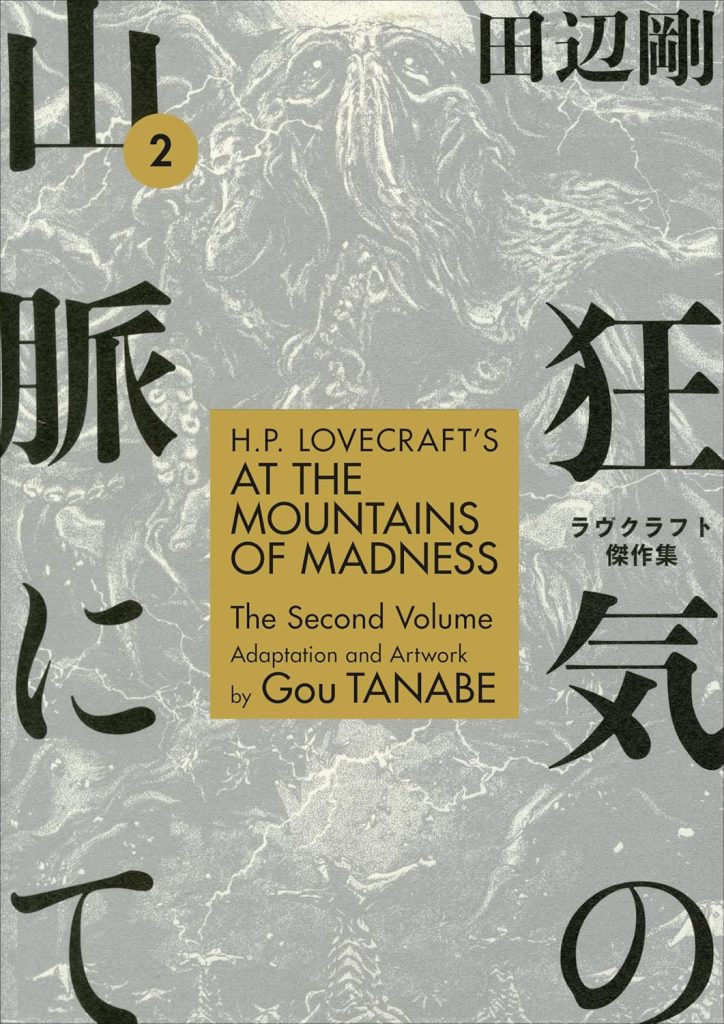
At the halfway point of Gou Tanabe’s sumptuous adaptation of H.P. Lovecraft’s At the Mountains of Madness, notwithstanding the tragedy discovered at the end of The First Volume, Professor Dyer announced his intention to fly to the Antarctic’s black mountains. He’s a geologist on the verge of confirming his theories of Antarctica having abundant life millions of years ago, but his trip so far has been treacherous, and it’s not going to become any easier. On the other hand, he’s due to make discoveries beyond his wildest dreams.
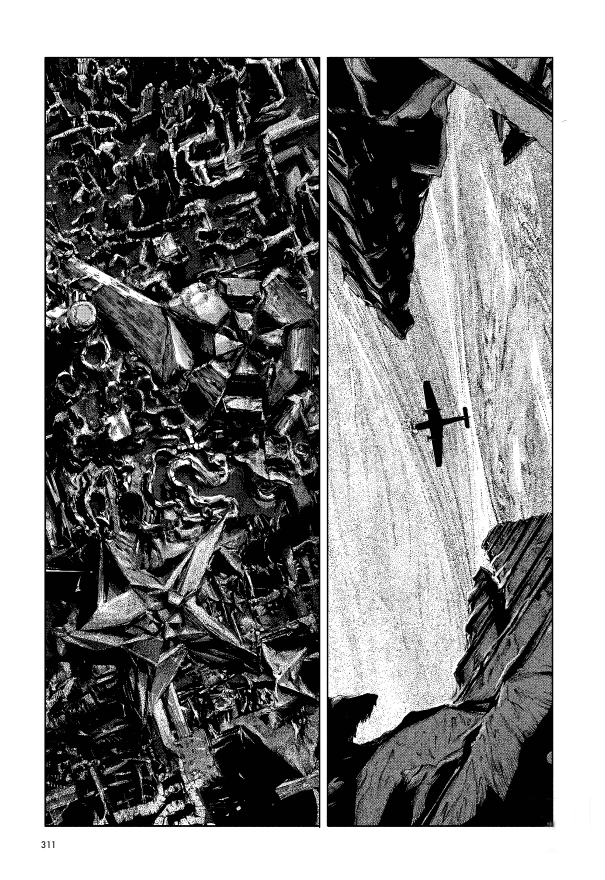
A matter Tanabe prioritises, expanding on Lovecraft’s original text through his illustrations, is the sheer wonder of discovery. This is greater than in the first volume due to Dyer now finding ancient structures hacked out of the mountains, and Tanabe duly delivers the scale as seen from the air, highlighted on the sample art. It’s only one of several magnificently imaginative pages reconstructing a city for beings not of human form.
The wonder gives way to endeavour, then to terror. Before exploring the structures Dyer and his assistant Danforth first have to climb to them, then gradually begin to realise they equate to descriptions from a forbidden tome called the Necronomicon. Tanabe’s art steps up even further as he illustrates the arrival of ancient life and the colonisation of Earth long before humanity. This myth creation occupies nearly a third of the volume, and is astounding even by Tanabe’s already exceptional standards. The shifting forms of the alien beasts set against the more recognisable structures are mindblowing.
Although held in high regard, Lovecraft can run on a bit, and Tanabe’s illustration both accompanying and breaking down such sequences delivers a work some might find superior to the original. Dyer is captivated by discovery after discovery, imaginatively conceived by Lovecraft, and like a moth to the flame ventures ever further ignoring Danforth’s voice of reason. Some of Lovecraft’s work can be very much tease and suggestion, the foundation of his horror being tension, but At the Mountains of Madness has a significant pay-off, and the bonus of creating the background for much of his other work. If you like Lovecraft, Tanabe excels, and readers not committed to Lovecraft’s form of horror might find Tanabe can sell it to them as comics when others haven’t.
As noted when reviewing the previous volume, as good as this is, so much of the wonder resides in Tanabe’s art, and this small format volume doesn’t do it justice. What you really want is the later Deluxe Edition at a larger size combining both volumes.