Review by Frank Plowright
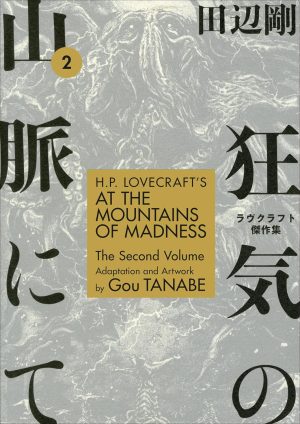
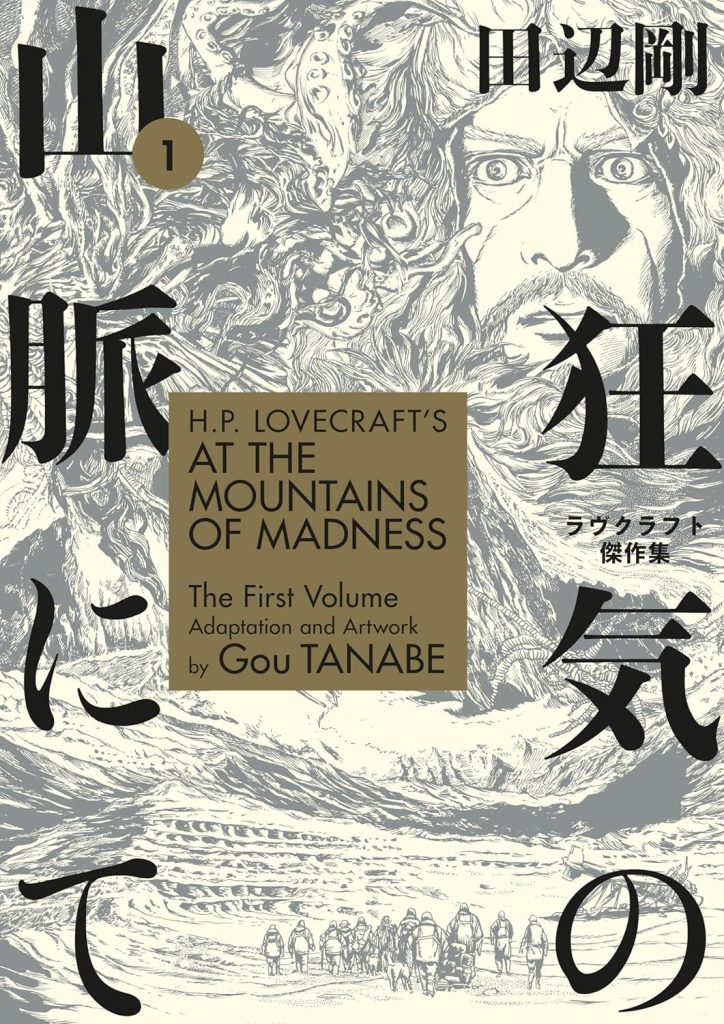
Gou Tanable’s adaptations of H. P. Lovecraft’s work are known for their faithfulness to the original text and for their stunning art, yet we’re going to advise you give this book a miss. The reason is that this and The Second Volume have since been combined in the larger format Deluxe Edition, and it displays that art so much better. This, though, is cheaper.
The background to Lovercraft’s stories is a connected universe, one where elder gods populated Earth long before humanity, and doorways remain to where they now exist. The kicker is these elder gods being vast, slimy tentacled creatures repulsive to human eyes. There are mere hints, though in this opening volume, which starts with a voyage of discovery that’s become a tragedy, before flashing back to the extensive story of how it began.
We’re introduced to geological Professor Dyer and his assistant Danforth, keen to prove a theory that millions of years in the past the Antarctic once teemed with life, and to this end funding an expedition. After landing, there’s a sequence expounding the joy of discovery before the first hint of something beyond human knowledge written off as a mirage. What develops is a disagreement between Dyer and a biologist, Professor Lake, resulting in Lake taking an advance party ahead. The remains of their camp provided the prologue, but before then we see Lake discover the structures giving the story its title.
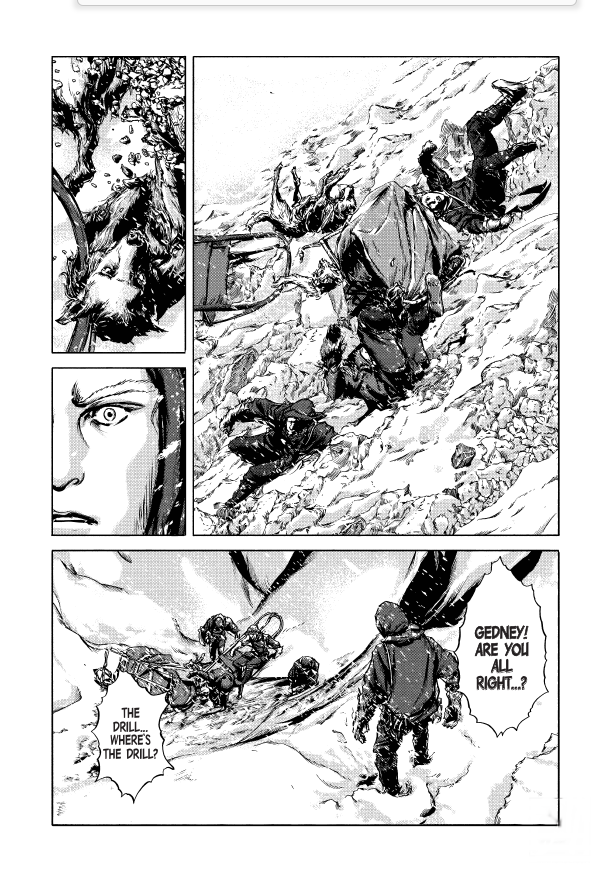
For such an incredibly precise artist who fills panels with detail, Tanabe is unusual in also rendering movement well. It’s not his preference, and the slow nature of Lovecraft’s plot suits that, yet as seen by the tumbling sledge on the sample art, if needed, Tanabe delivers. He also delivers majestic spreads of frozen scenery or life new to human eyes amid detailed character work. Frequent art is from a distance with tiny human figures in order to imprint the sheer scale of what’s been seen and discovered, and Tanabe’s evocative, scene-setting atmospheric illustrations lose no power for being in black and white.
Lake’s foolhardy enthusiasm while stumbling into the unknown is well detailed, as unlike other Lovecraft stories, the horrors are introduced relatively early, if in frozen form. For all that, tension remains as while Lake’s expedition occupies a fair number of pages, it’s only seen up to a point before attention transfers back to Dyer and Danforth because there’s radio silence from the advance party.
This opening volume ends full circle as the closing pages return to the prologue scene of Dyer discovering the devastation and strangeness at the advance camp, and discover one person isn’t accounted for among the corpses.
Impeccably told and beautifully illustrated, this is a great work enhancing the original, but better experienced in larger format.