Review by Ian Keogh
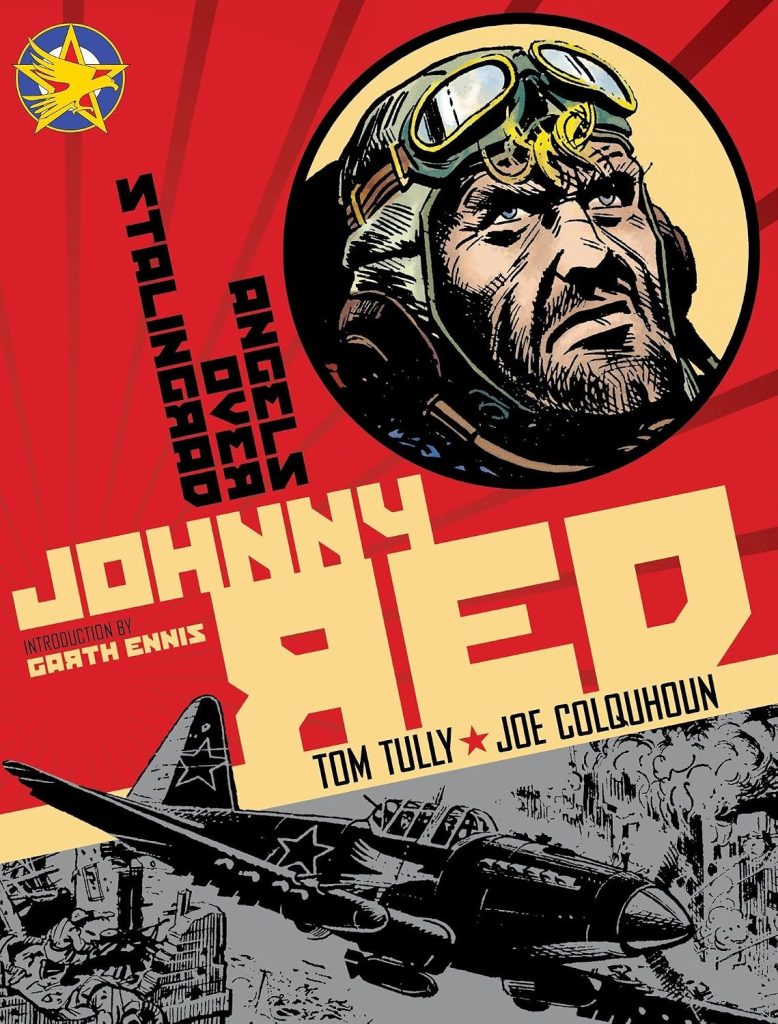
As Angels Over Stalingrad begins Johnny Redman has one hell of a problem. A rash and hot-tempered English transfer to his Soviet squadron is probably the brother of a man Johnny accidentally killed. More immediately, he needs to prevent his Hurricane from ditching into the sea, as per the cliffhanger ending to Red Devil Rising. As the three page episodes reprinted from 1978 are constructed to lead to such endings, the odds are high Johnny will survive, and sure enough it only takes him four panels to direct the plane up just in time.
The threat of discovery hangs over the first third of the material, before Johnny’s briefly captured by Germans, but most of the action concerns the 1942 battle of Stalingrad, where immense numbers of Russians died repelling the Nazi invasion.
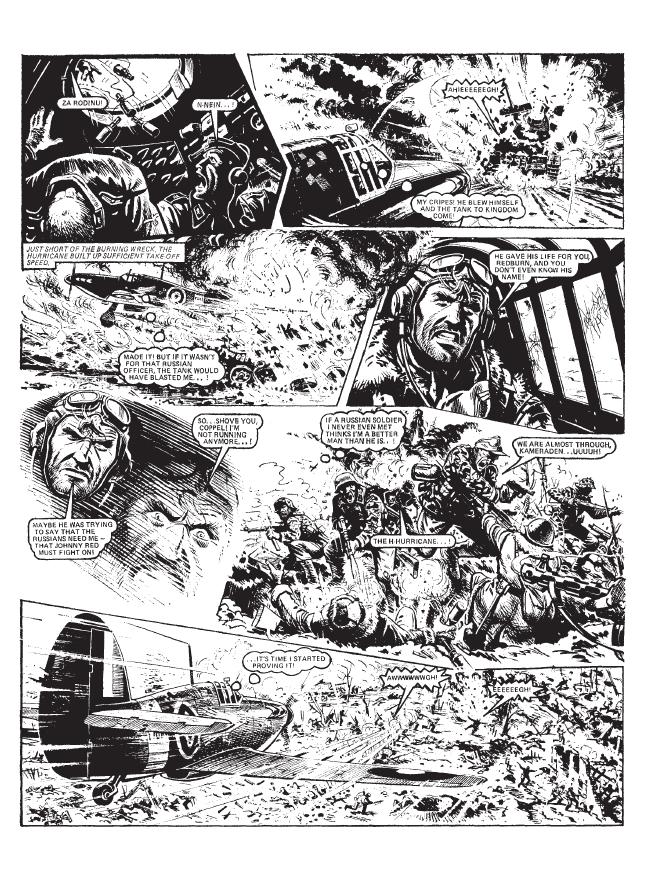
What artist Joe Colquhoun packs onto a page and into individual panels is astonishing. The sample art shows the sheer technique. A lot is demanded from a fast moving script, yet Colquhoun’s breakdown into individual panels tells the story so efficiently and excitingly. Then take into account the level of detail on Johnny’s equipment, the uniforms and on the plane. It’s also noticeable that the way he’s drawn, Johnny’s experiences have aged him.
As the series has progressed, Tom Tully has whittled down the supporting cast, with the distinctive looking Bear being the only other squadron member of consequence, but midway through proceedings we’re introduced to Nina Petrova who’d play a major role as the series continued. Tully’s research uncovered the Soviet air force having a squadron of female pilots, given the most basic of planes, yet nevertheless effective. Tully also revisits his plot of Johnny experiencing periodic blind spells, but still having to carry out his duties. This, though, is his best use of the idea, with Johnny actually having to fly blind. It stretches the bounds of credibility without snapping them for another great sequence with Colquhoun really selling the tension and aerial action.
It’s followed by an uncharacteristic period of Johnny on the ground in Stalingrad wanting to see the situation for himself, which is Tully acquainting the readers with a hellish ordeal. Colquhoun’s portrayal of a city under constant attack is amazing work even taking into consideration what he’s already drawn, as Johnny drifts across ruins with danger at every turn. It points toward Colquhoun’s future with ground warfare as he was co-opted to draw another Battle classic Charley’s War, meaning this is his final work on Johnny Red. What a way to depart. With The Flying Gun John Cooper takes over the art.
With Johnny Red aimed at younger readers, Tully can resort to both melodrama and easily resolved cliffhangers, yet he also delivers fast-paced and emotionally strong plots, with Johnny perhaps one-dimensional, but also a believable heroic figure. Angels Over Stalingrad really delivers. Alternatively, all Johnny Red drawn by Colquhoun is now available as Johnny Red Volume One: The Falcons.