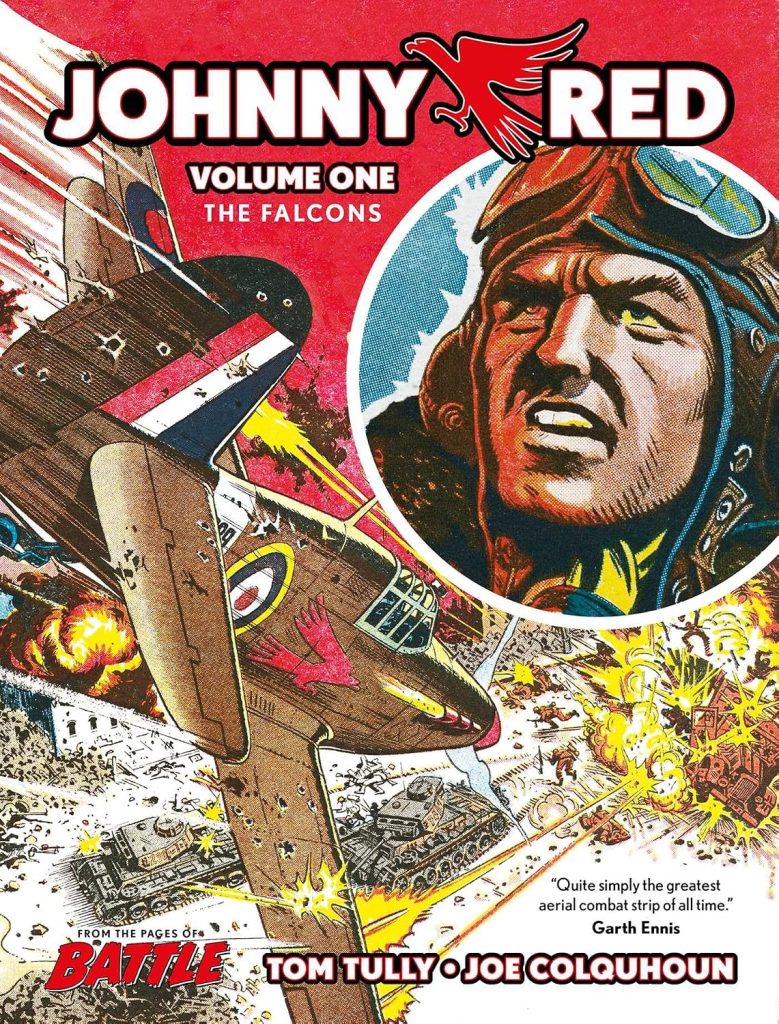
Review by Ian Keogh
During World War II British airman Arthur Burr ended up a long way from home, bringing his Hurricane plane down on the Russian coast. Whether Tom Tully knew of Burr when he conceived Johnny Red is uncertain, but Soviet efforts provided a new arena for British war comics when the series was dropped into Battle in early 1977. That it lasted a decade until Battle switched to all-reprint speaks volumes as to Tully’s ability to thrill an audience.
Training to be a pilot, Johnny Redmond assaults an officer, later revised by Tully to accidentally killing him, resulting in a dishonourable discharge and his joining the navy. When his battleship is attacked Johnny takes a Hurricane being transported and deals with the German bomber, but afraid of the consequences of stealing a plane he keeps flying, ending up in Russia. He and his plane are adopted by the Falcon squadron, and that’s when the true story begins.
It fades as Johnny’s adventures continue, but Tully makes a statement at the start by having Johnny encountering prejudice for being working class, and he never loses a connection with ordinary people. It’s seen early when the demoralised Soviet squadron he joins is considered disposable, but his innate skills render them invaluable. Several matters other than the setting raise Johnny Red above the standard 1970s was strip. Tully researched well, dipping in and out of a chronological continuity. The historical details might have been secondary to the action, but they bolstered the credibility. Toward the end of this volume a squadron of female Soviet pilots is introduced, historical truth, yet surely unknown to most readers, and Nina Petrova will go on to become a series mainstay.
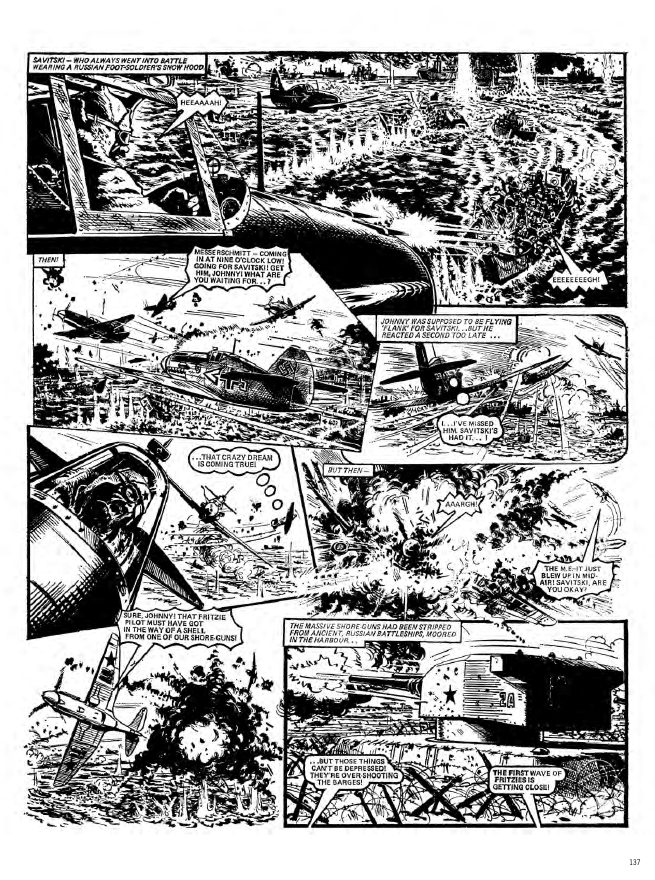
Joe Colquhoun as artist is invaluable. This opening collection gathers his entire series work, previously available in hardcover as Falcon’s First Flight, Red Devil Rising and Angels Over Stalingrad, and it’s astonishing. Colquhoun possessed a work ethic almost incomprehensible by today’s standards. The action seen on the sample page could have been told far more simply, yet Colquhoun includes detailed backgrounds, identifiable markings on the planes and keeps the viewpoint distant. The sheer amount of work applied to every panel in this collection is immense, and the drawing alone doesn’t account for the time required to research the accuracy in a pre-online era. Colquhoun’s characters are identifiable, and the grime and ruins of war are a constant accompaniment.
Equally, the amount of story packed into three fast-paced pages is incredible, Tully usually extending individual problems over three or four episodes. Tully’s writing was originally intended to keep pre-teen boys hooked on the next instalment, so plenty of cliffhanger endings are too easily resolved, and he’s not above repeated melodrama. Johnny sporadically losing his sight is an overused dramatic convenience, yet its final use here with Johnny actually having to fly blind is an utterly thrilling sequence.
Both creators really put the effort in to ensure Johnny Red engaged as weekly episodes, and the quality survives for a comprehensive collection that’s long overdue.