Review by Frank Plowright
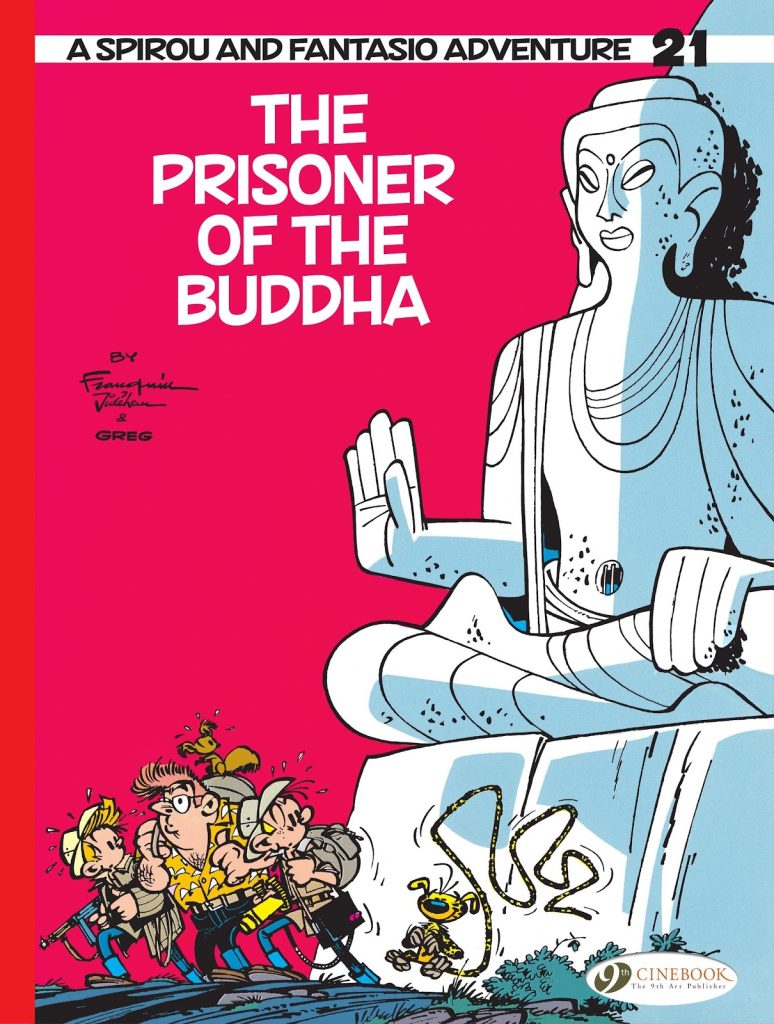
Cinebook aren’t translating André Franquin’s Spirou and Fantasio adventures in chronological order, but The Prisoner of the Buddha is a landmark for being his first collaboration. It’s also notable for Franquin’s generosity with regard to his co-creators by insisting they were credited on the resulting album, a practice other notable creators avoided.
Greg (Michel Régnier) first collaborated with Franquin via contributing to his strip about teenage couple Modeste et Pompom, never translated into English. They got along very well, and when Franquin began plotting the next Spirou and Fantasio story for serialisation in 1958 Greg was invited to contribute. His influence is apparent in the story’s background being the real world political Cold War, rather than the fictional fantasy of earlier episodes, as Spirou and Fantasio journey to China to rescue a captured American spy. His being imprisoned in the belly of a giant Buddha statue supplies the title.
When serialised it became the longest Spirou and Fantasio adventure, and before the main events there’s an extended prologue set in Champignac which is closer to the type of knockabout comedy that usually features. The pompous Mayor is embarrassed again, there’s chaos during the Spring Fair, and the Compte de Champignac has a new invention in his home. Unusually, though, the GAG (Gamma Atomic Generator) is developed by a visiting Soviet scientist.
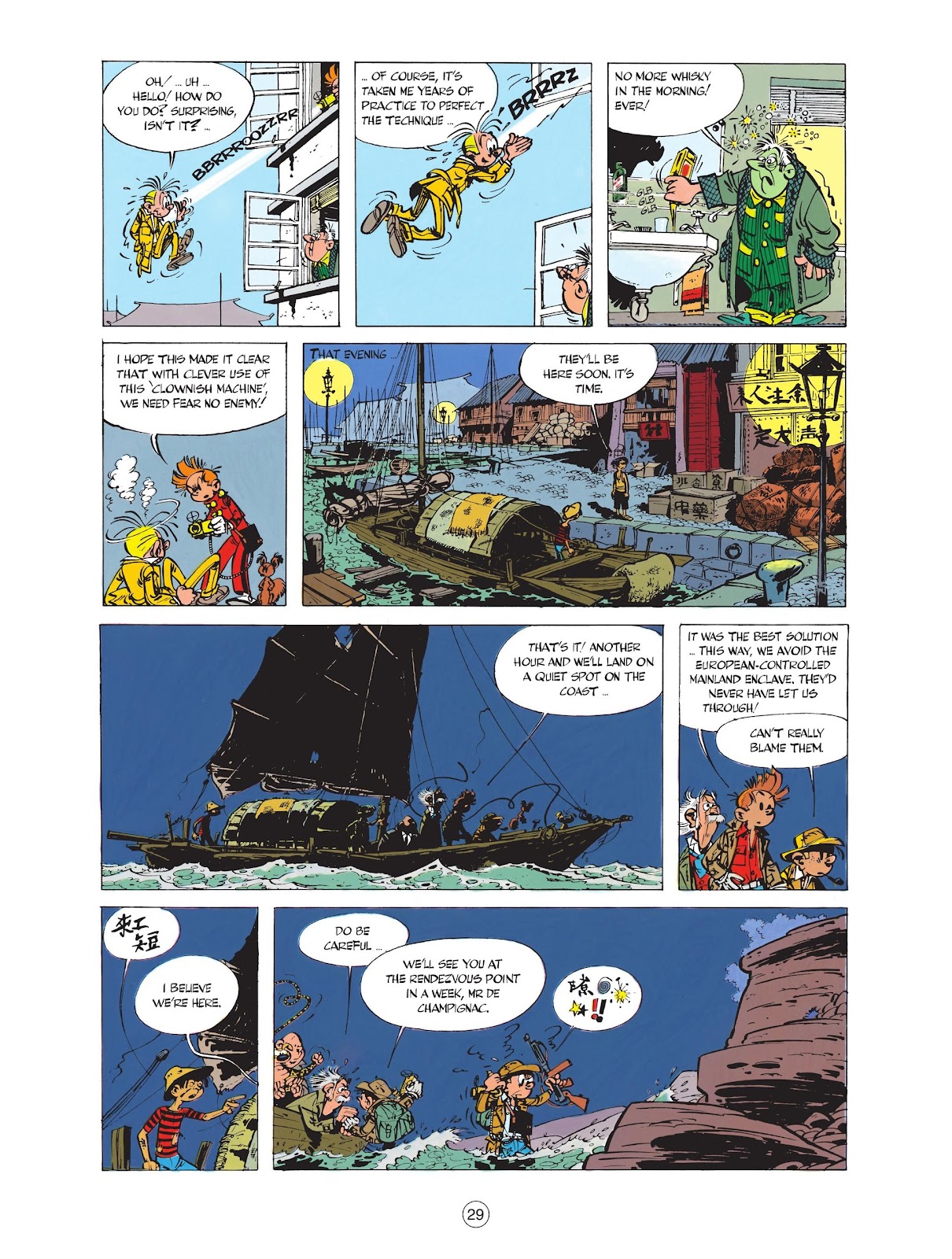
The comedy sequences are exquisitely plotted and beautifully drawn, and for the first time that’s not solely down to Franquin himself. Jidéhem (Jean De Mesmaeker) supplies the backgrounds, and as seen by the sample page they’re elegant and detailed. Franquin’s responsible for the figures, and for the tanks and cars, which he’s drawn realistically in earlier volumes. It’s intended that everything looks like Franquin’s work, and that’s the way it comes across. An artistic joke is the Marsupilami’s tail becoming ever longer from story to story, and Spip the squirrel is beginning the transition from background character to regular player.
The Prisoner of the Buddha moves Spirou and Fantasio more into the adventure territory occupied by Tintin, and does so successfully while still allowing for the inventive slapstick comedy characterising the series. However, there are still wrinkles to be worked out. The GAG is first seen denying gravity when pointed at people or objects, but becomes too convenient by also generating immediate plant growth and changing climate. Tighter plotting was on the agenda for the introduction of a major nuisance in Z is for Zorglub.