Review by Frank Plowright
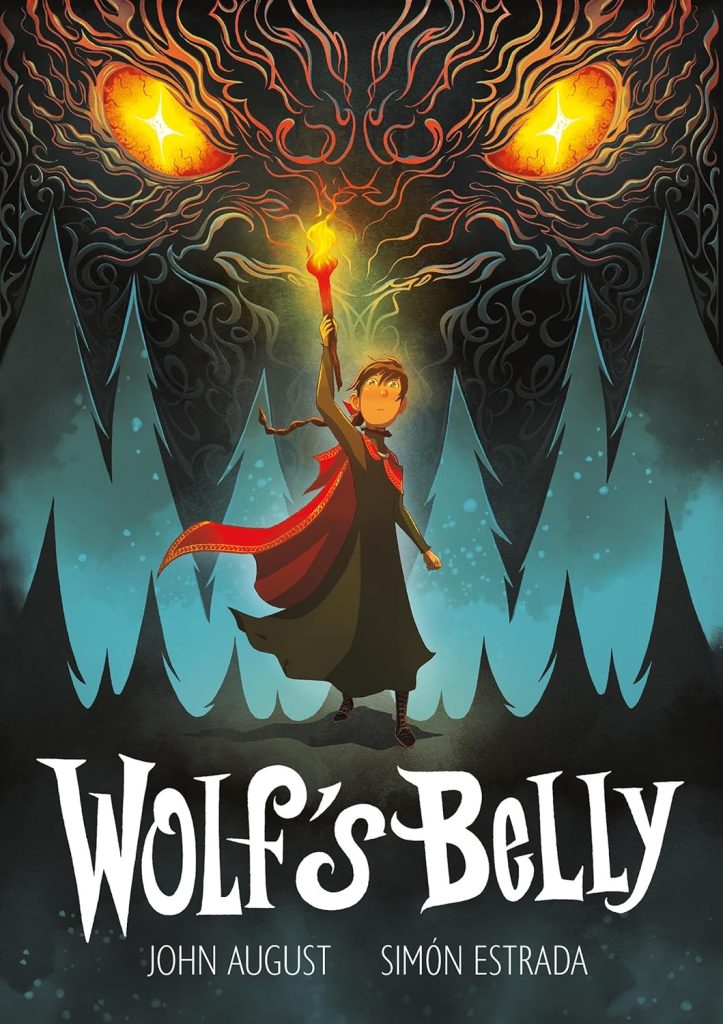
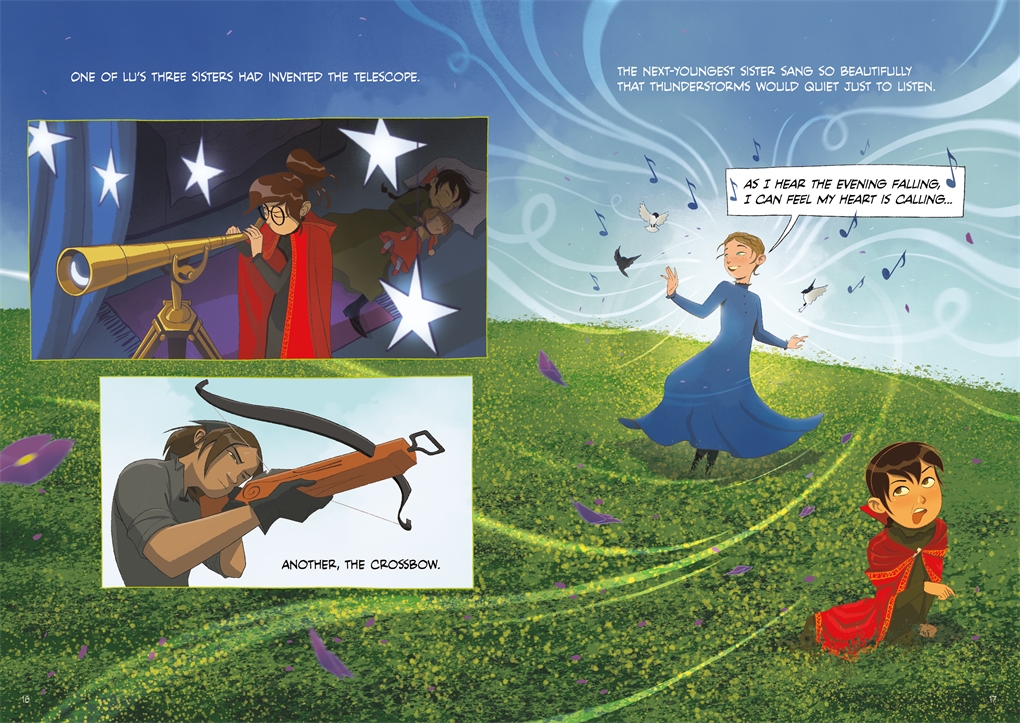
Wolf’s Belly begins as a thorough and imaginative reworking of Little Red Riding Hood’s fairytale. Previously known only for what she wore, Lu is given a name and background by John August, her mother a famous swordsman and her father a balloonist, and she has two brothers and three sisters, each with a wildly different talent. The family may be poor, requiring Lu to wear hand-me-downs, but there’s an exoticism to them, meaning in comparison with their achievements Lu feels she’ll never make her own name, and to that end comes up with a plan.
What first strikes about Wolf’s Belly is Simón Estrada’s plain beautiful art. His illustrative skills are primarily put to work on animation with dabblings in children’s books, and it’s that colourful approach applied here. Wherever possible he opens into a spread and the use of space, distance and scenery ensure these impress again and again even in dark situations where one might assume it’s a challenge.
August’s plot takes the fairy tale as a basis, but builds around it comprehensively, constructing characters, motivations and reasoning. Lu, for instance, is far from an unwitting victim. She plans to trap the wolf, a mythical creature only ever barely seen. The opening section is very fulfilling in remaining true to a fairytale setting while bolstering it with reason.
A wild leap, however, occurs when the wolf is met. In the manner of Dr. Who’s Tardis, internally it’s far larger than externally, and over time it’s swallowed enough people and objects to permit a civilisation to flourish, albeit with limited means. Lu becoming lost is also where August loses the plot, and it never comes back on track until right before the end. This isn’t due to lack of ambition. Having so successfully recalibrated the story of Little Red Riding Hood, August turns his attention to other fairy stories, fables and nursery rhymes, but not as successfully, and they’re combined with a more standard escape story. Estrada’s art still supplies astonishment, but in smaller doses as the spreads fade to accommodate a considerable amount of dialogue.
There’s a clever sequence before the end in which over-riding desire is castigated as a limitation, and the epilogue sections about the characters we’ve met applying what they’ve learned is nice. The resolution, though, while true to a children’s fantasy story, is all too convenient. There’s wonder to Wolf’s Belly, but the potential of an excellent beginning is largely unfulfilled.