
Review by Frank Plowright
Very few comic creators have lived to see annual awards named after them, and while Will Eisner might not have created the term ‘graphic novel’ as is often claimed, there’s absolutely no doubt that he pioneered the form from the late 1970s onwards. Yet his influence stretches back far further, the sample art showing how his late 1930s studio introduced the assembly line method of creating comics still used by superhero publishers today. Surely, then, he’d be pleased to see his own life supplied in comics.
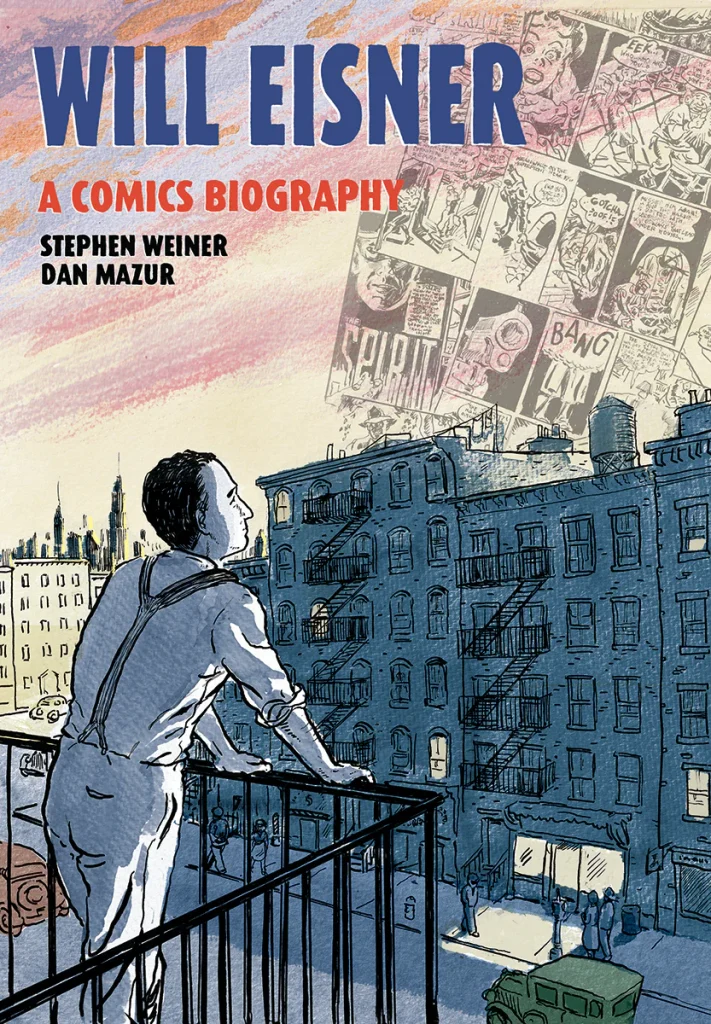
Stephen Weiner’s biography very much prioritises Eisner’s younger years, where his achievements are in danger of fading into obscurity, and goes back even further. The first quarter of the book relates how Eisner’s immigrant parents met, and how his early days consisted of many moonlight flits across New York when landlords pressed for rent Eisner senior didn’t have. Without explicitly stating as much, it shows why Eisner would develop many of the characteristics that saw him so well throughout his career. His artistic talent was inherited from his father, but we see many lessons learned along the way, possibly the most valuable being his salesman partner Jerry Iger telling him to keep the copyright on his work.
The city Eisner grew up in is well established by Dan Mazur, whose style of cartooning is definitively removed from Eisner’s own dramatic use of exaggeration and shadow. Mazur’s looseness, though, is skilled and purposeful, excellent at displaying personality through posture. A recurring figure of fun is Batman’s creator in the days before he become Bob Kane, shown as a struttingly confident school friend of Eisner’s, and Iger’s slippery character is also evident from the illustrations alone.
Eisner’s own slim autobiography, The Dreamer, considered his early years in comics, but Weiner expands on the selective recollections where aliases were used, and stresses Eisner’s dedication to ensuring financial security above all else. Assorted tales of the unscrupulous are aired alongside Eisner’s own skilled negotiation. He catches a lucky break when a newspaper syndicate want him to produce a superhero strip in 1940, but his savvy ensured The Spirit could be reprinted in the 1960s (strangely ignored), in the 1970s and on several future occasions culminating in hardcover books. Even when successful, though, there are still tragic periods in Eisner’s life.
Weiner pretty well ends in the late 1970s having shown how someone present at the birth of comics had taken another giant step, and connected with a new generation of creators. Stories do circulate of people disgruntled with Eisner’s single-mindedness, but that’s inevitable given the length of his career and the number of people he’s worked with, and a biography intended for a general audience isn’t the place for airing petty grievances.
This is immensely readable whether or not you’re familiar with Eisner or his work, and diligent in building up who he became and why.