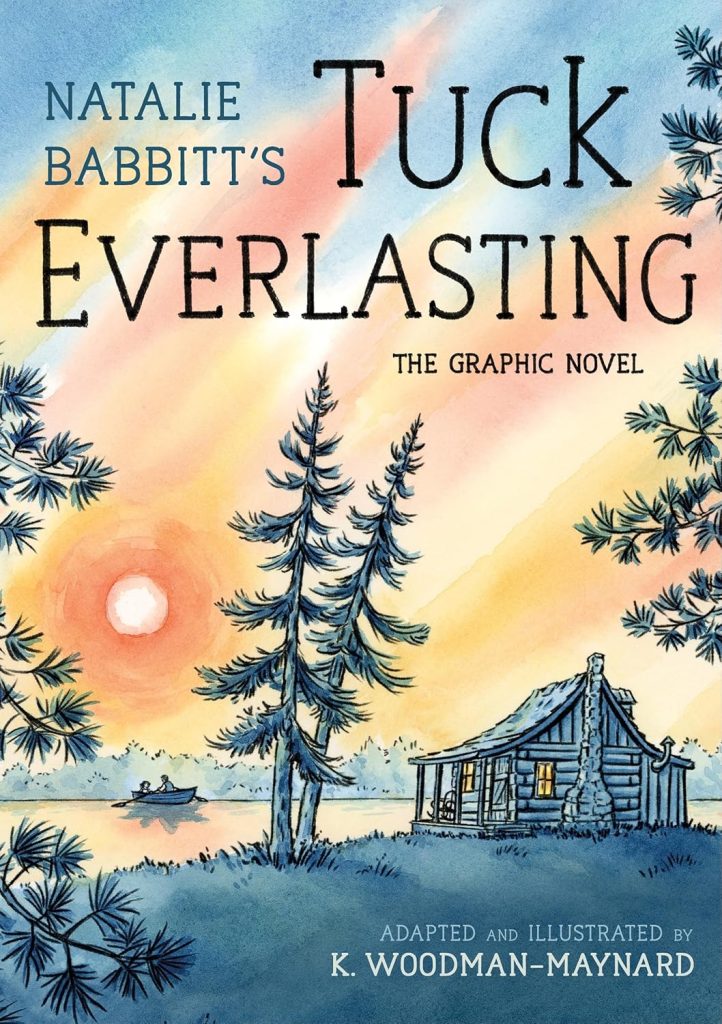

Review by Ian Keogh
Since first published in 1975, Natalie Babbitt’s Tuck Everlasting has proved somewhat the children’s classic novel, prompting two film versions and a stage musical. K. Woodman-Maynard now provides a first graphic novel adaptation.
The rural village of Treegap in 1881 provides the setting, with ten year old Winnie Foster so bored she decides to run away from home. It’s only half-intended, but when she’s deep in the nearby woods she’s abducted by a strange family. Readers have already been told they’re long lived, and they have a story to tell Winnie. Almost a century previously when they first moved to the area they drunk from a spring that bestowed eternal life, and they’ve not aged since and recover from perils that would kill other people. What they’re sure of is others are best kept from drinking the same water.
Woodman-Maynard contracts the novel’s opening to head to the fundamental aspects more rapidly, drawing a pastoral community in largely summery shades to bring out the appeal of the area. An artistic quirk is writing some of the novel’s descriptive text into the surroundings, having it appear in copses and clouds. The people wear the simple clothes of the era and the way they’re drawn indicates contentment rather than poverty.
Winnie has been a relatively isolated child, but bought up in luxury for the times, and visiting the Tuck house exposes her to new ideas beyond immortality. The Tucks are shown to be an ordinary family without privilege or great intelligence, but smart enough to realise immortality’s a curse as well as blessing. Babbitt’s original novel is clever in addressing the great childhood fear of death, putting both temptation and practical advice to Winnie, but leaving her to decide what’s best. The complication is a manipulative stranger who turns up and overhears what’s being told to Winnie.
Babbitt follows an unpredictable path and one that will constantly have young readers asking about a purpose in life or what’s wrong and what’s right. The clever aspect is there being no entirely correct answer, just one determined by an individual point of view, and that even applies to breaking the law. Tuck Everlasting has now lasted around half as long as the Tuck family when Winnie met them, and Woodman-Maynard’s beautiful adaptation brings a worthwhile story to a new generation and so prolongs the chance it may yet make the century.