Review by Ian Keogh
The Cloven’s story has centred on Tuck, a teenager bred at an experimental genetics facility who escaped. He located a community of other escapees in Book Two, but there’s doubt as to whether he survived the ending. It’s still not clear as this concluding volume begins, although someone is seen, from a distance, being taken to a healer.
Tuck has survived, although it’s a while before he fully recovers in an isolated community based around a deserted Canadian mine complex. It’s become apparent that human/goat hybrids exist in various forms, with either a greater or lesser percentage of human DNA, and much of this final volume explores a society where human values are negligible. Tuck has a form of guide in the elderly Willie, but has to navigate rules he’s not aware of when wrong moves can generate deadly consequences among a mindset more animal than human. Garth Stein contrasts Tuck’s experiences among a goat society with a slimy corporate CEO selling his version of a new world.
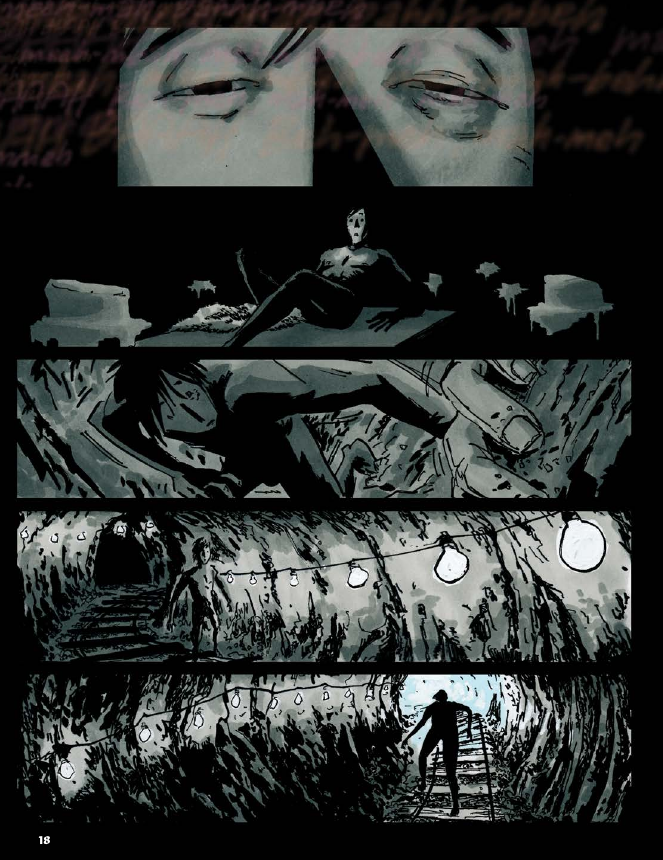
There’s considerable exploration of what’s in effect an alternative world, and that allows Matthew Southworth to draw attractive scenery, but always idiosyncratically coloured, emphasising the differences. There’s detail to all aspects of Tuck’s new world with Southworth’s visual characterisation strong, determining individuality when other artists might draw every hybrid creature the same way, and there are distinctive touches beyond, such as CEO Goff’s futuristic glasses.
The Cloven is genre fiction of the type once published by Vertigo, making it an unexpected choice among the Fantagraphics list, the more so for some clumsy narrative choices. As Tuck stumbles around his new home, mistakes he makes might easily have been prevented with fundamental information provided sooner. Having explored one version of what could be, Stein has a reason for sending Tuck back to a big city, and he underlines polarised opinions about genetic tinkering via a unsubtle radio show exposition dump. It cements Stein as not the best judge of how long a scene should take nor of when to supply relevant information. A journalist’s conversation is scattered throughout, returned to near the end in order to preface the ending when most readers will have forgotten it was taking place.
Tuck remains a sympathetic lost presence, someone who reacts to circumstance rather than plotting ahead, but too much of what’s rolled out in this meandering conclusion contrives to negate that. Paranoia is justified, but an abrupt ending doesn’t address two major problems, all the more frustrating for too many scenes extending beyond their shelf life. It leaves The Cloven airing some ideas bearing further contemplation, but not fulfilling the promise of its scenario.