Review by Frank Plowright
For reasons seen in Blood Hunt, Doctor Doom became Earth’s Sorcerer Supreme. That’s pretty well all you need to know heading into One World Under Doom, and Ryan North begins with the fait accompli of Doom uniting the nations of Earth under his rule.
The expected response would be the world’s heroes uniting to relieve Doom’s global control, and North shows how that goes in the opening chapter. As eight more follow, it’s hardly revealing state secrets to note the heroes are completely outmanoeuvred, enabling North to explore what a world is like with Doctor Doom calling the shots. For starters Doom abolishes two massive inequalities restricting life in the USA and many other countries. Education at all levels and healthcare are now universal rights.
One World Under Doom is an interesting graphic novel at a time when American society is more divided than has been the case for decades. In the real world, populism is achieved by fermenting division, but Doom’s alternative, as high handed as it is, apparently works for the betterment of mankind as a whole, not just the few, and it’s seductively presented. In fact, though, it’s a more generous variation of the sacrifice of freedom for security currently being implemented in many countries.
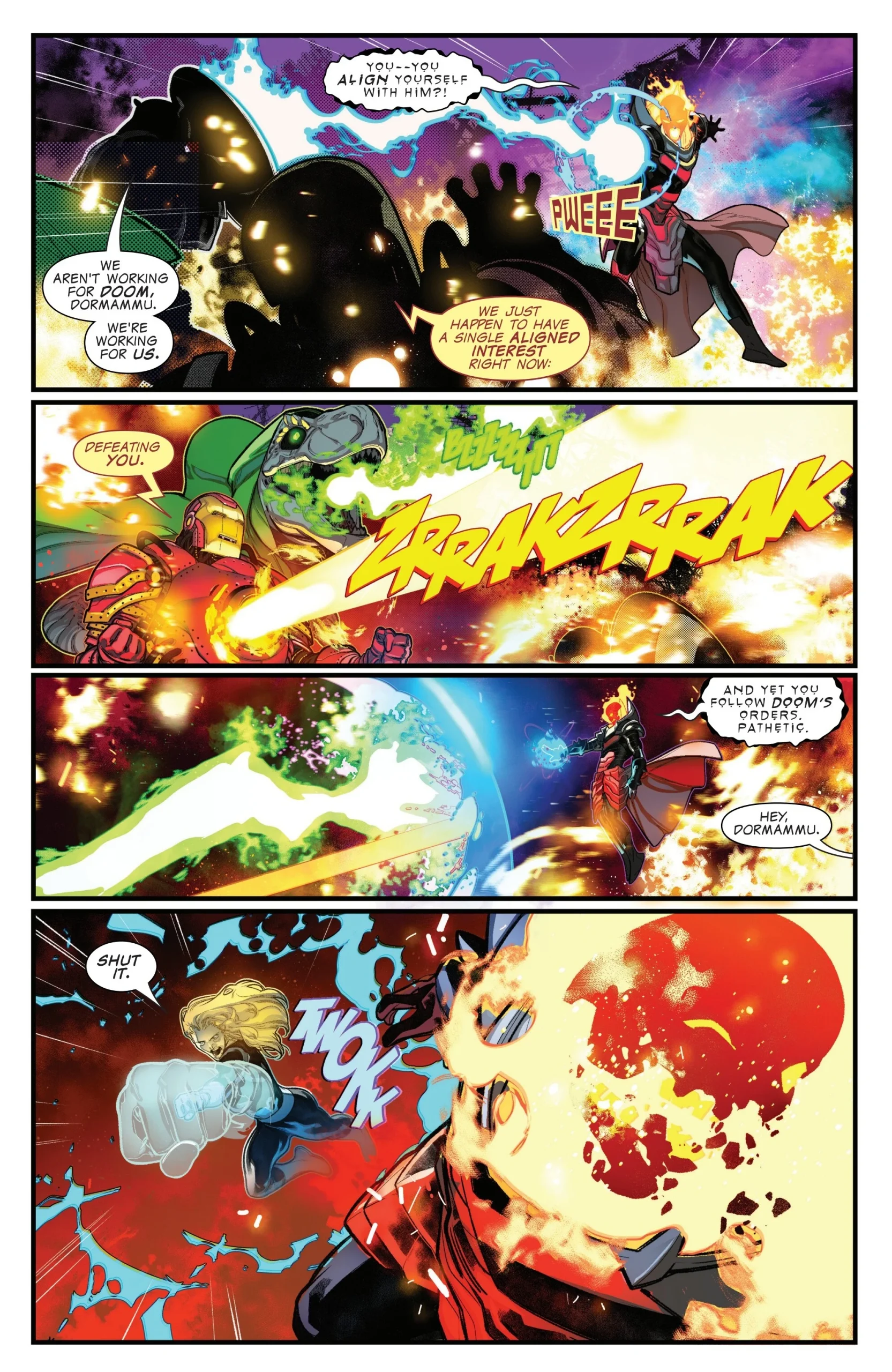
Explaining everything takes words, many words, which is almost a throwback to the excess verbiage of 1980s comics. It’s a great relief when Dormammu tips up and the word count sinks. It’s pity North couldn’t have reined in the dialogue as the substance of it prompts thought and during better moments, such as a debate between Doom and Mr. Fantastic, it recontextualises the ethics of superheroes.
R.B. Silva’s art is superficially attractive, with David Curiel’s vivid colours contributing greatly. It’s a form of trickery, though, as Curiel fills in much of the background with colour abstractions, and while Silva knows his way around a dramatic pose and an attractive face, his form of storytelling is very much based around individual illustrations. Each is well drawn, but they lack substance. If you like the style, though, it’s a visual treat.
Ultimately, Doom is a villain, and so there’s villainy afoot, yet North also uses this intelligently in a fragmented era where people are more willing to believe what they’re told from the right voice than believe the evidence of their own eyes. One who certainly does believe her eyes is Valeria Richards, under no illusions as to what Doom can be, yet also aware there’s a bond between them and a mutual respect. That relationship leads to a compelling and desperate concluding chapter founded on truth and emotion instead of intellect and manipulation.
A common complaint about superhero crossover events is of all the blood and desperation merely setting up the next crossover, which an elusive ending presumably does, yet it’s the one time North panders to the marketing conventions. One World Under Doom can be read and understood without reference to any of the associated graphic novels, nor does it require consulting them because events move forward between chapters. That’s commendable, and when all is said and done there’s far more to contemplate here than in your average superhero crossover. It twists, it turns and it thrills.