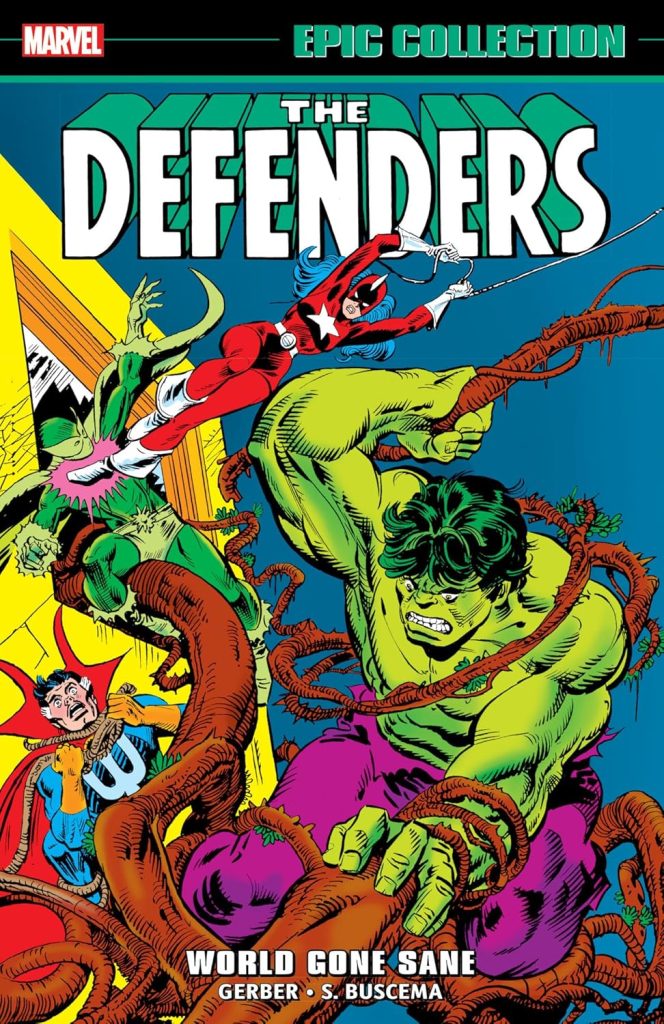
Review by Frank Plowright
During the 1970s The Defenders was the nearest Steve Gerber came to mainstream superhero entertainment, and the peak of that approach is presented here followed by an epic in which Gerber swerved astoundingly off-piste.
Most writers of superhero comics have a formula and themes that become recognisable after a while. Gerber didn’t, beyond one never knowing what a Gerber story would provide. He could be wilfully indulgent and brilliantly observational in the same story. He’s best remembered for the satire of Howard the Duck, but satire’s immediacy rapidly dates it, and the 1970s fads and obsessions make much of it beyond comprehension now. Howard’s here, though, teamed with the “non-team” in fine form.
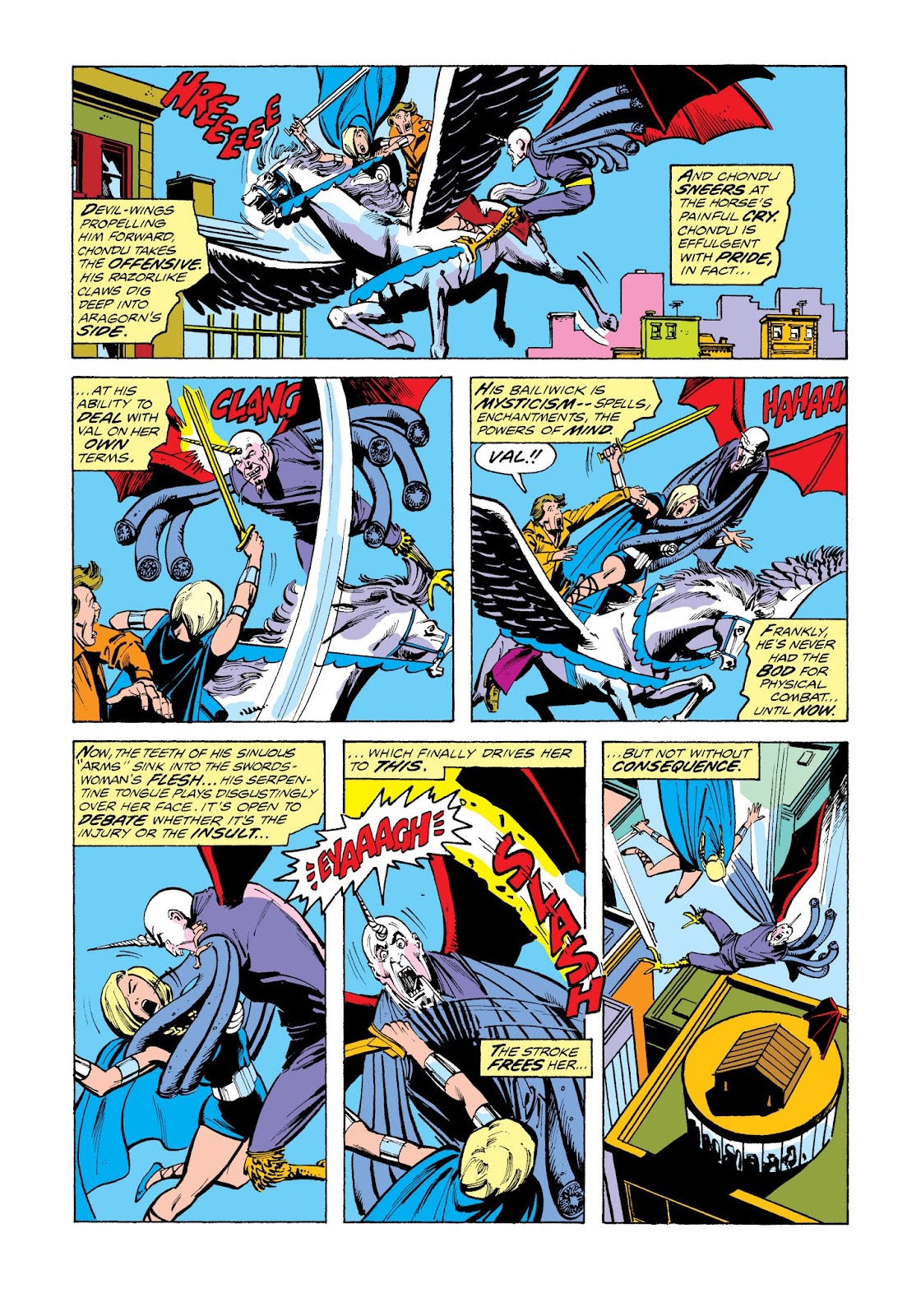
Teaming Earth’s Sorcerer Supreme, an Asgardian Valkyrie, the Hulk and millionaire superhero Nighthawk and making the dynamics work was an achievement on Gerber’s part, but he seemed even fonder of other misfits. The 1970s Guardians of the Galaxy weren’t the crew beloved by 21st century film goers, but an even more eccentric bunch protecting the 30th century. Perhaps it was the idea of a thousand year old man, or humans genetically engineered to survive on other planets, but Gerber loved these obscurities and teams them with the Defenders to repel an invasion of Earth by the Badoon. It’s almost straightforward superhero adventure and drawn very well as such by Sal Buscema, but even among that Gerber throws in wild ideas, conceiving an entire mating pattern for male and female Badoon upon which the ending to his five chapters depends.
We’ll gloss over Bill Mantlo’s laughable contribution separating Gerber’s two continued stories, just saying it involves Doctor Strange being captured and tied to a display cake by a tap-dancing villain. Mantlo trying for Gerber’s whimsy utterly belly flops.
Teaming the Defenders and the Guardians of the Galaxy was Gerber’s commercial apex, but there’s little concern for commerciality about his following twelve chapter delve into identity and absurdity. We’re in Lynchian territory from a beginning chapter of Nighthawk’s brain being removed. It’s later transferred into a fawn. Other bizarre ideas include ridiculous villains like the Porcupine undertaking therapy to improve their efficiency, an elf with a gun committing random murders, Doctor Strange developing a puerile sense of humour, a powerless Valkyrie in jail and a new villain with the body of a glamour model and a round red sphere for a head.
Introducing a healthy dose of absurdity is one thing, but the wonder is how Gerber slots so many bizarre elements together cohesively. He draws on the personalities and the history of the Defenders, and it all makes sense in the end. For most of the story Buscema’s staid art is given a rough edge by the inking of Klaus Janson, dragging it away from the glossy superheroics seen earlier. This is a darker and more puzzling world, and Janson’s instrumental in making it look that way.
Originality is certainly key, but another reason Gerber’s nutty Defenders still read so well is that he doesn’t use a lot of thought balloons and many of his caption boxes feature a questioning narrative voice. In a few places there are signs of Gerber’s habit of plotting on the hoof, but that also keeps the story fresh because if he doesn’t know where he’s going next, you certainly don’t.
This material was previous available as Marvel Masterworks: The Defenders Volume 4 and Volume 5, or in the second Defenders Omnibus. In black and white the content is spread across Essential Defenders Vol. 2 and Vol. 3.