
Review by Frank Plowright
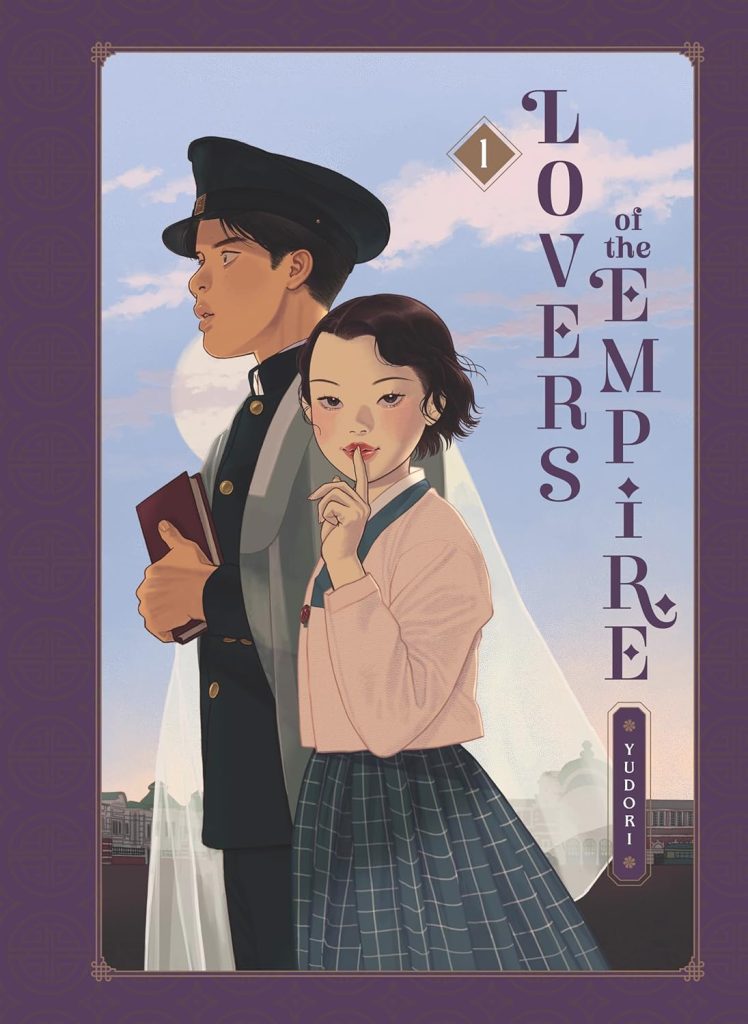
In 1929 the entire Korean nation was under Japanese control and had been for almost twenty years. A reorganisation of society was implemented, with many Korean structures and traditions abolished and banned. Against this backdrop Arisa Jo, glamorous teenage daughter of a wealthy businessman meets the staid Jun Seomoon, employed by her father to ensure she comes to no harm in the city.
Both characters are efficiently established by Yudori in the opening chapter, drawing attention to their beliefs, their differences, and how each is seen by others. Arisa has an easy confidence about her, while country boy Jun is academically smart, but comes from poverty and is intimidated by the sophistication of the city. Their relationship develops awkwardly, a succession of comedy mis-timings and wrong words spoken, all beautifully illustrated.
Judori’s art carries Lovers of the Empire a long distance. Arisa and Jun exude personality, and are contrastingly drawn to emphasise differences, Arisa enjoying life in a succession of fashions modern for the time and Jun always stiff in a pseudo-military school uniform of the era. The illustrative attention to detail extends to other characters, with the only drawback being Yudori adopting the occasional manga technique of not bothering with facial features on occasion. It doesn’t have any symbolic purpose, and Yudori is hardly an artist looking for shortcuts, so why do it?
Much is made of the shock Western attitudes generate in 1920s Korea, with standard behaviour considered unseemly, if not immoral, a subtext being it’s the way others view Arisa due to her fondness for Western clothing. Yet there’s also jealous admiration for her Western-style thin eyebrows. Yudori is an astute storyteller, subtle with her emphasis and her evolution of character. Silent and stewing for so long, the stressful circumstances of Jun erupting follows a deftly constructed path of resentment and uncertainty.
A budding relationship, certainly nowhere near a romance as yet, builds through six chapters, each of which can be read as an individual vignette. Yudori seems in no rush to complete a story, and her confessional background strip reveals her priorities in creating the series. So far it’s intriguing, beautifully drawn and ripe with possibility.