Review by Frank Plowright
It’s taken a French creator to produce a graphic novel about a man whose influence on the USA has been immense, yet John Muir’s is not a household name. This is despite his 19th century lobbying resulting in the creation of national parks and his pretty well originating the idea of conservation and environmental activism.
Lomig opens his biography by showing Muir approaching thirty in 1867 worried about whether he’ll regain his sight after a factory accident. It’s a transformative period as confined to a darkened room for weeks he regrets not spending enough time appreciating the wonders of nature. His sight does recover, and he remains true to his regrets by using his degree in botany as he wanders from place to place studying whatever catches his attention during a walk that eventually extends over a thousand miles.
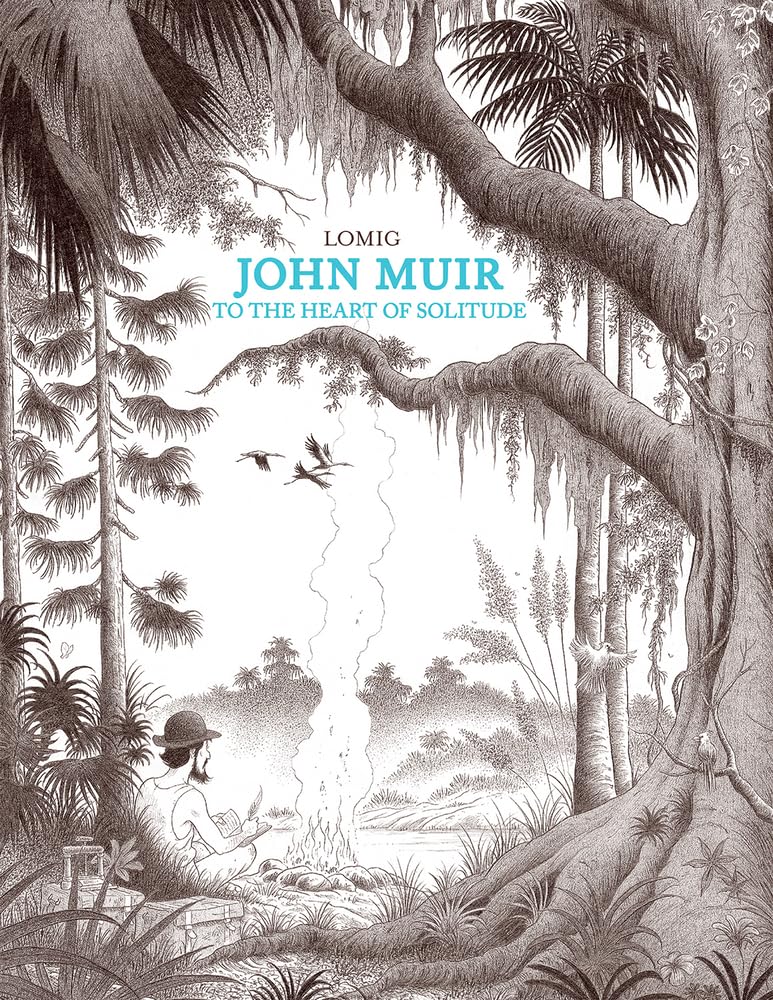
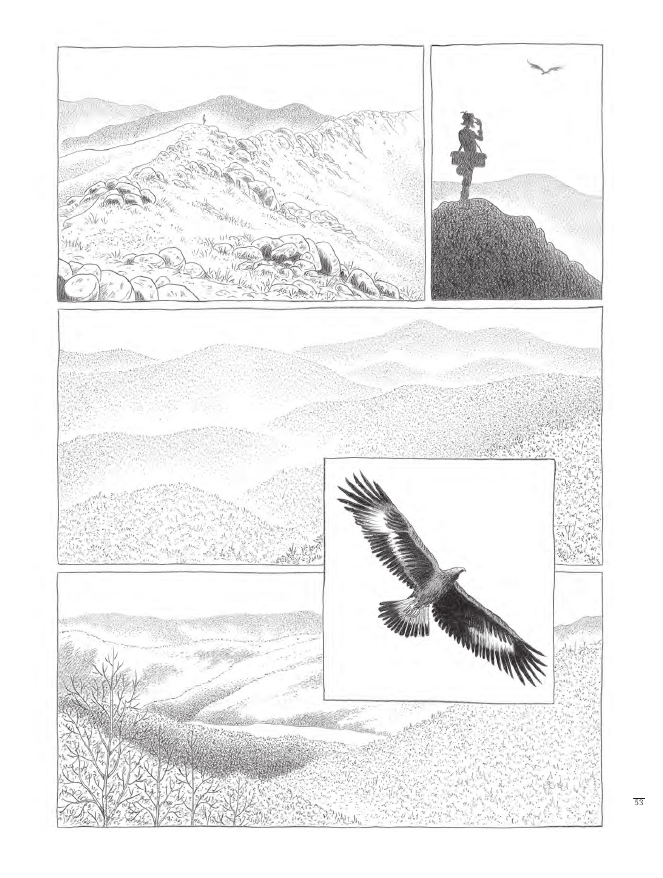
Muir kept extensive journals, and Lomig uses these as the basis for his text and Muir’s conversations, but makes the interesting choice to depict the scenery Muir so admired in sepia tones rather than colour. He nevertheless conveys the beauty of the USA’s wilder areas, being somewhat the magician at creating it from the multiple small jagged lines seen on the sample art. That’s rolling hills, but Lomig is equally adept at depicting assorted other areas. He takes Muir’s reverence as a guide, but Muir’s descriptions aren’t always precise, so it’s interesting to consider what Lomig draws, as attractive as it is, may have only the sketchiest similarity to what Muir viewed so enthusiastically at any given time. A less naturalistic approach is taken to Muir himself and those he meets,
Lomig delivers a fair amount of information visually, sometimes as conversations occur simultaneously, so for maximum insight don’t just concentrate on the dialogue. Transitions between the present of Muir’s wanderings and the past occur several times, and while those flashing back to his childhood are obvious, others take a few panels to sink in.
Muir’s two years walking across the USA in the late 1860s are the focus of To the Heart of Solitude, including a diversion to Cuba. As he travels, Muir talks with those he meets, keen to listen and eventually formulating his views on conservation, while particularly in the American south hearing from people still embittered by the then recent Civil War. He inspires a travelling companion when reaching San Francisco and they journey to the areas Muir would later succeed in protecting from development and occupation.
To the Heart of Solitude’s primary intention is to convey the wonder Muir experienced and the thoughts it provoked, much of which remains relevant. Muir was a reluctant writer, but Lomig chooses his quotes well, particularly one about people in troubled times destroying the environment to make money, seeing it only as a source of profit. An informative biographical essay on Muir by the well qualified Mike Wurtz completes a monumental experience.
The lack of general recognition around Muir’s name proves this isn’t going to be a graphic novel for everyone, but those inclined to the pastoral will discover magnificence.