Review by Woodrow Phoenix
Milt Gross (1895–1953) was an undisputed titan of cartooning in the USA for most of his life with an immense public following, highly influential among other cartoonists, famous in film and animation, yet left behind so completely by the relentless advance of popular culture that he’s virtually unknown today.
Gross’s work was built around an exaggerated and manic form of observational humour, using the rhythms of Yiddish dialect and customs to create ‘screwball’ characters and situations drawn with energetic detail. He famously used busily crammed compositions to achieve his slapstick effects. His Gross Exaggerations strip which began as an illustrated column, ‘Gross Exaggerations in the Dumbwaiter’, in the New York World newspaper in 1925 was the first of his successes. A book collection of those columns entitled Nize Baby after one of his catchphrases sold over a hundred thousand copies. Many more hits followed including the book that comics historians call his masterpiece, He Done Her Wrong: The Great American Novel and Not a Word in It — No Music, Too, in 1930. This novel was wordless, in the manner of Lynd Ward’s Gods’ Man which had been published the year before – but funny.
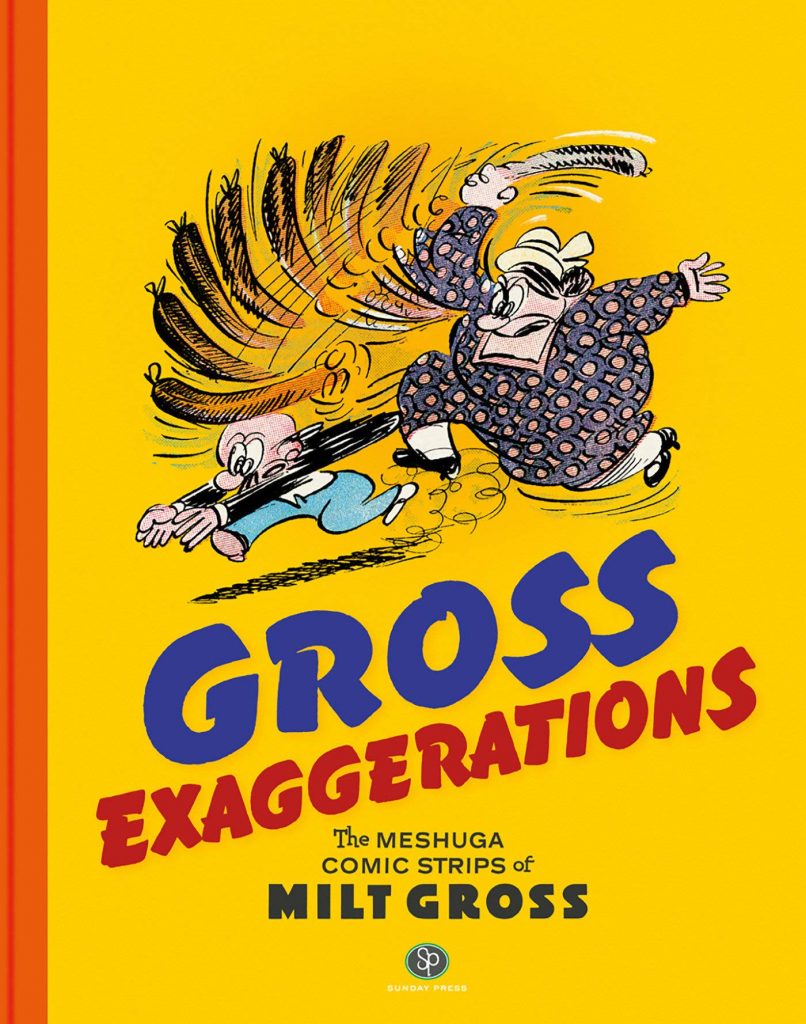
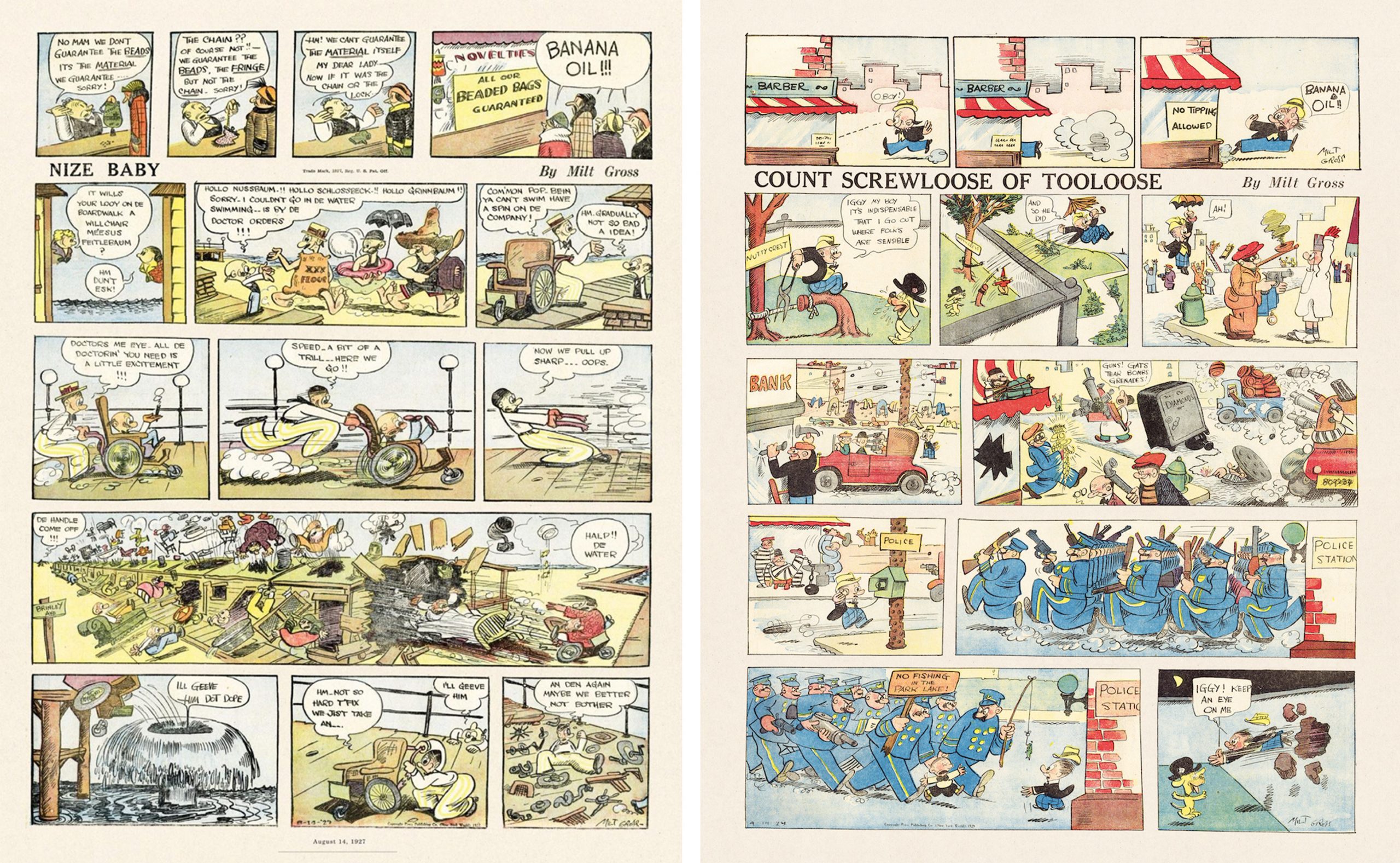
Gross Exaggerations: The Meshuga Comic Strips of Milt Gross is an oversized 44 x 32cm hardcover book that gives an overview of Milt Gross’s life and his career in cartoons, comic strips, animation, film scripts, radio and television, with many examples of his incredibly prolific output. The text features cover his work from the 1920s to 1950, before the selections reprinting complete Sunday pages from three of Gross’s best-known strips: 47 pages for Nize Baby, 31 pages for Count Screwloose of Tooloose, and 46 pages for Dave’s Delicatessen. Each of these was accompanied by a ’topper’, a smaller strip above the main feature, so there are actually six strips showcased here.
Nize Baby, a domestic comedy about an accident-prone father with three sons and a long-suffering wife, ran between September 1926 and February 1929. It is accompanied by Banana Oil, a strip puncturing the cheats and fakeries of everyday life (“Banana Oil!” is what the disgusted or annoyed protagonists shout at the end of each strip). Count Screwloose of Tooloose, published from February 1929 to May 1931 is a man who escapes from his confinement in the ‘Nuttycrest’ insane asylum every week but is soon driven back there by the lunacy of the outside world. Banana Oil continues as the topper strip here before being replaced in 1930 by Babbling Brooks, a man who ruins every scheme he is involved in by talking too much. Lastly there is the longest running of all Gross’s strips, from June 1931 to January 1935: Dave’s Delicatessen, set in a New York deli with a too-helpful grocer whose good deeds for his customers always go wrong. Count Screwloose of Tooloose continued as the topper strip before the two strips merged in 1934. It was replaced by Count Screwloose’s Penguin Parade featuring aquatic birds Otto and Blotto. A single panel gag cartoon entitled ‘That’s My Pop!’ spoken proudly by a clueless child who admires every crime his lawbreaking dad commits, was squeezed in next to Penguin Parade, making the Dave’s Delicatessen Sunday page a real feast of Gross cartooning.
The impressive array of styles, formats, approaches, methods and jokes demonstrates why Gross was so admired and successful, but also how very tied to his time period his humour was. From this vantage point much of it no longer works and is often painfully creaky. Still, the energy and visual inventiveness makes up for a lot of the outdated worldview and this is a brilliant collection of a very distinct period of American newspaper cartooning.