Review by Lewis Savarese
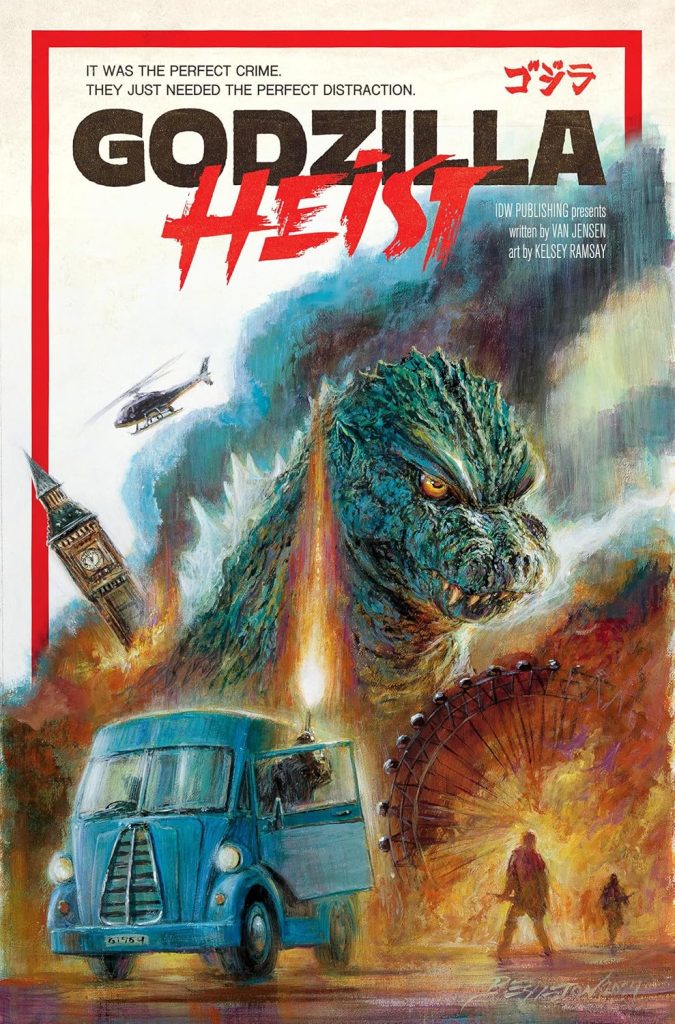
What if you committed high-profile robberies and your partner in crime was Godzilla? You would be in a different, perhaps more interesting, story than Godzilla: Heist. Instead, this book follows inventor/thief Jai Kulkarni who uses a Godzilla rampage as a distraction during his heist. Not satisfied with such a straightforward story, writer Van Jensen gives Jai motivation from his past that extends beyond pure avarice. This genre-bending tale from Jensen and artist Kelsey Ramsay is in line with IDW’s idiosyncratic Godzilla offerings such as Godzilla’s Monsterpiece Theatre and Godzilla: Skate or Die, but fails to deliver on the attempted conceit and characters.
Early on, after his initial heist of a casino in Manila, we learn that Jai is not your average thief. When abducted by a team of mercenaries with codenames taken from the Greek alphabet (Alpha, Beta, Kappa, and Chi), Jai reveals that he invented a “neutrino cannon” that creates atmospheric anomalies which in turn lure Godzilla. The mercenaries want Jai to use his cannon and spherical drones to bait Godzilla to London where they will break into a top secret chamber located beneath the Ministry of Defence’s Whitehall building and steal an undisclosed object of immense power. Jai explains via narration that he knows the mercenaries intend to steal Mechagodzilla and in fact he has orchestrated everything up until this point to double-cross them. His reasons for wanting Mechagodzilla are tied to themes of generational trauma and postcolonial plunder, weighty subjects that Jensen shoehorns into the narrative.
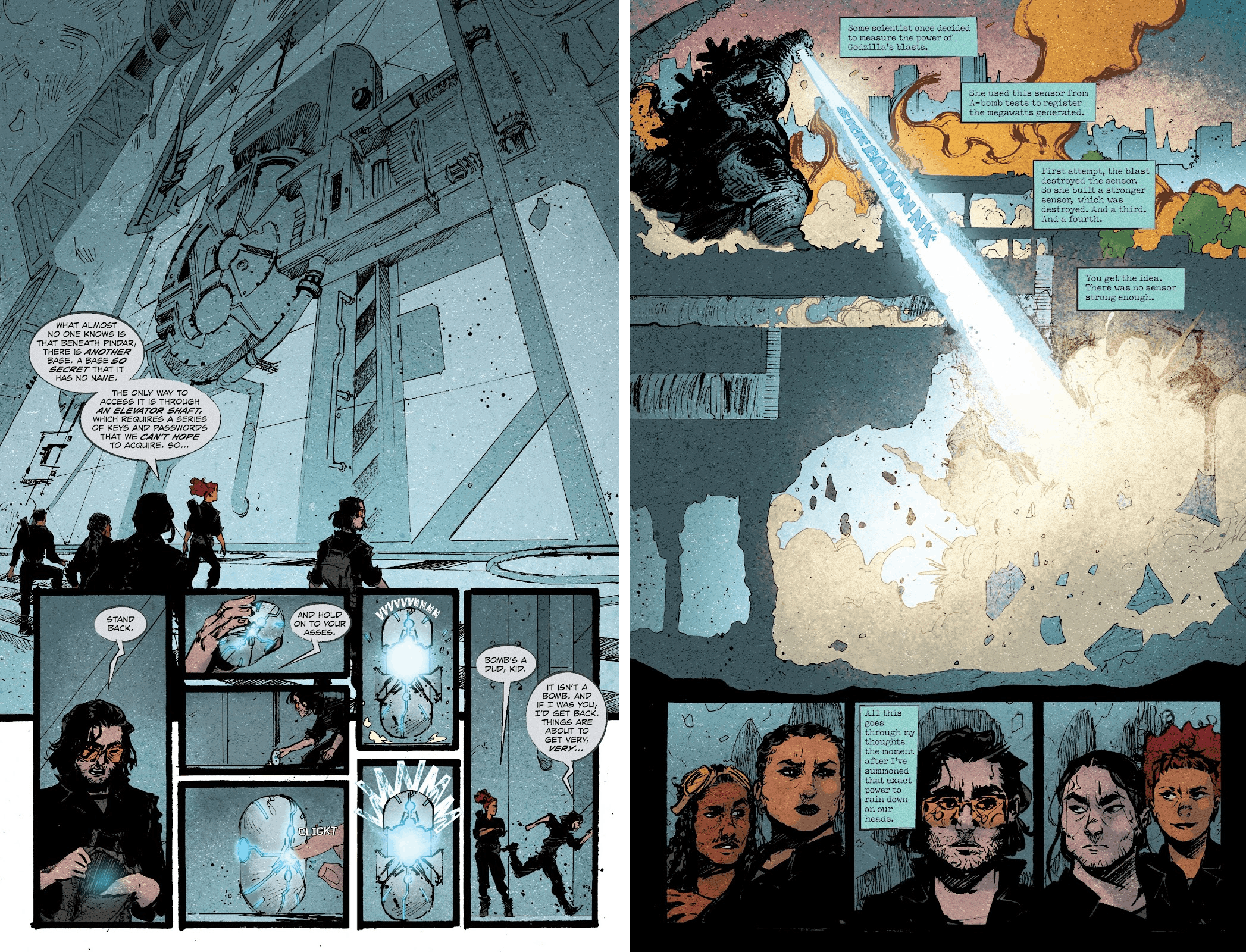
The London heist itself spans a considerable portion of the book’s page count. While the plan is initially explained in broad strokes, the procedural details are revealed during the operation. This type of narrative structure tends to work better if the individual elements of the heist are distinct and thrilling, keeping the reader on their toes. Jensen’s plotting lacks both qualities, as Jai and the mercenaries rely on brute force time and time again. Godzilla’s role in the heist is less distraction, more safecracker courtesy of his atomic breath. This bit of action gives us one of the best pages of the book, a cutaway of Whitehall and its underground chambers being ripped apart by Godzilla’s blast.
The flawed portrayal of the eponymous heist could be excused if we were spending time with interesting characters, a hallmark of all great crime fiction. Jai is at least given motivation and characterization, albeit slight, but the mercenaries are a lacklustre crew. Upon meeting them we’re given a rundown of their skills and dispositions via Jai’s narration. Beta, the homicidal sociopath, is the only one who lives up to her characterization in deed and demeanor. Chi, the chattering gearhead, is not particularly talkative and can barely outmaneuver Godzilla in a helicopter during a pivotal moment. Kappa, the strong-and-silent type, is so silent you forget she’s there and uses her muscle once to toss a couple of soldiers who were already being torn to shreds by machine gun fire.
Ramsay’s impeccable linework steals the show. Her detailed hatching coupled with colourist Heather Breckel’s gritty textures add a cinematic quality to the story, as if we’re watching an old film print with scratches and grain. Ramsay conveys a palpable sense of scale when appropriate, be it a nigh impenetrable door to a secret base or the titans Godzilla and Anguirus locked in battle. Hopefully Ramsey’s original art will be showcased in the inevitable reissue of IDW’s Godzilla: The Monster Comic Art Collection or subsequent Godzilla art books.