Review by Frank Plowright
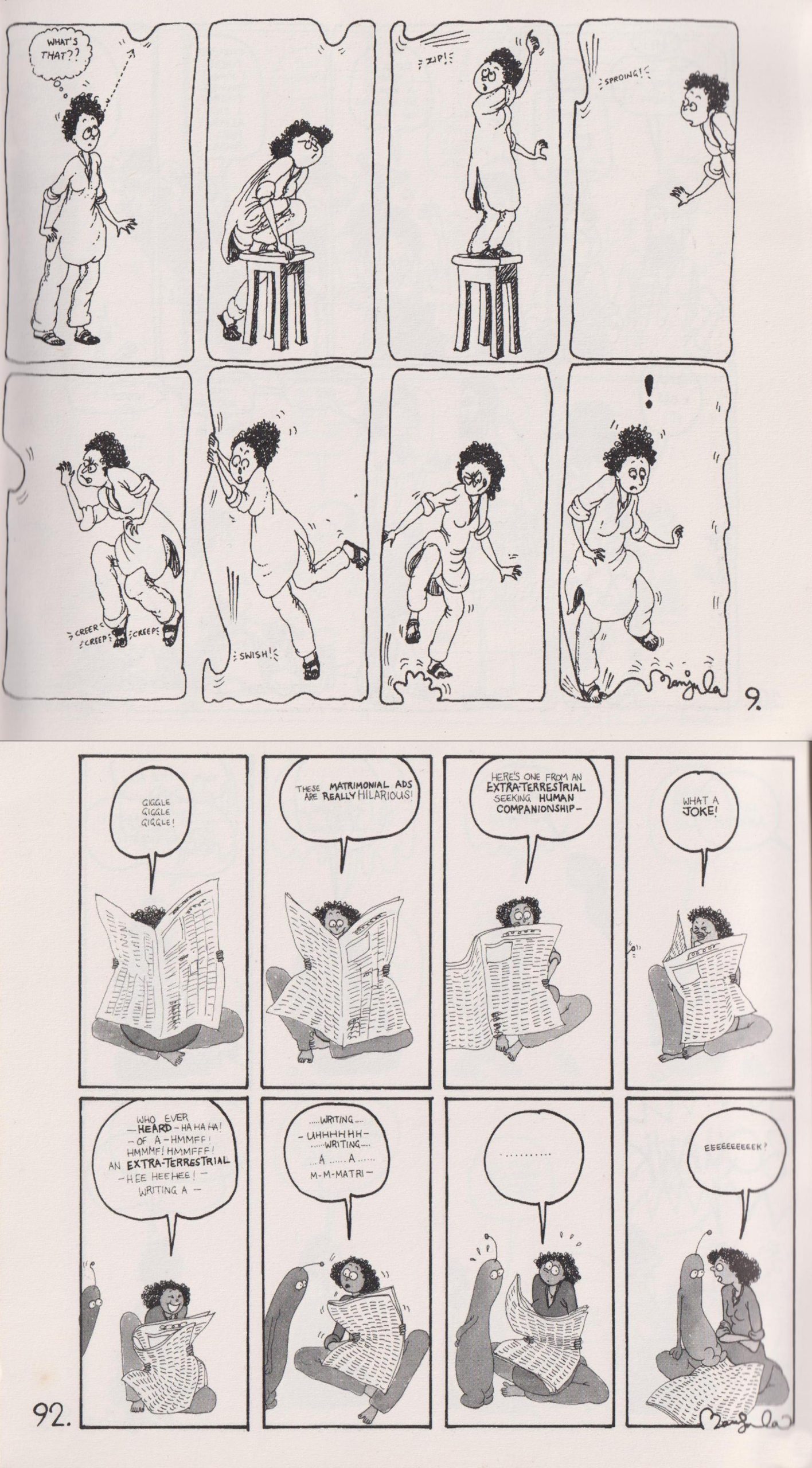
Manjula Padmanabhan is an Indian illustrator who began serialising her strip Double Talk in Bombay’s Sunday Observer in 1982, and this collection proves a fascinating study. Lead character Suki begins as a stand-in for Padmanabhan herself, commenting about local issues or life in general, but her creator seemingly isn’t someone overly burdened with the baggage of newspaper strip or comics history. The result is at first a talented artist finding her way into a new form, and then someone comfortable with that form experimenting with the possibilities.
It’s not long into the strips before Padmanabhan’s having Suki break through panel borders or affect their shape, or messing with planes, and there’s an immediacy to what follows because there doesn’t appear to be any over-arching plan. One strip ends with the joke of god sending a thunderbolt down from heaven, and the next has Suki writing to them about their poor behaviour. A few more thunderbolt strips follow, and Padmanabhan moves on to something else.
Social commentary is a speciality, and it’s distressing to read how the inhospitality of UK immigration has a history stretching back long enough to already have a reputation among Indians in the early 1980s. It’s with these strips and the experimentation that Double Talk is at its best. While Padmanabhan’s expressive art can sell more the traditional set-up and punchline format, it takes a time before she’s really comfortable with it. Where the strip succeeds almost immediately is in presenting philosophical posers for some strips as a proto-fill in.
The art is notable from the start, with Suki a loosely drawn presence sometimes seeming to sway in the panels, and others fitting in around her in plain white backgrounds, except for the few strips with a grey wash. The lettering improves notably from a shaky start, and at the start can be used as an artistic statement. It’s a shame to see this fade away as the book continues.
It takes individuality to deliver the most memorable art, and the creative mind jumping from subject to subject and a personal viewpoint renders Double Talk as a strip that needs Padmanabhan. She continues to play with form, one later strip daring for being printed upside down in a newspaper with the joke cleverly on the readers. A frog is introduced to give someone for Suki to talk to other than readers or a friend, and so is a derivative poet, and by the end an alien is also regular. Not everything is comedy gold, but imagination takes Double Talk a long way.