Review by Ian Keogh
Disciples opens in 1978 with Wendy wild, free-spirited and keen to sample the freedoms the decade offers, while Clara is more conservative. A few pages later she’s revealed as the only survivor of a sinister cult’s activities, and the narrative switches to the present day.
Over time we learn what Clara endured, via what’s occasionally an almost a playful winking eye approach from film makers turned graphic novel writers David Birke and Nicholas McCarthy. Their films are imaginative horror, and here they cultivate a deliberate sense of implausibility.
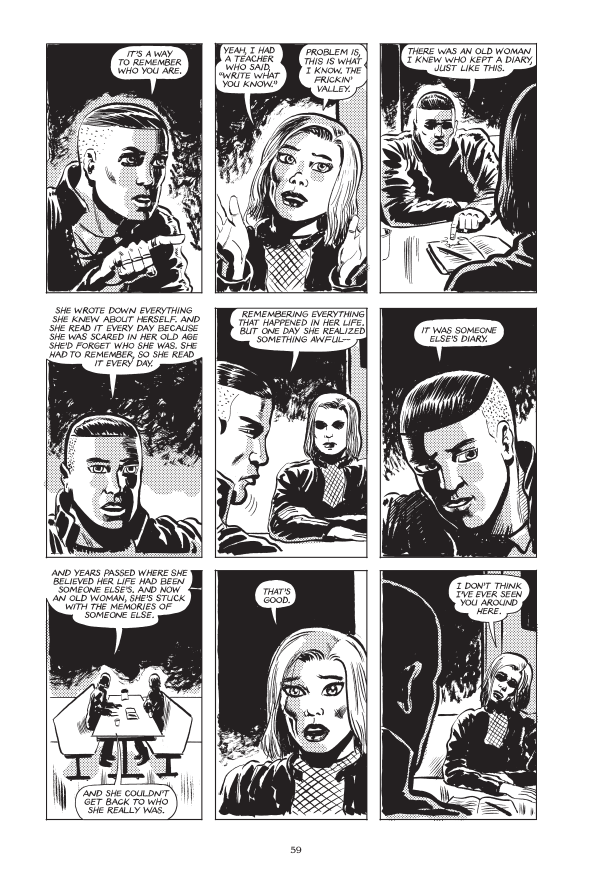
Benjamin Marra is great at generating a dark mood via frequent shadow, but while he’s so good in portraying the wildness of his own stories (see recommendations), he’s an awkward fit with something requiring restraint and conversation. The nuances of those conversations don’t always transmit, partly because three women of different ages living in the same house all look broadly the same, partly because Marra doesn’t vary the viewpoint enough, and partly because portraying emotion isn’t a strength. He gets it completely right on a scene of Clara recalling the past to her boyfriend, which is an excruciating portrayal of damaged arousal.
Because the writers are film makers by trade, there’s the temptation to assume Disciples is either a film never made, or one yet to be made. There are occasions when the pacing indicates a film script rather than the different needs of a graphic novel, and the deliberate limitations of the locations would transmit better as film.
There’s a lurid appeal to a predictable plot, but too few smart moments, such as the eventual use of a coin. It leaves a detached story sealed by a distant ending that can’t elevate Disciples above homage.