Review by Lewis Savarese
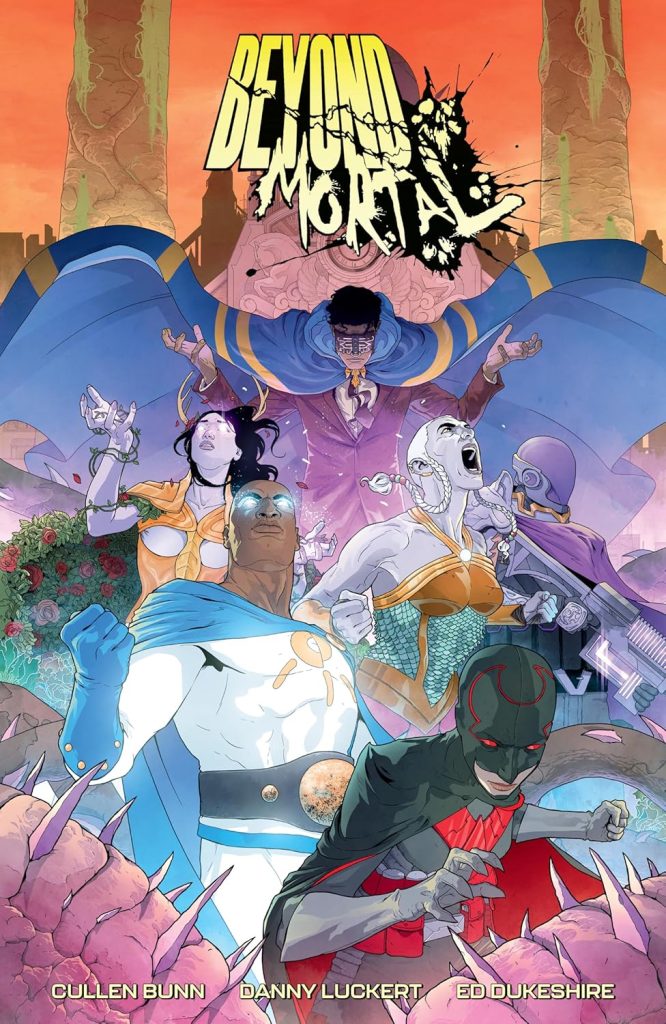
Comics creators are no strangers to pitting superheroes against cosmic horrors. Everyone from Batman to Spider-Man has encountered eldritch entities, be it DC’s Iog-Sotha or Marvel’s Shuma-Gorath, and occasionally Lovecraft’s Cthulhu himself. Charting their course with an original comic universe, Cullen Bunn and artist Danny Luckert explore the nexus between superhumans and elder gods in Beyond Mortal. In Empire City, a superhero team known as the Alliance faces off against the Leviathan, a pantheon of primordial gods posing an existential threat to humanity. Bunn and Luckert craft a universe heavily reliant on pastiche, but lacking the allure and rich characterisations underscoring the works that influenced it.
Beyond Mortal is indebted to the DC universe, with members of the Alliance and their supervillains taking inspiration from an assortment of well-established characters. Commander Comet’s Superman-like powers are activated when his geriatric alter ego, a twist on Captain Marvel’s adolescent alter ego Billy Batson, utters “temoc”; Devil-X and his successor Devil-X+ are Batman clones with crimson costume trim and a fondness for firearms; Torpeda is the warrior queen of the underwater kingdom Abyssia, equal parts Aquaman and Wonder Woman; Mother Nature, vessel of the Greek goddess Gaia, is a cross between Poison Ivy and Doctor Fate; rounding out the cast is the Secret, a sharply dressed mystic akin to the Phantom Stranger. The universe’s supervillains range from analogues of Reverse-Flash to Lex Luthor, Tattooed Man, and more.
Luckert adapts classic superhero iconography to best suit each character, but tends to overdesign their costumes. Commander Comet has the cleanest design, with an asymmetrical tunic jacket and cape reminiscent of Captain Marvel’s first appearance. His luminous blue and white colour scheme is a welcomed contrast to the darkness of outer space and the putrescent palette of the Leviathan throughout. Both iterations of Devil-X have a recognisable aesthetic, immediately establishing them as the Batman substitute. While the devil horn pattern on their cowl is a nice touch, the abundance of pouches, padding, pockets, and ribbing evokes a maligned 1990s costume trend.
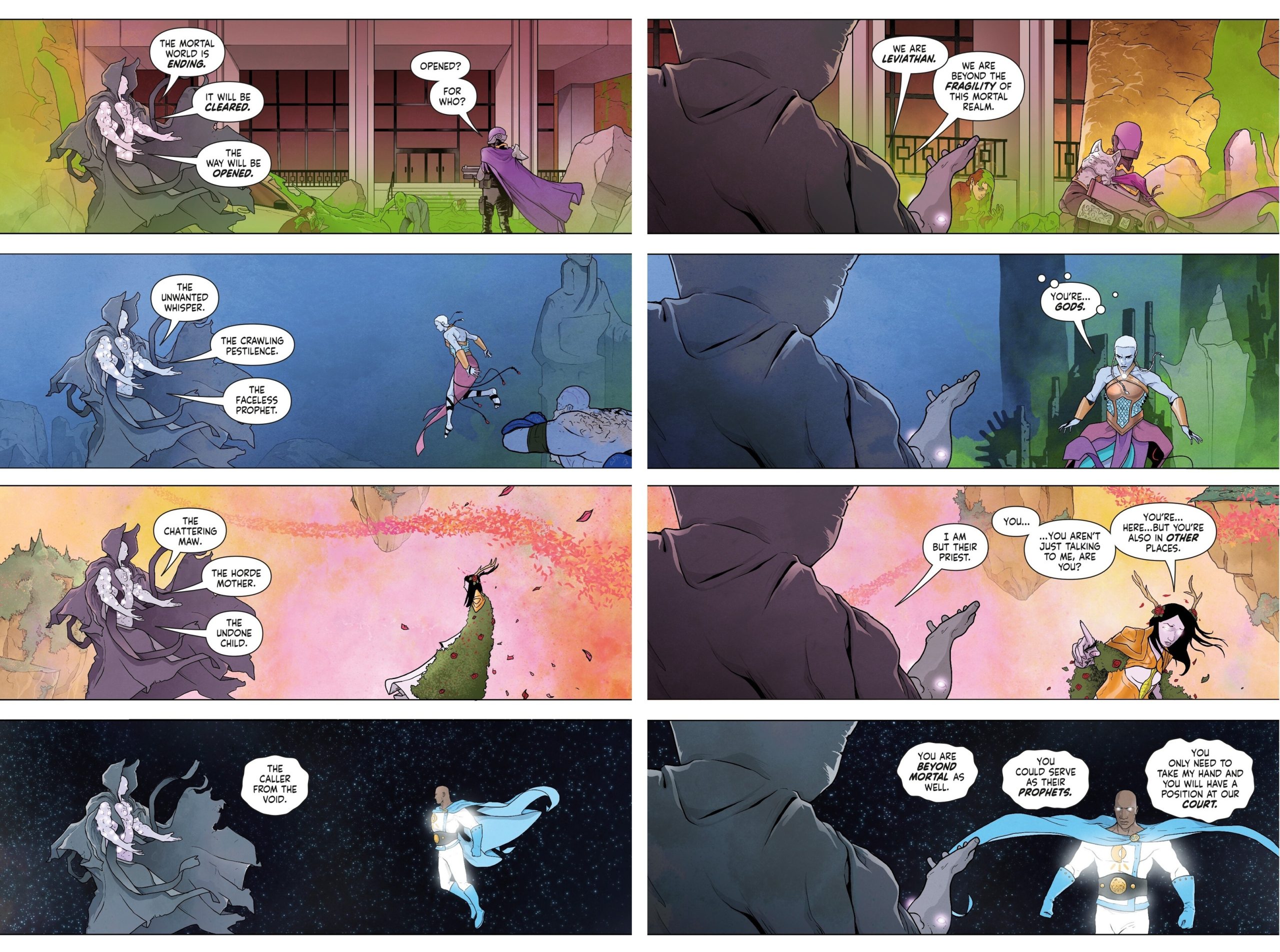
Bunn’s universe is strikingly similar to another 1990s remnant, the Authority. The edgy tone, pastiche characters, dark humor, and gruesome violence harken back to a time when these ideas were novel. However, these qualities are now commonplace, if not tedious. The similarities between Beyond Mortal and the Authority extend beyond several admittedly superficial elements and veer towards outright imitation. The ‘Outer Dark’ storyline, collected in The Authority: Under New Management, features a being called ‘God’ returning to Earth after eons away, in order to claim the planet for itself. The Authority battles tentacled parasites and God is portrayed as a pyramid floating in space. The Leviathan of Bunn’s universe tells the heroes they have been a part of Earth since the beginning, here now to reclaim what is theirs. They disperse tentacled horrors across the globe and the head of their pantheon, the ‘Caller from the Void’, is depicted as a star-like dodecahedron.
The derivative nature of Beyond Mortal is the product of a narrative overburdened by genre assumptions. Having no background knowledge of the characters, we are sporadically fed expository world-building in lieu of characterisation. Team dynamics are rarely examined, with archetypes such as the vigilante, the mystic, the tank, or the scientist doing the heavy lifting. There is a reveal towards the end, regarding the mysterious connection between the superhumans and the elder gods, that might justify the forthcoming volumes, Jumpscare and The Murk.