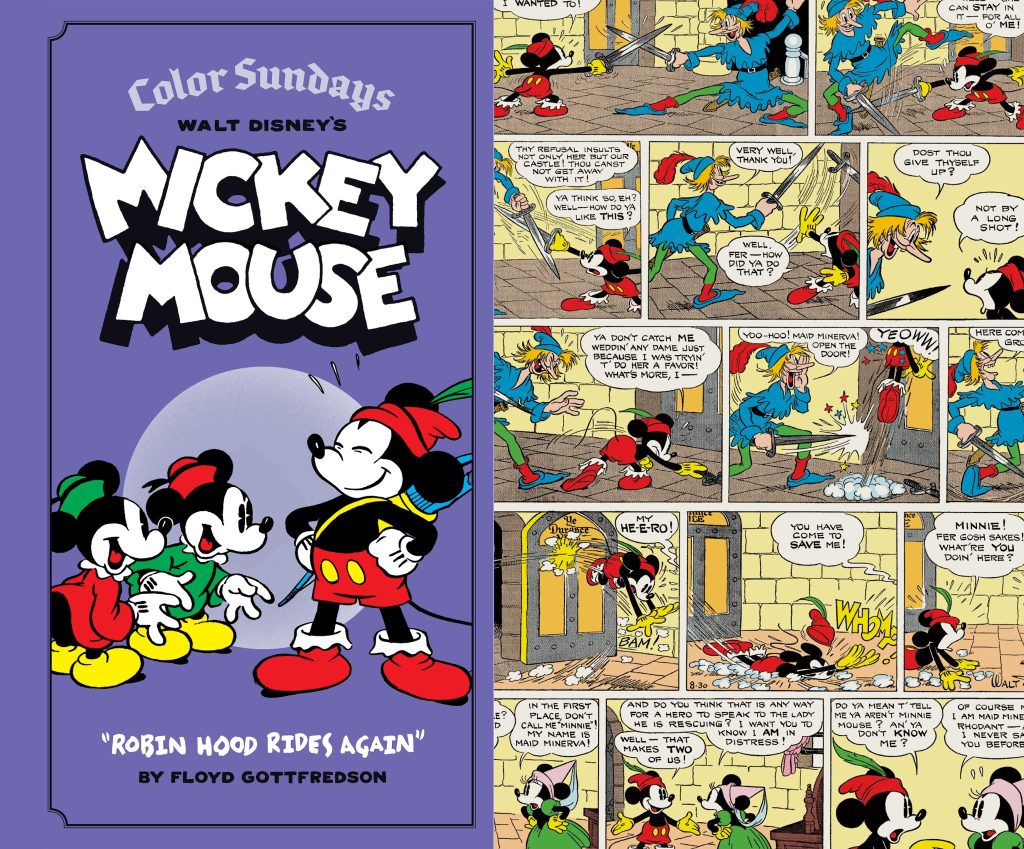
Review by Win Wiacek
Floyd Gottfredson plotted and drew the Mickey Mouse Sunday strip across five decades, transforming Mickey from a vehicle for gags into some of the earliest adventure continuities in comics history. A very welcome second archival compilation of some of the most engrossing continuities the comics industry has ever enjoyed picks up from Call of the Wild in January 1936 with ‘Mickey’s Rival’.
Our hero’s dark mirror antithesis manifests in a sequence written by Ted Osborne, pencilled by Gottfredson and inked Ted Thwaites. Here a most manly, not to say thuggish and vulgar, fellow rodent named Mortimer makes major inroads courting Minnie and a month of escalating escapades – and even stern advice from Goofy – are ineffective. Ultimately, low cunning and unsportsmanlike tricks clear the path of true love and Mortimer is sent packing.
Gottfredson’s policy was to separate his scintillating adventure serials with runs of gag strips. They’re funny in detailing how, for instance Mickey and faithful hound Pluto dodge dog catchers, fail to open cans and bottles, fall foul of ice and snow and even street race old cars with Donald Duck. However, it’s the serials that cement Gottfredson in comics history, and each is preceded by introductory text providing background information and context, relating how Gottfredson constantly varyied his themes.
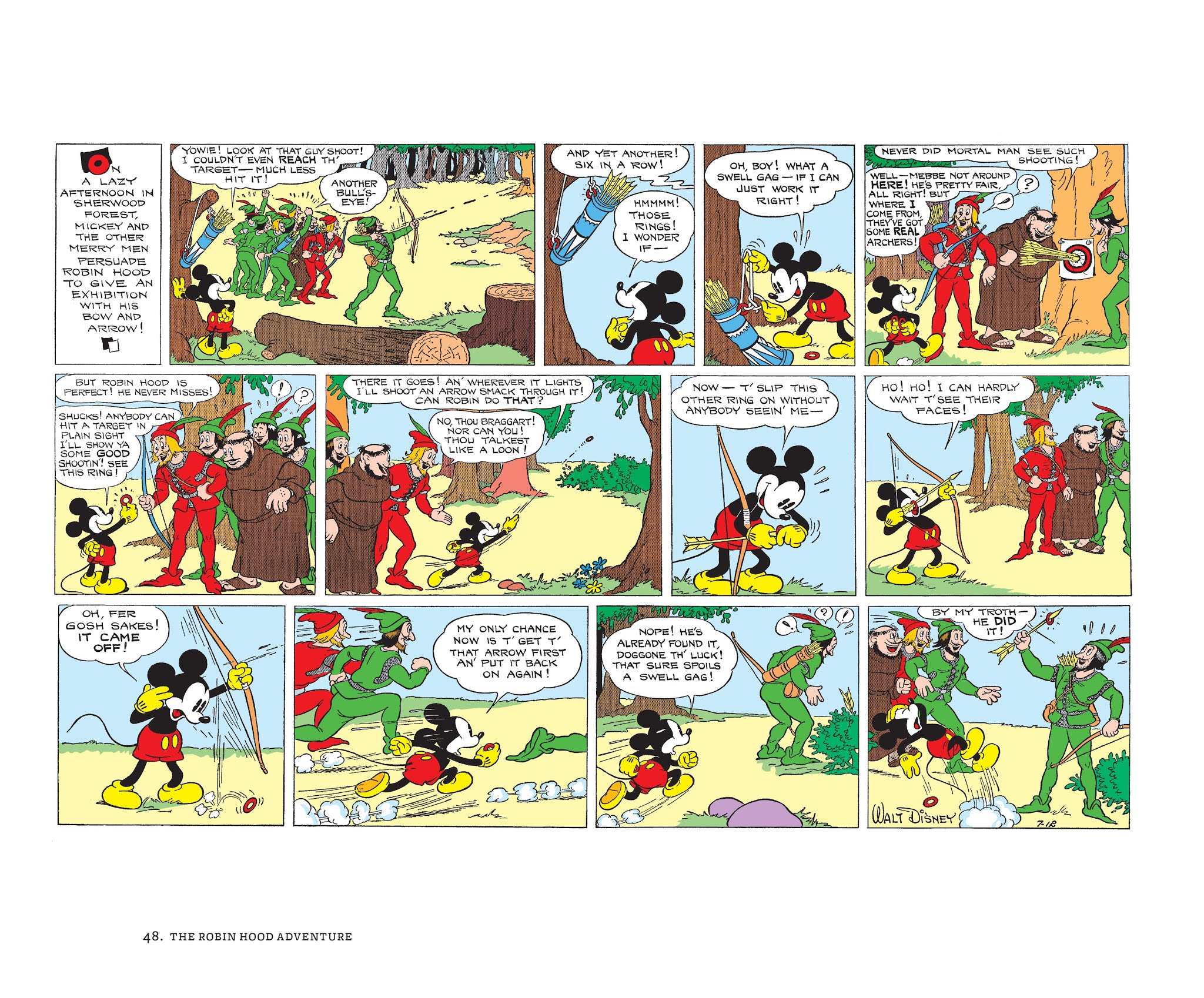
The first two extended adventures here are totally different. Extended fantasy romp ‘The Robin Hood Adventure’ has a story-within-a-story as ardent gardener Mickey is transported via beanstalk and magic book back to Sherwood Forest to for dashing derring-do, comical capers, swashbuckling swipes and satirical jibes. Next is ‘The Ventriloquist’ with the rascally rodent exhibiting his voice throwing gifts and puckish sense of prankery to Pluto, Goofy, Horace Horsecollar and Clarabelle Cow, before inevitably suffering a major reversal of fortune. In other extended tales we see Mickey as a cowboy, managing a petrol station and an adaptation of Mickey’s film The Brave Little Tailor.
Rather than extend to a third volume a final chapter addresses Gottfredson’s later years on Mickey from the 1950s. Gottfredson illustrated several other animation adaptations and the gag strips star a far more sedate and suburban Mouse traversing 1956 to 1976. Stories by Bill Walsh, Roy Williams, and Del Connell are lovely but no longer in any way subversive, detailing swimming pool and gardening woes, ice cream parlor perils, entertaining bored kids, sports, decorating, fashion, camping, pets and snow.
Also included are ‘The Seven Dwarfs and the Witch Queen’, plotted by Gottfredson for Julius Svendsen, and the Gottfredson-drawn adaptation of 101 Dalmations and ‘Larry the Sheepish Lion’.
This curation features not only Gottfredson’s work but erudite explanations of it, image-packed extras, and examples of international adaptations. After too long in the shade, thankfully we have these archives to enjoy, inspiring us and hopefully a whole new generation of inveterate tale-tellers.
Still, isn’t there more we could find for a third book?