
Review by Frank Plowright
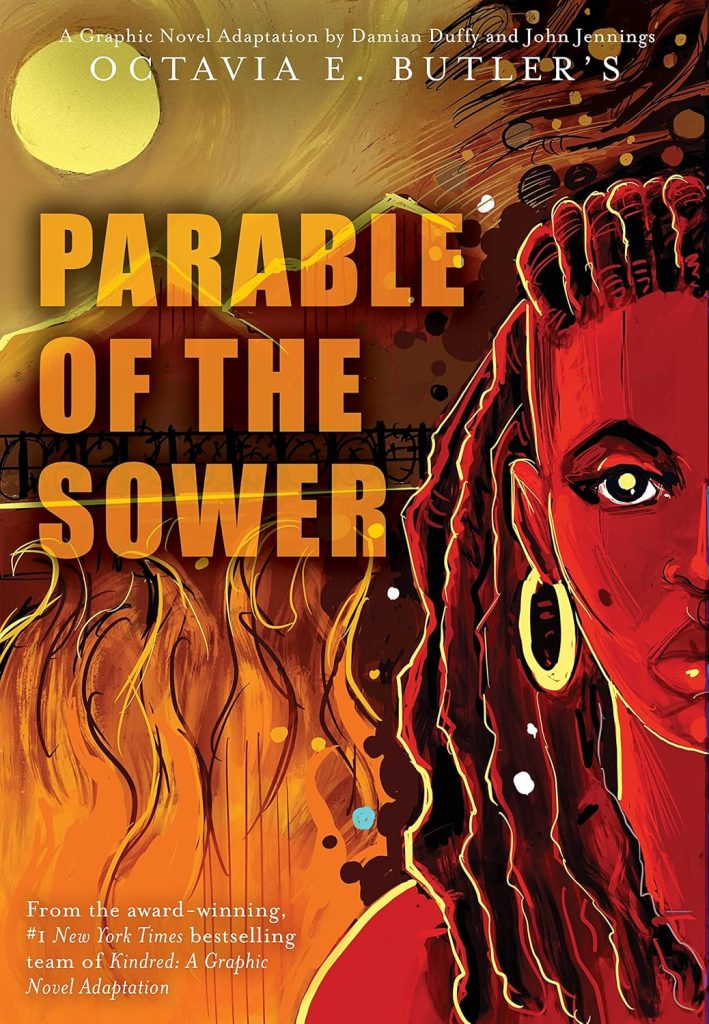
When Octavia E. Butler published her novel Parable of the Sower in 1993 it dealt with Lauren at fifteen growing up in California during the 2020s. Butler didn’t paint a pretty picture, noting she tended toward pessimism.
The prevailing state is seen as Lauren and her family cycle to church and pass the dispossessed, the sick and the mutilated. She’s been born damaged by chemicals rendering her hypersensitive, and there’s plenty to be sensitive about. Her narrative accompanies illustrations about how climate change is wreaking havoc, while we also learn that people being randomly shot without their deaths being properly investigated is par for the course. Meanwhile the disparity between rich and poor is at an all time high. She may have considered herself tending toward pessimism, and she didn’t predict the rise of online culture, but Butler’s fictional 2024 bears striking similarities to reality’s 2025.
Damien Duffy’s adaptation uses Lauren’s diary entries to move the narrative forward, ending in 2027. She struggles to reconcile the God of her father with reality, so devises her own belief system involving bending God to the needs of people. This is a gradual process conceived with her small community in upheaval, and she comes to the conclusion she’d be better off risking herself beyond the walls of her gated community, although is reluctant to take that step.
John Jennings takes a fine art approach to the illustration, concentrating on individual panels rather than a visual continuity through entire pages. This supplies many evocative portraits covering the emotional spectrum, but there’s not enough variety to multiple panels of this sort with smudged colour backgrounds. In places, though, Jennings will surprise with a vividly coloured page or a composition an artist steeped in comics wouldn’t consider, but it’s small compensation.
Duffy via Butler builds up a grim portrait of a well-meaning community looking out for each other as they struggle against enormous odds, attempting to keep to ideals and faith when all authority is corrupt. Ethical discussion is frequent, few conversations lacking some kind of moral background, the intention being to prompt consideration, and the tone of the discussions change as the cast age and due to what they experience. Also assuming greater importance as Parable of the Sower continues is just how far lives are controlled in the interests of profit, everything undercut by human tragedy.
Lauren dreams of escape, but it’s eventually forced on her in what becomes almost a Biblical exodus, and the Earthseed religion she’s conceived takes on greater relevance as a form of guidance. She begins spreading it to others as they join her journey.
Butler’s horrific story is well adapted by Duffy, whose work never feels like a contraction to meet allocated pages. He brings out the full social horrors of humanity driven to desperation, which thankfully Jennings is relatively abstract in showing. Jennings, though, is otherwise responsible for an incendiary and provocative novel not having nearly the impact it ought to in graphic form. The same creators are responsible for adapting the sequel Parable of the Talents.