Review by Lewis Savarese
In Thor & Loki: Double Trouble, the second installment of Mariko Tamaki and Gurihiru’s Marvel series for young readers, the trouble has in fact doubled as neither beloved characters nor charming art manage to save this shallow tale of brotherly strife. Much like the first installment, Spider-Man & Venom: Double Trouble, Tamaki again prioritises hijinks and banter to the detriment of story and characterisation. Gurihiru’s art is dynamic as ever, but their talent is constrained by the limited scope of the story.
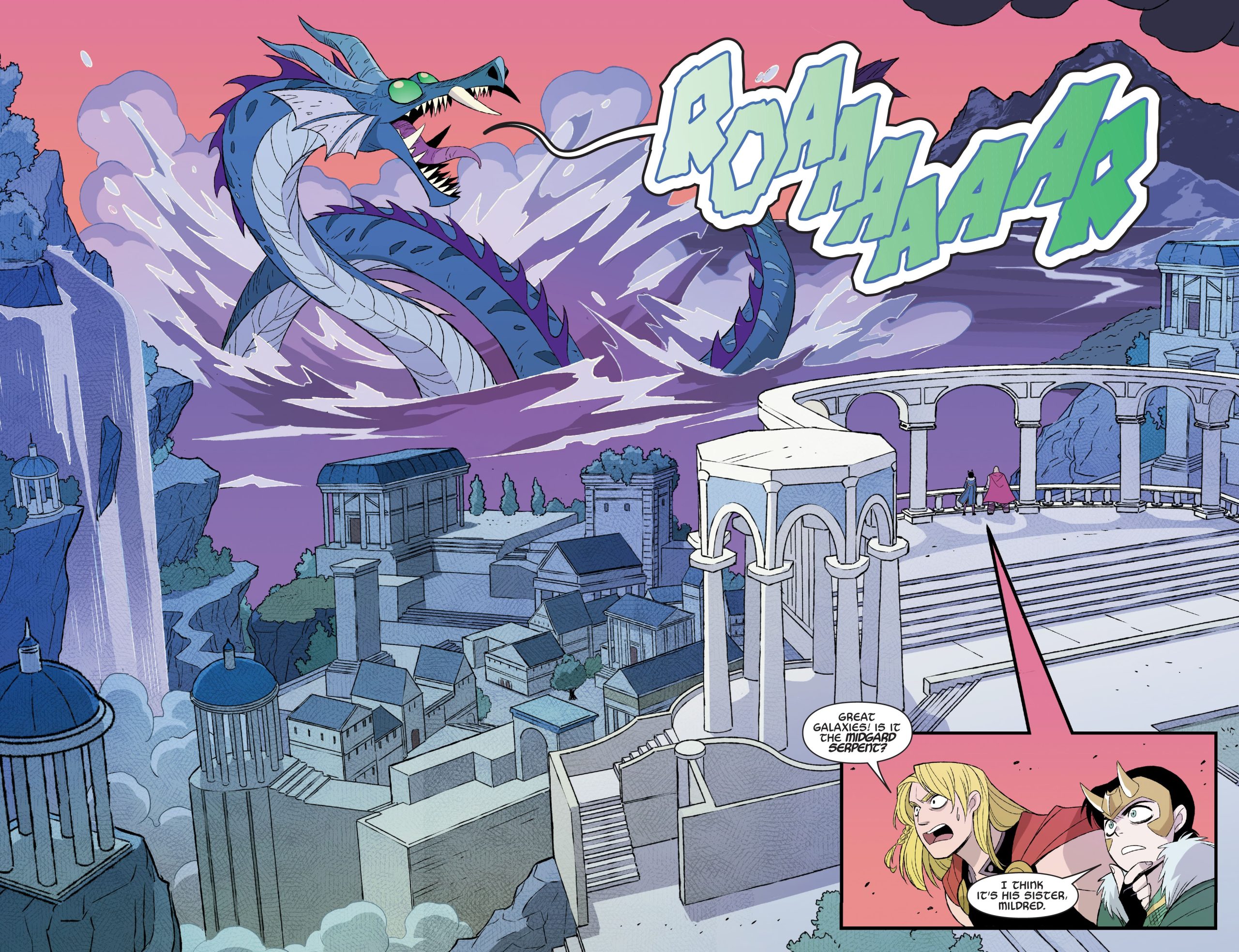
As a first introduction to Marvel’s Thor and Loki, Double Trouble presents young readers with an oversimplification of their personalities. Tamaki accurately portrays Thor as arrogant and Loki as mischievous, but their actions lack motivation. Loki kicks things off by challenging Thor to steal the Lur of Luramena from Odin’s vault. Thor only agrees to disprove Loki’s assertion that he is ‘scared’. Thor’s rash decision feels like a contrived character beat existing solely to hurry along the plot. Once Thor pulls off the caper, Loki sounds the lur which summons the Midgard Serpent’s sister, Mildred. Gurihiru renders Mildred emerging from the waters outside Asgard in a glorious spread that conveys the enormity of the problem Thor faces and Loki typically revels in the destruction of Asgard, one of his enduring desires. However, Loki’s ostensibly nefarious motivation for this scheme quickly evaporates as he helps Thor vanquish the serpent. Loki even sticks around to aid Thor with cleanup.
A characteristic bit of Loki mischief soon propels the brothers towards their doubles, as referenced in the title. As they clean up Asgard, Loki reveals to Thor that he stole another treasure from their father’s vault, a magical orb with reparative properties. They try to use the orb to rebuild the marketplace that Mildred the Serpent destroyed, but instead open a portal to an alternate reality. Here we meet Jane Foster Thor and Lady Loki, the doubles. Gurihiru’s designs for the doubles mirrors those of Jason Aaron’s Thor (2013) and J. Michael Straczynski’s Thor (2008), respectively, with little variation. The banter between the Thors and the Lokis leans heavily on the pairs repeating each other’s lines, humour that diminishes in quality with each instance. The most interesting interaction between doubles is a wordless shapeshifting fight between Lokis, enhanced by Gurihiru’s art. As they fight over the magical orb, the Lokis transform into various animals, maintaining certain aesthetic traits of their human forms to differentiate them. Gurihiru depicts the male Loki’s animal forms with a light green color palette, fur collar, and short horns. While Lady Loki’s animal forms have a teal palette, markings that mimic her long hair, and protruding horns.
The male Thor and Loki eventually return to their reality (Earth-20420, in case you were curious), which is actually the main narrative conflict for a good majority of the story. Tamaki crafts an adventure in which Thor and Loki encounter gender swapped versions of themselves seemingly at random, fight over an orb, and go home. Gurihiru’s art aside, it is hard to recommend a book that eschews story to instead rely on flat humor and flimsy characters. The final instalment is Peter Parker & Miles Morales: Spider-Men Double Trouble.