Review by Frank Plowright
When Hester and Rachel Martin become unemployed in the 1920s there’s no welfare safety net to protect them. The local mill burning down removes the area’s main employer, and it’s already been made clear that working there only pays a wage barely above subsistence level. Two weeks without work is all it takes to reduce a family to poverty. Hester is sensitive and artistic while Rachel shows more concern about fighting against the iniquities of society, and when she learns a family secret and matters worsen she becomes more vociferous.
Ethel Carnie Holdsworth published both under her birth name and married name, hence both used on the cover. Under either name she was a passionate fighter for greater social equality, and online information about her paints a character very similar to Rachel, strident and honest in pointing out how life could be improved for everyone. As the centenary of This Slavery approaches, a novel long out of print for much of those hundred years is brought to startling life by Scarlett and Sophie Rickard, pleasingly making an effort to use local phrasing for what takes place in North England.
It’s a clever story, using the dynamics of the Victorian family novel to tell something with power and pointing out again and again how being born into the working class during early 20th century ensured an existence, not a life. The title is well considered with a slightly different meaning according to where the emphasis on “this” is placed. In the UK the owning of slaves was abolished in 1807, but different forms of slavery continued as they had done for centuries and the servitude of a wife, and keeping workers just at subsistence level and constantly concerned for their jobs are featured. Even dying brings no comfort as it imposes the burden of unaffordable funeral costs on those left behind.
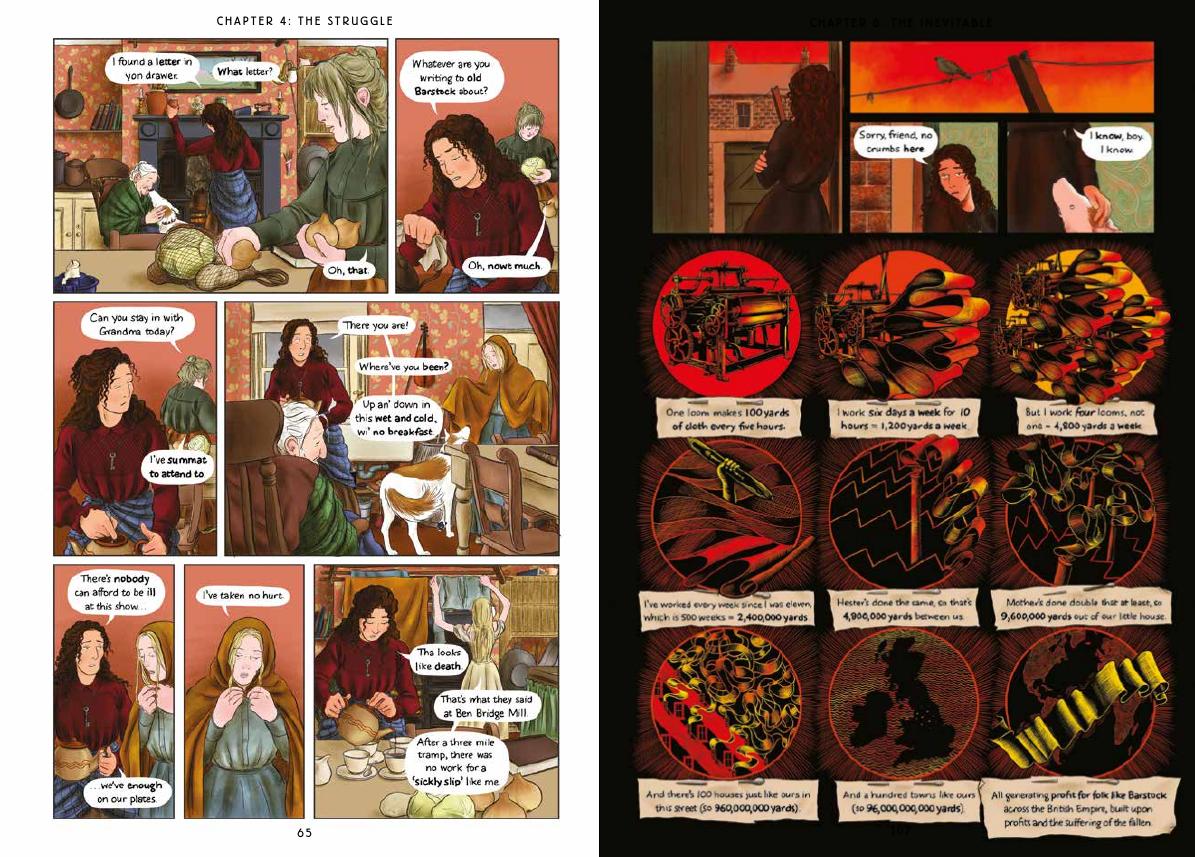
The Rickard sisters bring this to life visually with emotionally strong personalities, well defined surroundings and a real sense of purpose. Period details are scrupulously conveyed and where the story permits there’s an expansion into startlingly decorative locations and attractive countryside, although it’s made clear most haven’t the time to appreciate that. Holdsworth dissects the hypocrisies of the era, and the art shows the industrial chimneys in the background as Hester’s health declines. Overall there’s the same colourful and flat look often seen on trade banners carried in parades.
Amid some ingenious plotting Holdsworth creates memorable examples identifying meaning. Poverty is exemplified by the sisters fretting over the cost of replacing a washing line, instead knotted every time it breaks, and a string of pearls later illustrates the priorities someone holds. She also crafts fine character interactions, notable when This Slavery jumps forward several years and people’s views are challenged, and during some squirmingly unpleasant behaviour. The Rickards bring this out, accentuating the right moments, ensuring the driving passions are clear.
By today’s literary standards This Slavery dips a little too often in preaching, especially in a key speech Rachel makes, and it’s not without caricature, but many truths apply to exploitation as much now as then, instantly refuting any accusations of period comfort reading. An author who still has something to say has been proudly restored to topicality by Scarlett and Sophie Rickard.