
Review by Frank Plowright
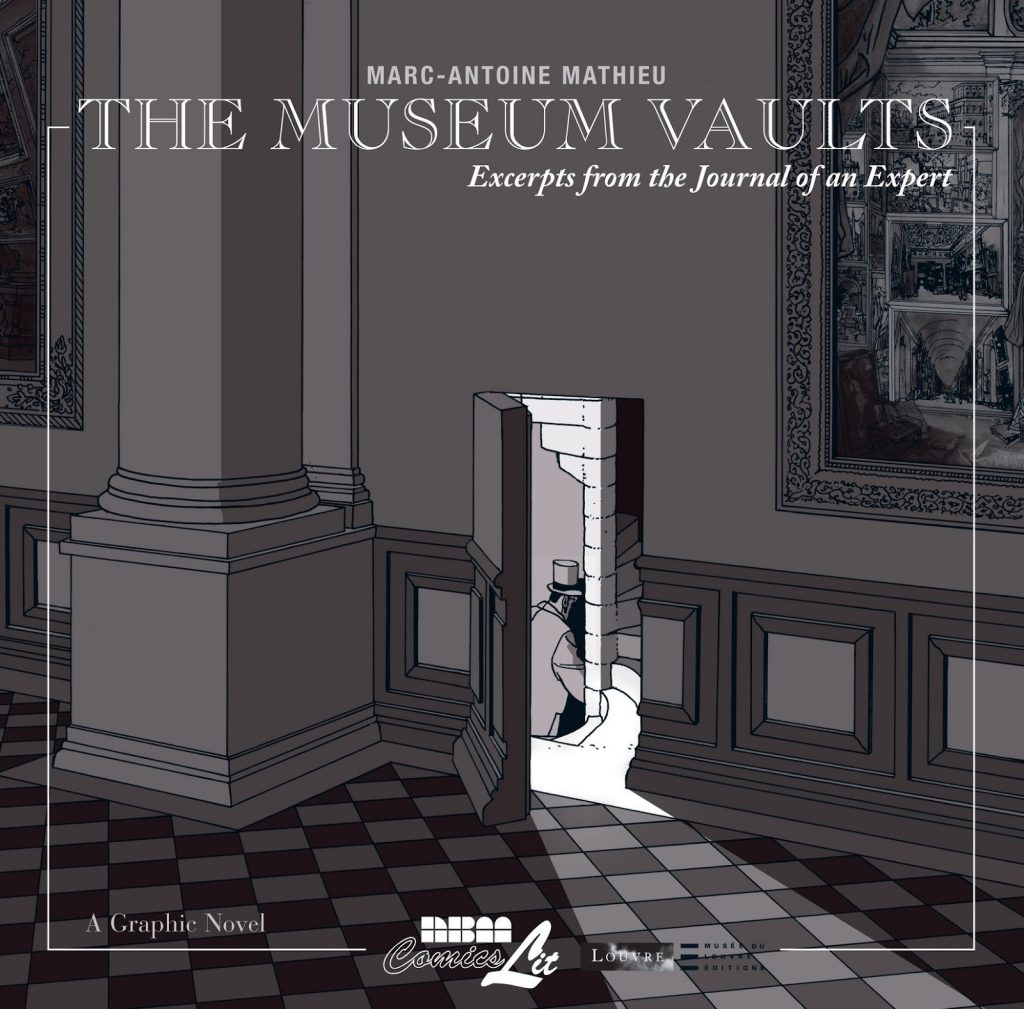
Eudeus Volumer is hired by the Musee de Revolu to catalogue and evaluate the museum holdings. It’s a structure so massive that no-one entirely knows its extent of its underpinnings, nor the workings of a vast technical support system. The more Volumer and his assistant Leonard explore, the more cavernous and intimidating the surroundings are, and the more the structure itself becomes a journey back through time.
From a start offering several alternative anagramatical names for the Musee de Revolu, itself an anagram of Musee de Louvre, then revealing no-one recalls the structure’s true name, Marc-Antoine Mathieu sets a tone of absurdism contrasting the formality of Volumer and his observations. The more Volumer explores, the more he’s drawn away from his purpose and into an endless labyrinth.
The Museum Vaults is a co-production with the Louvre museum in Paris, which every year commissions a graphic novel about the museum or its contents. Could one imagine the Smithsonian or the British Museum doing the same? The prestige speaks to how comics are accepted as an artform in France, and as much as anything Mathieu is asking questions about which art should be preserved. Part of the joke is Volumer spending years wandering the structure and learning about the craftsmen and technicians perpetuating it, yet only rarely coming across any actual art not in a state of restoration. When it is seen it’s usually mentioned in dismissive terms, while a technician discussing the oldest form of mould known in the basement refers to it with reverence.
In admiring the structure, Mathieu applies a diagrammatic accuracy to his art, emphasising the vastness of scale in precise illustrations. It makes his visual jokes stand out, particularly in a section where it’s suggested deliberately crude reconstruction might be desirable in forming its own statement. It’s the most obviously funny section, culminating in the craftsmen caricaturing their manager and him not realising. Other sly little jokes abound, such as a discussion of reproductions taking place in front of several versions of Nicolas De Crécy’s cover illustration to Glacial Period, the previous year’s Louvre commission. Intricately designed complex means of traversing or viewing abound, and Volumer’s eventual fate is foreshadowed when he meets an earlier expert overwhelmed by his task.
As Volumer’s journey continues, Mathieu’s jokes become a little more obvious. Admiration of frames leads to the thought that the frames themselves can tell a story, and there’s a good laugh to be had about the numerous Mona Lisa copies exhibited one after the other.
There’s a prevailing intelligence, and constantly interesting comments prompt the thought that not everything is intended as satirical. So what is Mathieu’s point? Is it that craftsmanship ought to be valued as much as art? Perhaps not. There’s enough to come back to and mull over that you’ll spend plenty of time considering art, its fittings and surroundings.