Review by Frank Plowright
Perhaps not as well known to English language readers as their European counterparts, Antoine de Saint-Exupéry’s The Little Prince remains a much-loved children’s story now over eighty years since its 1943 publication. The original reputation was bolstered by aviator Saint-Exupéry’s reputation as a World War II hero whose disappearance has never been definitively solved.
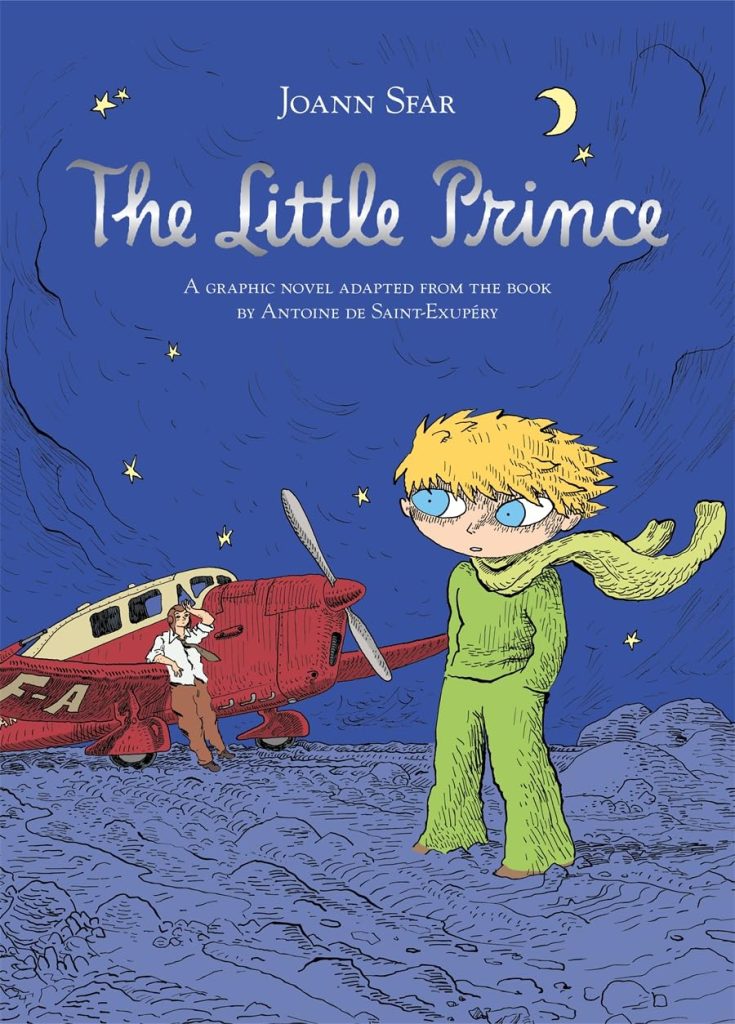
The title is perhaps misleading for a story beginning with a plane making an emergency landing in the desert. The pilot then narrates how when attempting to fix the plane he was approached by a young boy demanding a drawing of a sheep, which takes several versions before the boy is satisfied. We learn he’s a prince from some far away planet, yet while there are descriptions of life elsewhere, the entire story is set in the desert.
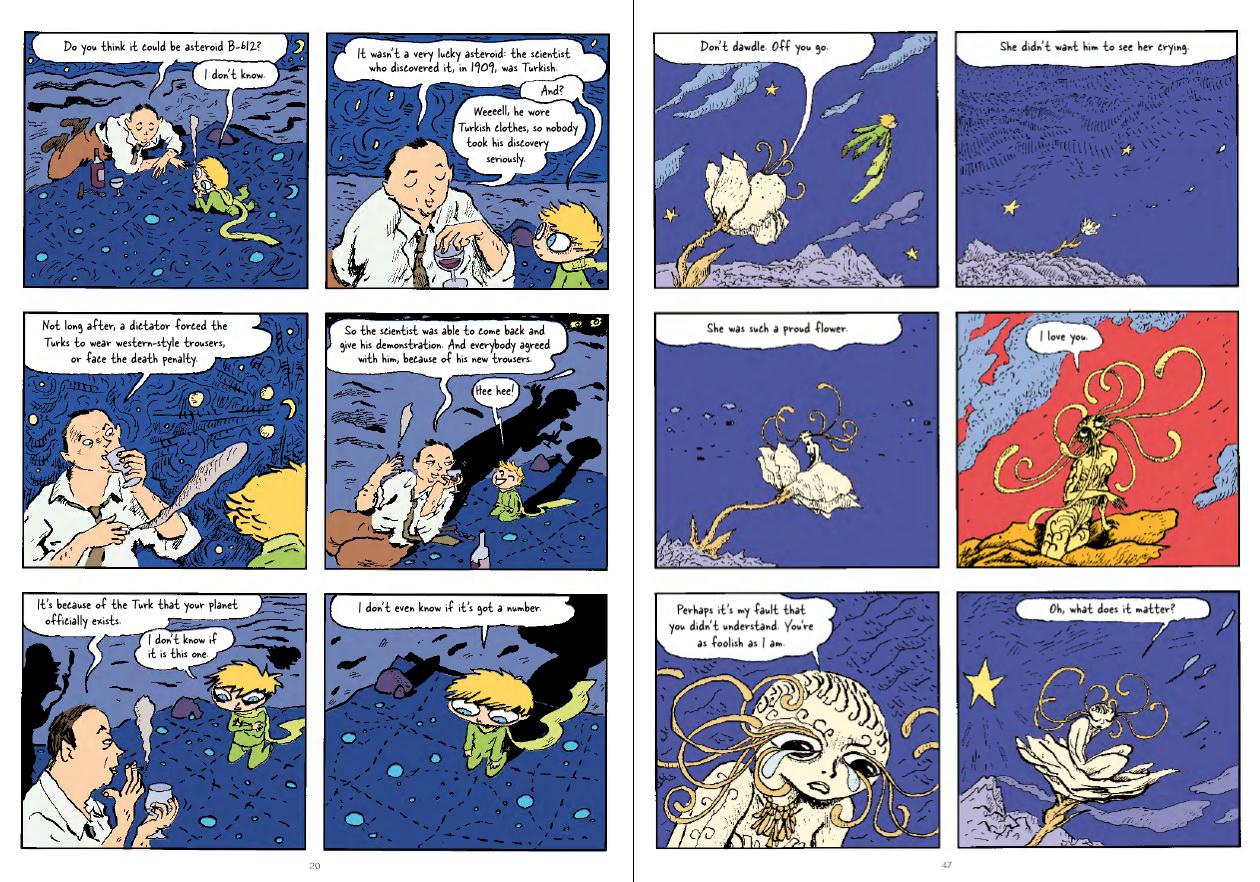
Adapter Joann Sfar has de Saint-Exupéry’s own relatively crude drawing illustrating his novel as a guide, but opts for using his own style rather than modifying it to match the book illustrations, and it’s not entirely successful. Rather than enhancing the free-flowing imagination of the original story, Sfar constricts it into an unvaried grid of six panels per page. It works in accommodating almost all the the original text, but items of wonder such as the vain flower suffer from the restriction when larger illustrations might have expanded the allure. What it does bring out is the sense of scale. Although small on Earth, hence the title, it’s almost always the case that the Little Prince is large when visiting other planets.
The Little Prince is a morality tale pointing out poor behaviour or the nonsense of people wasting their lives on pointless tasks. While the Prince himself is almost a wide-eyed manga character, Sfar’s designs for people he meets on other planets are more imaginative, with the multi-eyed acquisitive businessman and his craft standing out. A multitude of foibles are covered and continued when the Prince lands on Earth, although wisdom is also passed on.
The growing bond between the pilot and the Little Prince is conveyed, and de Saint-Exupéry’s ending is astonishingly unsentimental, but while Sfar’s adaptation charms, it’s competently delivered without ever becoming what it might be. Perhaps a desire to be faithful is the restriction.