Review by Ian Keogh
Orpheus Collar’s adaptation of Rick Riordan’s magical fantasy trilogy concludes with this third volume, the opening line noting only a year has passed since Carter and Sadie Kane discovered their ancient Egyptian heritage. The powers of gods Horus and Isis are channelled through them respectively, and they’ve become embroiled in a secret war threatening the entire planet. It’s taken a toll, but Carter, Sadie and their allies have dealt with those working for Apophis and even delayed his plan to swallow the sun, but he’s gradually working loose from his trap, and attacks on the House of Life refuge are increasing.
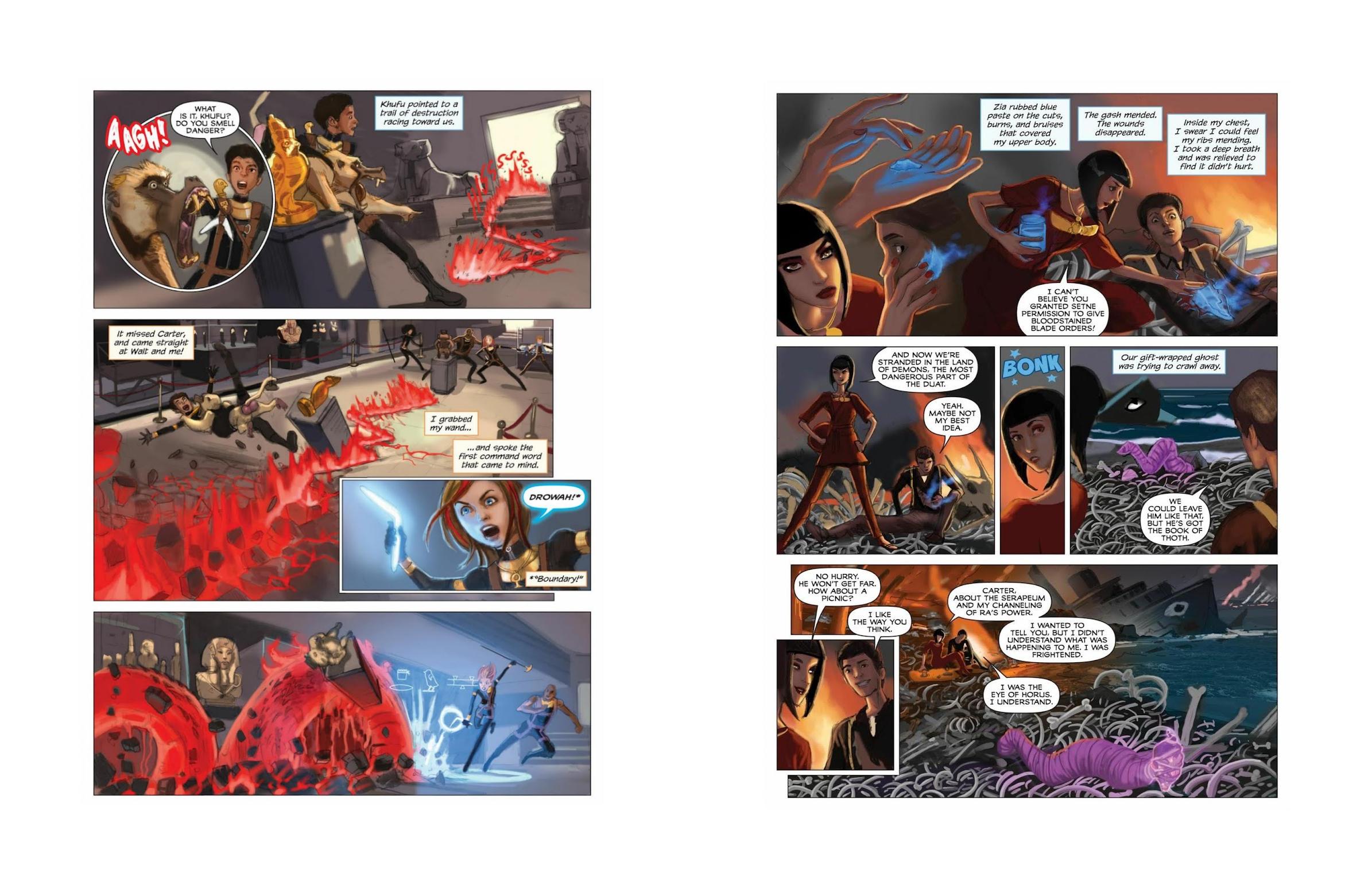
Riordan’s plot is well constructed and it was established in The Throne of Fire that no simple way of ending the threat of Apophis exists. With that major menace hanging over everything, Riordan serves up a multitude of slightly lesser problems, both attacks and personal, enough to keep all the well-intentioned young magicians extremely busy. Extra tension is added via Carter’s growing relationship with Zia, promoting her to greater importance. Disappointments, betrayals and shocks await. Most of the time The Serpent’s Shadow reads very smoothly, but occasional glitches occur, seemingly connected with contracting the novel. The sample art shows Carter’s rapid recovery from life-threatening injuries via magic, and the feeling is that if it’s that simple, why have him injured in the first place?
As with the previous two volumes, Collar follows the pattern of Riordan’s novels by having the narration alternate between the two lead characters, indicated by the blue or yellow colouring of the caption boxes. Visually he again brings a great imagination to transferring Riordan’s prose to illustrations, and truly delivers the action and chaos of the finale, where full pages and spreads featuring multiple characters are instant wall posters. Collar’s art has improved with each volume, and this is another step forward.
However, right at the end there’s a puzzling moment where it seems a character has died, yet they’re restored without any real explanation. Readers wouldn’t have wanted it any other way, but surely it was spelled out in the novel.
Both readers who love the novels and those coming to The Kane Chronicles for the first time should be happy with Collar’s adaptations. The path is certainly that devised by Riordan, but Collar’s faithful to the source while adding a new level of visual fantasy to the novels.