Review by Frank Plowright
Being claimed as central to three religions has made Jerusalem a constant prize for occupation over the centuries, while entrenched religious belief over-rides suggestion of compromise. It’s been Israel’s capital since 1950, but also a partitioned and segmented city since then.
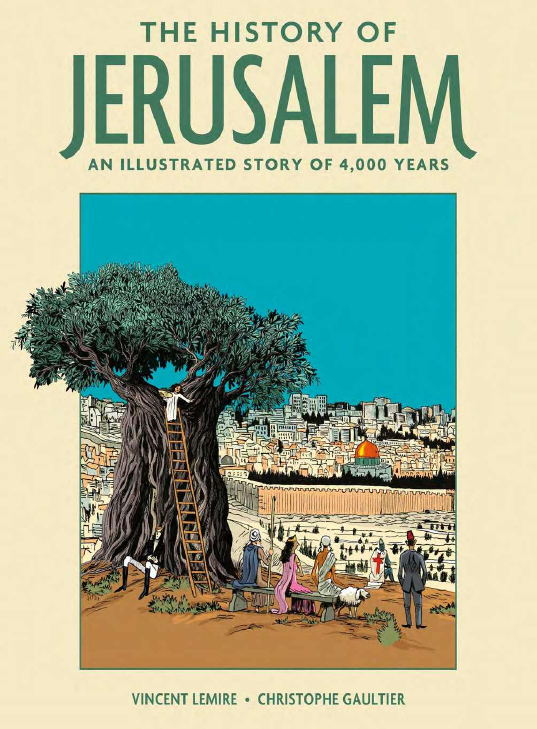
Vincent Lemire is an award winning historian whose speciality is Jerusalem, and he begins his history by pointing out how, geographically, it’s in a strange location for an ancient important city. It’s distant from any ancient trade route, difficult to reach and lacking access to any significant source of water, yet surrounded by three hills. Rather fancifully, Lemire has an old olive tree atop one of them act as primary narrator.
A dense history directly addresses the ‘truth’ of holy scriptures, the tree dismissing some quotes from them as lacking corroborating evidence. In Biblical times, Jerusalem was a relatively insignificant community, and Lemire points out the incongruity of King David choosing the location as his primary settlement along with other lapses of logic. However, it’s all in the context of what can be definitively established, and that’s quite a bit even in the centuries before the Christian era.
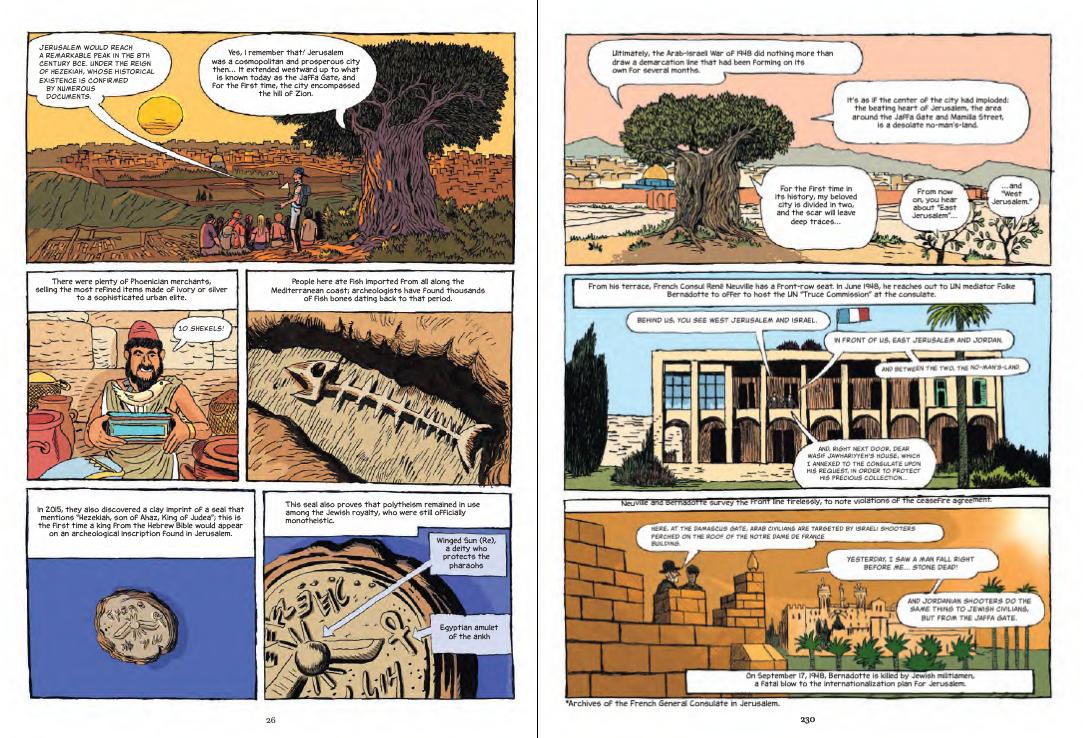
With no continuing plot, artist Christoph Gaultier delivers neat panel by panel illustrations, broadly cartooning, but switching to diagrammatic representations when required. Throughout he has to balance his art around the significant amount of text, and there’s no shortage of places where the art suffers.
Quotes are extensively used from the start, and from the earliest mentions of assorted occupations Lemire presents contradictory accounts when facts may be difficult to establish. When more modern times are reached the content is more likely to be picked apart for indications of bias. One can see regarding events of 1948 for instance how both Arabic and Jewish readers might feel atrocities are understated. However, this is the history of a city in which events occurred, not a history of those events alone, and Lemire provides an extensive list of suggested further reading, although not shy about including his own books.
The density throughout makes The History of Jerusalem an imposing experience, graphic novel form notwithstanding, and a book unsuited to being rapidly devoured. It is, however, extremely informative and offers insight into a city where tragedy has abounded over the centuries and no civilisation or religion can claim the moral high ground.