Review by Karl Verhoven
The Dragons of Paris may begin long in the past, but it’s a form of fairy tale set at the turn of the 20th century and involving mythical beings beyond dragons. The core is the friendship between the wrestling Maori Queen Kopa’akea and a siren she rescues from being sacrificed to a dragon. The curse of the siren is that everyone falls in love with her, which duly occurs.
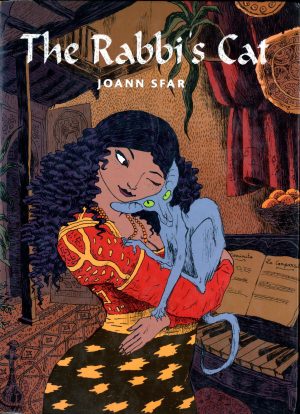
Before then it’s already been explained how a kindly monk named Mabilon in the middle ages has agreed to protect the remaining dragons from humanity. They become the gargoyles and other figures perched on the buildings of Paris. The single exception is the dragon transformed into an old woman caring for a church within which Mabilon sleeps, only to be woken if another dragon should cease being a gargoyle. While they search for whatever set his alarm off, Kopa’akea and the siren attempt to evade a variety of threats. Joann Sfar certainly makes Paris a magnet for the fantastical.
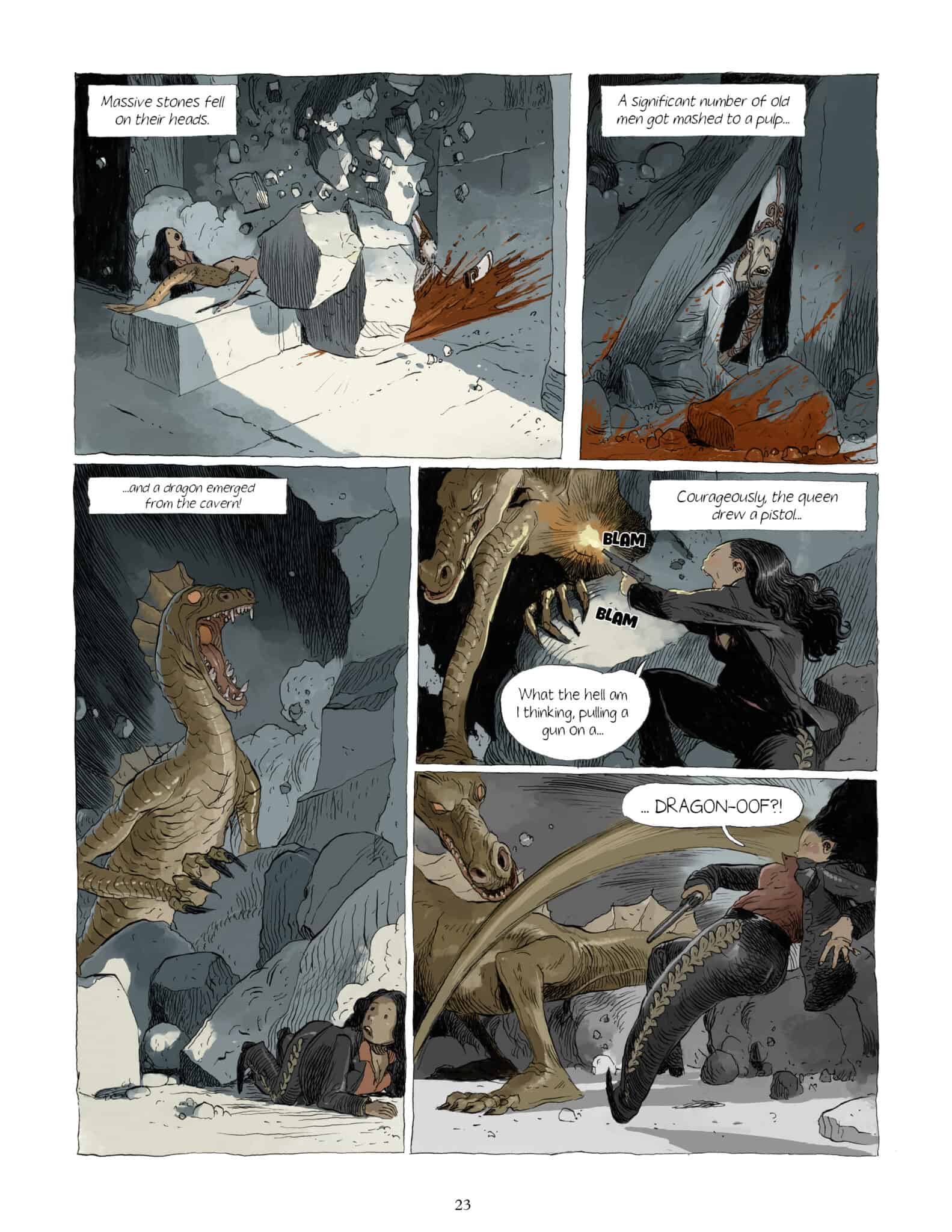
Tony Sandoval draws a selection of eccentrically attractive people with a playfulness about them that matches Sfar’s script. Most folk have large noses, some dripping, and his dragons are uncharacteristically slim, but nonetheless powerful. He has to design a fair few of them. The locations are well imagined, presenting a spooky city with many hidden passages, yet with an attractive sketchy simplicity.
Sfar’s writing veers between a story being told to listeners in a pub and the narration of a fairy tale, using complex, flowery language that sometimes rhymes. The intentions survive the translation, with credit due to translator Dan Christensen. However nudity and swearing also feature, and there are violent sequences graphically shown, so despite appearances, this isn’t aimed at a young audience.
The Dragons of Paris is a weird mixture as Sfar follows his muse wherever it leads, which can be the surreal interlude turning the attention away from the main cast to see a bunch of opportunists sell stolen firemen’s hoses. To whom? “I fry them, cook them and sell them as calamari” says a chef, before bizarrely and offensively adding “for anyone who want (sic) to convert to Judaism I can pass them off as foreskin”!
Building toward an apocalypse, this is very self-aware throughout, although consistently funny in making it’s way toward a concluding moral statement. If you’re happy to follow where the creators lead you’ll enjoy this arch fairy tale, but expectation of logic and consistency will lead to disappointment.