Review by Woodrow Phoenix
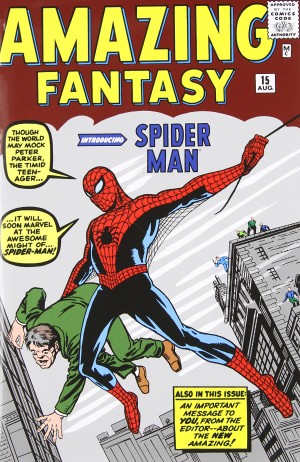
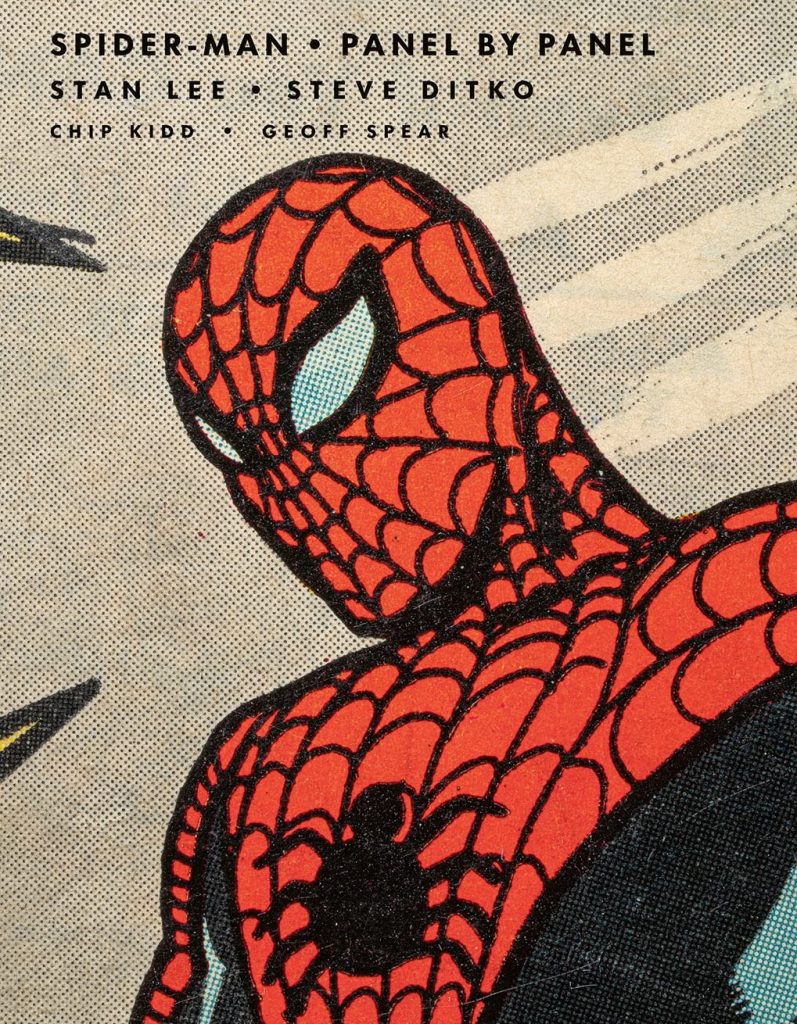
Spider-Man: Panel by Panel is the second of designer Chip Kidd and photographer Geoff Spear’s deconstructions of foundational early Marvel Comics’ issues, and they do exactly the same thing here as they did previously with Fantastic Four No. 1: Panel by Panel. Spider-Man was introduced to the world for the first time in the August 1962 issue of Amazing Fantasy, created by Stan Lee and Steve Ditko, with cover art by Jack Kirby. A year later in March 1963 came The Amazing Spider-Man no. 1 with two more stories of Spidey under another front cover by Jack Kirby.
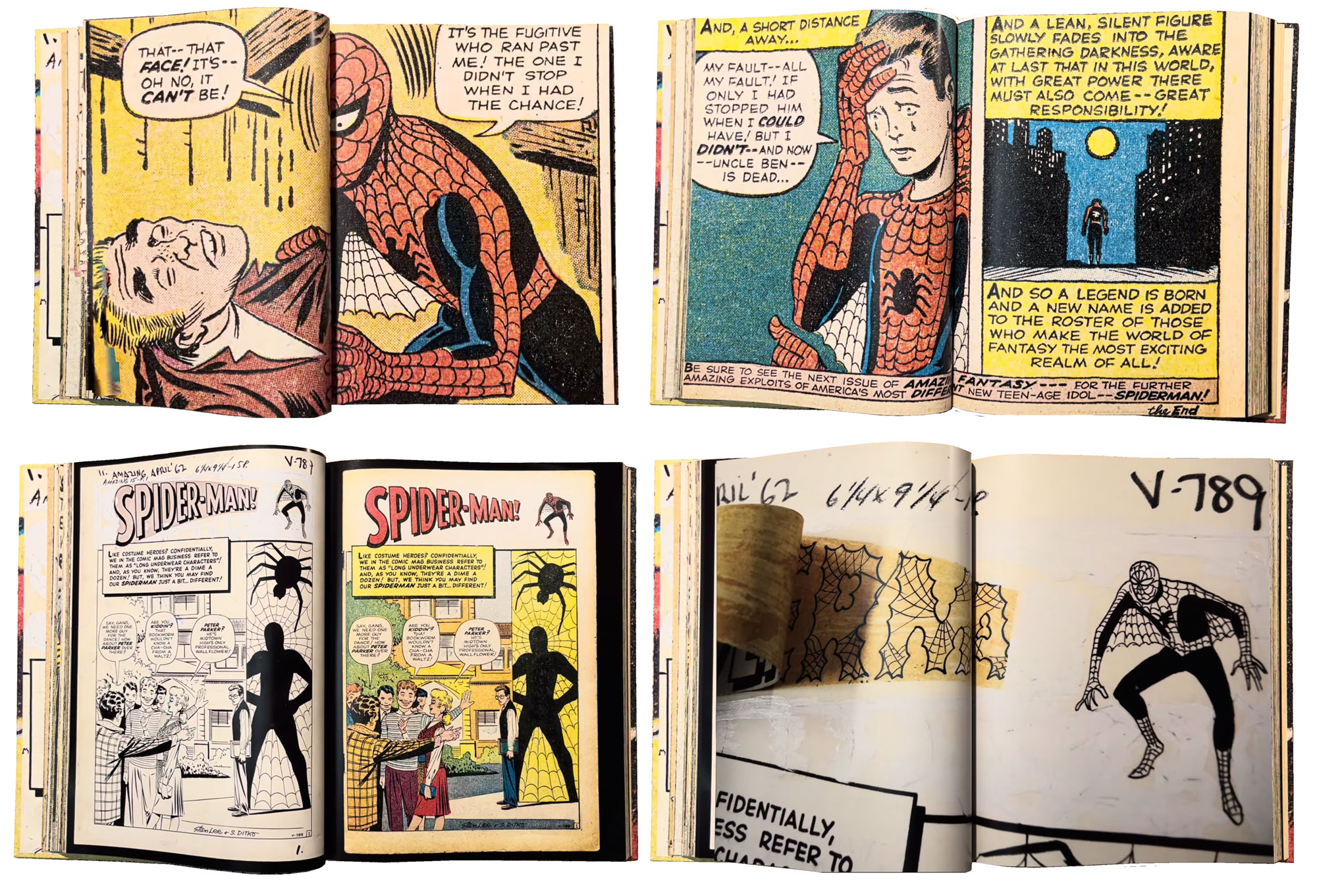
For this project, original vintage copies of these two rare and expensive comics were borrowed from a collector and taken to Spear’s studio in New York where he made carefully lit, very high resolution photographs of each page of both issues; interiors, ads and front and back covers. Chip Kidd then designed a layout to present the artwork zoomed in so that each panel is hugely enlarged, filling a single page or even a whole oversized spread.
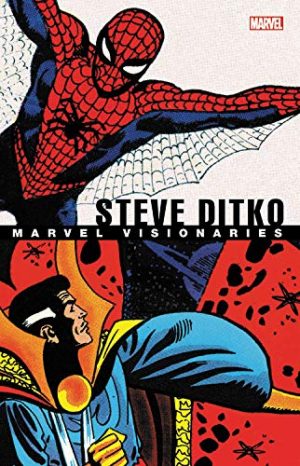
The effect of seeing these old comics panels this way is like holding them right up to your nose, like a child burying themselves in every tiny detail and nuance of the old four-colour printing methods. The dots that make up the coloured inks become visible and their patterns are strong over the drawings. The black inklines become less solid at this scale, revealing varying amounts of paper texture and patches of grain. The drawings become more powerfully odd as they take on almost billboard-like proportions and you can’t breeze past each enlarged panel as you would at normal size. The brushstrokes, penmarks and angular crosshatching that make up Steve Ditko’s strongly graphic images are mesmerising, slowing you down and holding your eye on the page. Comparing Ditko and Kirby’s art is of course a pointless exercise but it does seem that this approach works even more effectively in this book than in Fantastic Four No. 1: Panel by Panel. An extra bonus is that in 2008 the Library of Congress received the pages of Steve Ditko’s original art for Amazing Fantasy no. 15 from an anonymous donor. Those pages have also been carefully photographed to exacting specifications, and like the vintage comics, reproduced here with enlarged close-ups to reveal all kinds of previously hidden details: from handwritten pencil notes to redrawn areas, rewritten captions and other production secrets.
The texts that accompany these images have a similar forensic style. Marvel editor Tom Brevoort analyses each page discussing how the stories were made and what decisions contributed to their final form. Peter Sanderson goes into more detail from a historical and production perspective, and finally Sara W. Duke, curator of Popular and Applied Graphic Art in the Prints and Photographs Division of the Library of Congress, discusses Ditko’s original art pages. It all adds up to a fascinating package, although you don’t need to read any of the investigations to be completely enthralled by the strength of Ditko’s beautifully off-kilter imagery. For those who already know how brilliant this creator was the original art pages alone are worth buying this book for, giving a remarkably privileged insight into this work that makes it feel like a new discovery.