Review by Frank Plowright
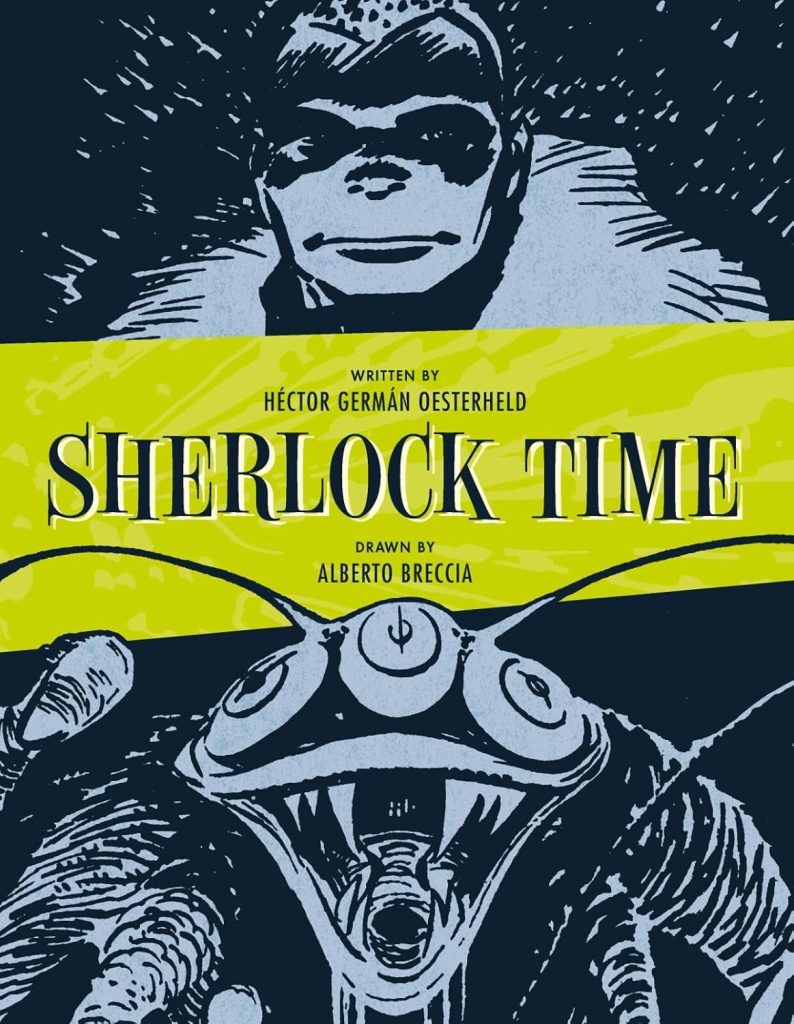
The collaborations of Héctor Germán Oesterheld and Alberto Breccia are legendary, and this was their first, produced in the late 1950s at the same time Oesterheld was working with Francisco Solano López on The Eternaut, a series he’d later reboot with Breccia’s art.
We’re introduced to Sherlock Time, an actual person, via Julio Luna, who’s just retired and bought an old property with a spooky history. He’s almost trapped by it, but extricated by Sherlock, who introduces himself as a detective covering time and space, which he describes as inseparable. It’s the type of casually thrown-off concept with no further explanation typifying the series. We’re later told there are places where the future doesn’t exist.
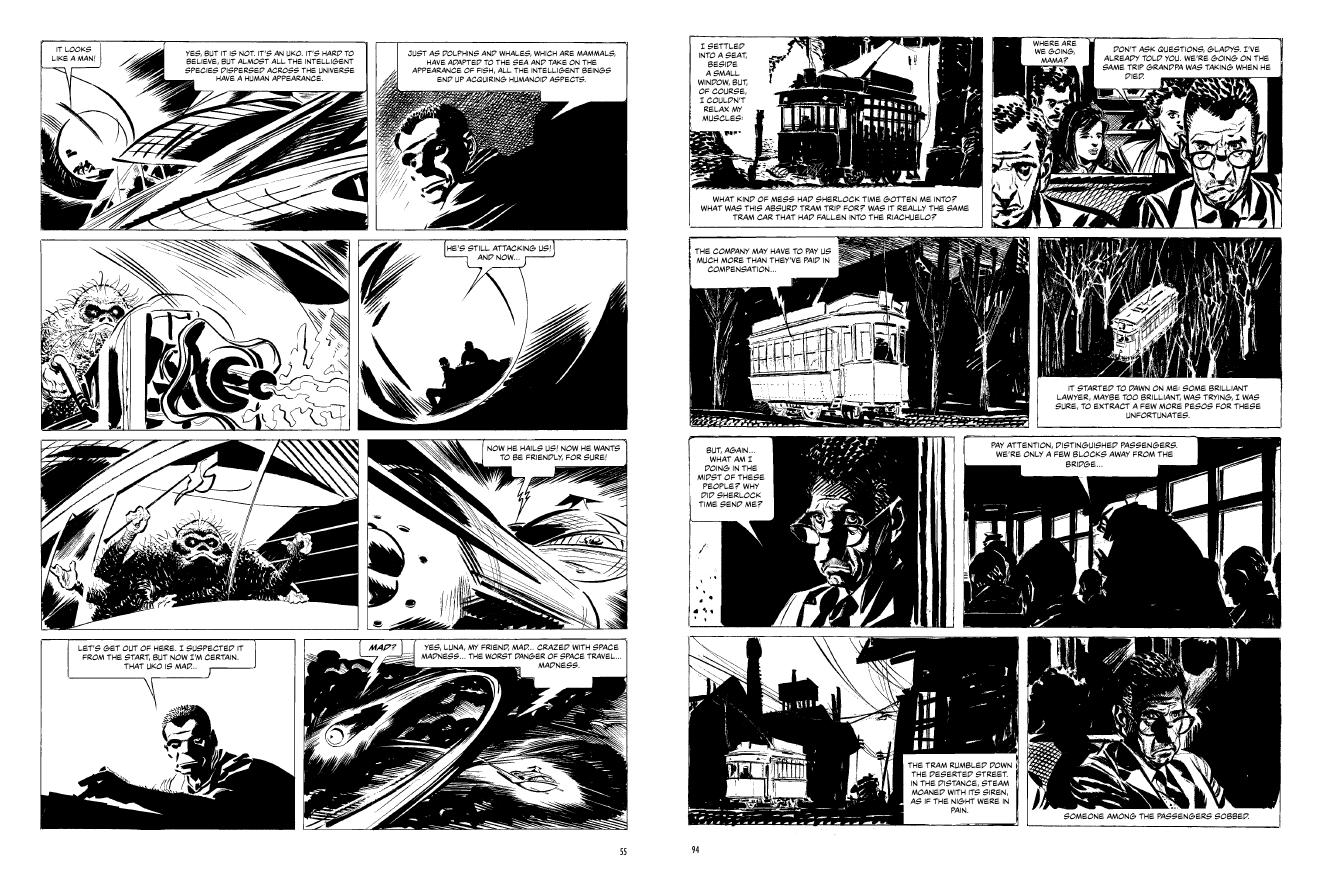
While considered a series of science-fiction stories, writer Oesterheld makes a statement from the start by introducing Sherlock Time with two homages to the horror chillers of Edgar Allen Poe. This is complete with flowery language well translated by E. Rowan Mena. Only then do we progress to some SF adventures, although they’re of a unique and distanced type, dealing in abstracts muddied by technobabble, with Oesterheld not wedded to the form. If a more earthly mystery attracts Sherlock he’ll pay a visit to the racetrack to figure it out. We never quite figure him out, though. He has a knowledge far in advance of humanity, yet also on occasion a curious lack of compassion, but never tires of providing explanations to Luna rather than going about his business on his own.
As the series begins, Breccia’s not quite the artist he’d become, although already greatly experienced and a master storyteller. As the stories switch moods, so Breccia switches his approach, with less black ink used for the straight SF material, and he becomes more creative and occasionally experimental as Sherlock Time continues. To offer perspective, the peak of American SF comics in the late 1950s was the work of Murphy Anderson and Carmine Infantino, both good, but working within limited parameters. Oesterheld’s plots can occasionally mine similar territory to those supplied to Anderson and Infantino, but Breccia creates greater mood and has licence to draw the woman who turns out to be a robot so much more imaginatively.
Although the feature is named after Sherlock, he’s not the key character. Luna isn’t just the introduction to the series, he’s the focal point, an everyman supplied with glimpses into a world that’s not his, often fainting from experiencing the impossible, only to awaken safe back at home with Sherlock providing an explanation as to what happened. The approach of telling rather than showing is at first novel, but over a dozen stories the wish is for fewer philosophical musings and greater spectacle.
It’s provided in the final stories, one a more traditional thriller mystery in an Antarctic crevasse, and at 49 pages in landscape format, the longest inclusion here, reading as if a serialised American Sunday newspaper strip. The final strip is only six pages, but packed with incident as Earth’s end is on the menu.
Taken in its entirety, Sherlock Time is a maverick strip with some moments of greatness, but the constant shifts of tone and approach make it difficult to cherish as much as other works by Oesterheld and Breccia.