Review by Lewis Savarese
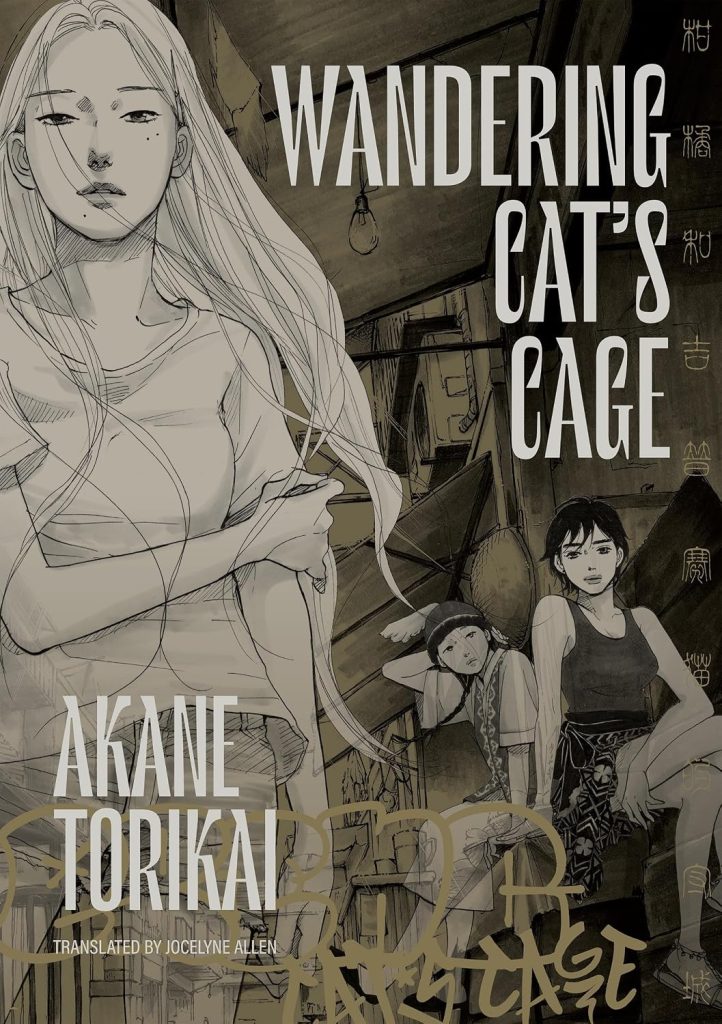
This josei manga, translated for the first time in English by Jocelyne Allen, envisions a dystopia where reproduction is controlled by a matriarchal elite from the safety of their tower blocks in Town. Across the river on the margins of society, live the women of Not Town and the only male resident, Reiho. An acupuncturist named Sanada, along with outcasts Ejima, Kanan, Kiri, and Jun, form Reiho’s motley found family.
For the thirteen chapters of Wandering Cat’s Cage, Akane Torikai offers a masterclass in speculative fiction. With each chapter she slowly reveals aspects of a world that at first glance resembles our own, divulging just enough of its idiosyncrasies to keep you hooked. Reiho’s unique position as the only man in Not Town becomes even more intriguing as we learn that most women have never seen a man, nor do they know the differences between men and women. The women in Reiho’s life are exceedingly confused by what he does at night with his female clients from Town. It takes several chapters before the link between Reiho’s sex work and the captive breeding program operated by the Health Ministry in Town becomes apparent. Torikai manages to add some levity to the somber subject matter as Sanada and the girls routinely speculate about what makes men different, at one point comparing a hypothetical male member to a steamed dumpling.
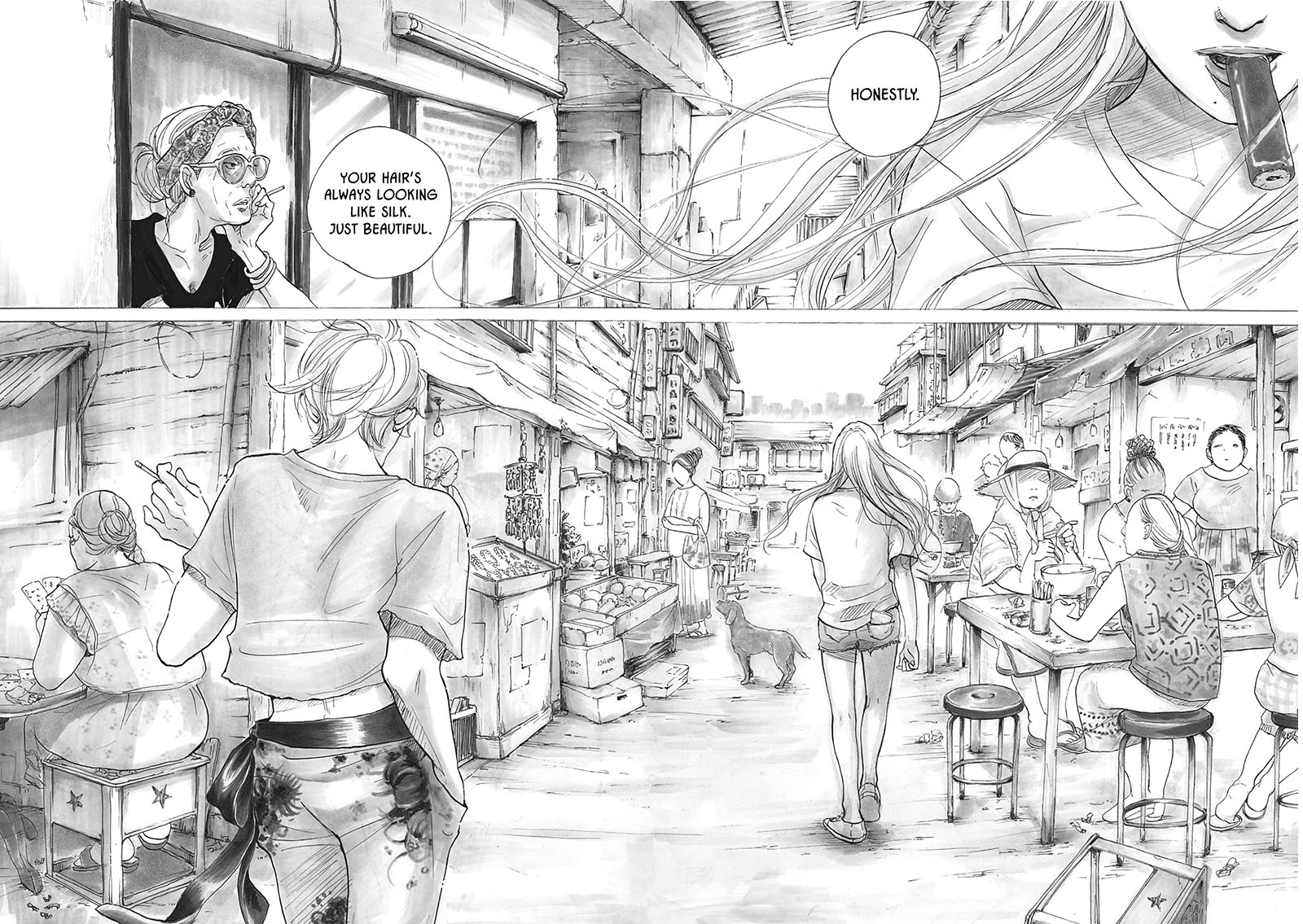
Torikai renders Not Town as a fully lived-in place with a communal ethos. Jobs are scarce in Not Town, so residents do what they must to survive. To help their family, Kanan and Kiri scavenge while Jun finds her calling as a seamstress. The remaining women who populate Not Town are all older, and everyone seems to know one another. Torikai’s attention to detail is keen, filling every panel with details of how these women live: cramped streets jammed with stalls, washing lines criss-crossing overhead between stout buildings arranged haphazardly. The linework and washes bring this community to life. In contrast, Town is a sterile city, emphasised with tall panels depicting orderly spaces. There is a motif of birdcages in the Town sections that at first feels a bit too heavy-handed, but the batting cage motif in Not Town provides a poignant ballast.
The majority of the narrative is kitchen sink realism with a twinge of science fiction, centered by feminist philosophy. Besides the daily life of Sanada and Reiho’s family of misfits, we spend time with Mirai, the daughter of a Health Ministry scientist in Town, and Sanzo, a member of the Town’s ruling family. The autonomy of the individual, or lack thereof, in an authoritative state is a throughline for each character. Bodily autonomy, especially reproductive freedom, is examined through the lens of science fiction in Wandering Cat’s Cage, but what’s discussed are the realities women face globally today. Torikai presents an astute observation towards the end, that liberation is not possible as long as we deny our fellow humans autonomy, no matter which gender holds the reins.