
Review by Frank Plowright
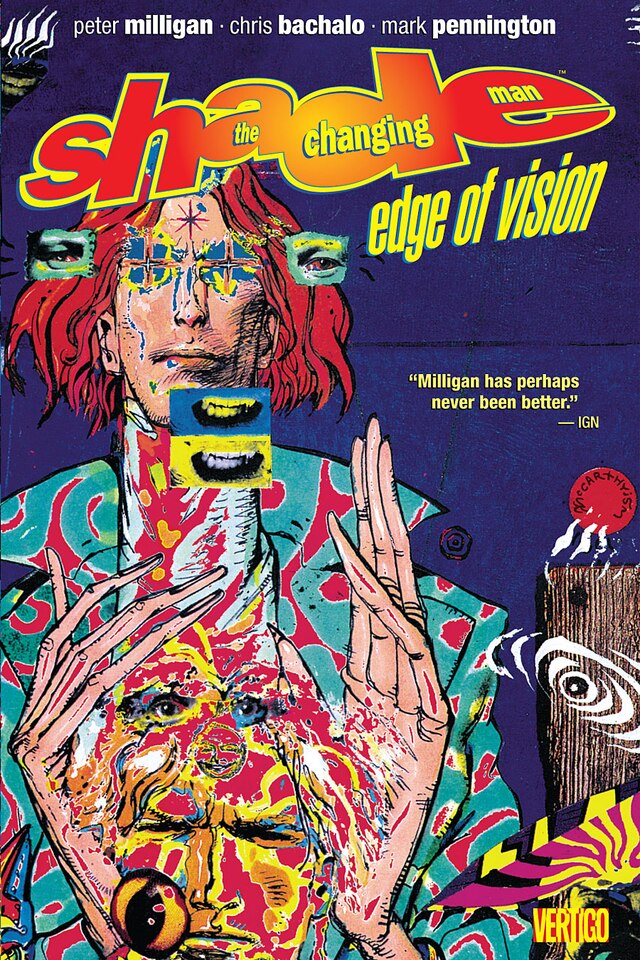
Shade the Changing Man was intended as a limited series, but the power of Peter Milligan’s imagination, his twisting of already strange concepts and his skewed view of the USA proved a heady and hallucinatory mix and the series continued from The American Scream.
A catalogue of American personifications continues to be funnelled into Shade via Milligan, distorted through the hallucinatory prism of Shade’s drawing madness from another dimension. It’s an explanation as to how practically anything can happen such as Kathy and Shade going to sleep on one coast and wakening on the other. Theirs continues to be the uneasy relationship of other dimensional human with partial memory loss inhabiting the body of the man who killed Kathy’s boyfriend. There’s a pretence of crime drama with Shade being tracked by a suited law official, but Milligan has no real interest in such a conventional idea when able to explore the unusual. Edge of Vision’s weakest section is the concluding horror of a serial killer returning, which heads into unusual places – those with triggering issues beware – but doesn’t ever transcend its origins.
Milligan’s prose occasionally strays a little too far into indulgence, but he’s attempting something different, and his conceptual uniqueness transmits across the decades. The gap between Shade’s publication and today is longer than that between 1960s hippie-era San Francisco and the 1991 serialised comics, yet the cultural touchstone remains strong. The same applies to the hypocritical normality pedalled by 1950s US TV, amusingly shredded here.
The strength is amplified by Chris Bachalo’s ever more confident art, showing an immense learning curve. Taking his lead from Shade’s distinctive coat, Bachalo’s now incorporating design elements, can now better show what the cast feel, and there are now moments where Daniel Vozzo’s colouring transcends its era, especially in the San Francisco sequence. Bill Jaaska’s art for a single chapter tells the story well, but lacks Bachalo’s imagination.
Edge of Vision’s legacy element, though, is the introduction of Lenny, a supporting character who pushes herself into the spotlight and transforms the series. The traumatised and struggling Kathy has her place alongside the less traumatised Shade, who’s also struggling, but Lenny’s confidence and eccentricity plays off Kathy and Shade. Already interesting, her personality is yet to be fully defined, but she’ll blossom gloriously in Scream Time.
Given the first three paperbacks are good, but the series improves, you’d be better investing in the first Shade the Changing Man Omnibus. It combines the paperbacks and heads far further into a notable series.