
Review by Frank Plowright
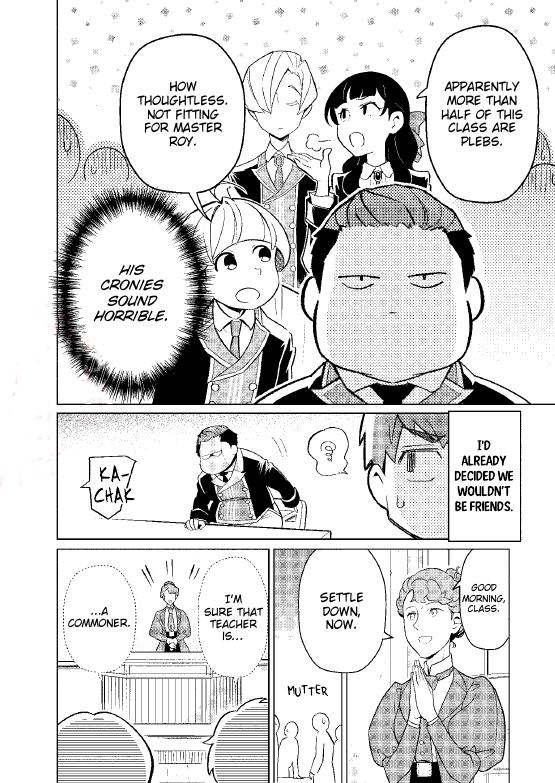
A title like School for Wizards leaves no doubt as to what the inspiration is, so the twist provided by Yuhi Ueno’s original webnovel is extending the privilege and entitlement of Draco Malfoy throughout an entire school. Two grand families live on the island of Altiria, and the Avarums and Superbias are conflicting political dynasties, represented at Altiria Academy by Roy Avarum, seen on the sample art, and Van Superbia. It’s later explained that the political affiliations of secondary families determine their status, and everyone is taught to despise commoners. Van, though, can’t see the sense of that, and treats everyone equally.
An opening chapter does little to dispel a lack of originality, but Ueno drops one hell of a bombshell to end it. Strangely, though, instead of exploring the idea of Roy originating on another world, it’s all-but forgotten other than spurring him on to learn magic at eight, earlier than would usually be the case. Then even that’s forgotten for an extended sequence founded on the subtleties of the rules aristocrats perpetuate to distinguish themselves as supposedly superior.
Adapter and artist Yunagi has a neat style defining characters with an admirably delicate line, and there’s something amusing about young children always dressed in their finery, complete with top hats. There seems a joy in drawing old-fashioned cities in a culture lacking technology, and when the monsters turn up they’re suitably fearsome.
Old Enough to Learn Magic! is a peculiar book, with both title and subtitle selling a series on the basis of magic, and then barely featuring any. Perhaps it’s a casualty of adaptation, Ueno’s original story not featuring the proper magic until later, but pages of characters analysing social interactions in terms of aristocratic expectation isn’t going to be anyone’s idea of an adequate substitute. Good art distracts, and Roy’s progressive character is the highpoint, but readers will expect more actual magic next time.


