Review by Roy Boyd
The Mascot, introduced readers to jail guard dog Rin Tin Can. That is, unless they’d already encountered the canine from his earlier appearances in the pages of Morris’s most famous creation, Lucky Luke. The Godfather continues the solo adventures of “the dog dumber than his own shadow”, a play on Lucky Luke’s tagline of shooting faster than his own shadow.
The story begins in the penitentiary, with Rin Tin Can capturing an escaped convict. Needless to say, this is entirely by mistake, as our canine hero almost always misunderstands what’s wanted of him, and any success he has is usually of the happy accident variety. This invariably leaves the humans with a far higher opinion of his abilities than he deserves.
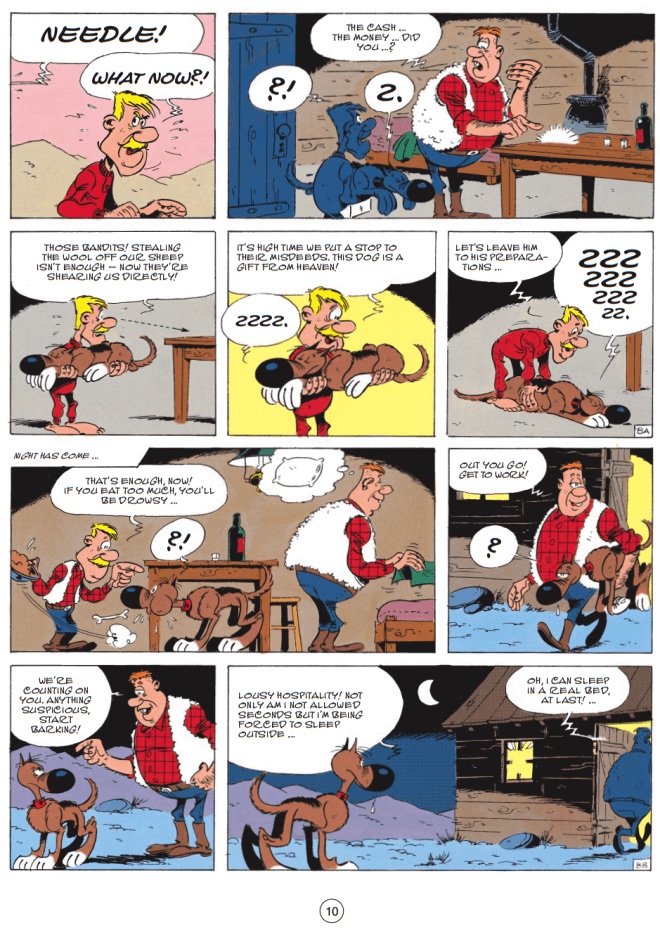
Mistakenly thinking he’s going to be chained up, Rin Tin Can sets out on his own and, in two shakes of a lamb’s tail, he’s living with a couple of sheep farmers. Bandits have been shearing their sheep, and our hero soon tangles with the culprits. It transpires they’re shearing the sheep because they’re looking for a map to buried treasure their bank robber father tattooed on a sheep. There then follows a painfully tortuous series of misunderstandings, unbelievable coincidences and many moments of confusion, mayhem and high silliness. Occasionally the writers, Xavier Fauche and Jean Léturgie, attempt to make a point about something, like the rapid growth of civilisation in the Wild West, but mostly they’re far more concerned with providing an endless series of gags.
The book’s title is a strange one. Readers might reasonably expect a story with at least shades of Mario Puzo’s famous book of the same name – or the even more famous movie – they’ll be sorely disappointed. Instead, the title refers to a plot device introduced for no apparent reason, and then dropped entirely without any further explanation.
Belgian artist Maurice de Bevere (better known as Morris) has a style that remains largely consistent throughout his career. Panels are better filled than in the previous volume, with less sparse backgrounds. However, this book actually predates the first volume by thirteen years, so there’s not really much point trying to discern any trend in his development.
The fact these adventures can appear in any order serves to highlight one of the strengths of these stories: the reader needs no previous knowledge of characters or what has gone before. Undemanding and silly, this book is most likely to be enjoyed by younger readers (or Lucky Luke fans). The next book in the series is A Dog’s Ransom.