Review by Frank Plowright
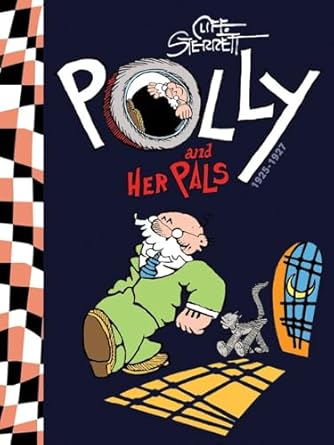
Cliff Sterrett doesn’t quite number among the earliest newspaper strip cartoonists, but a solo career begun in 1912 didn’t start long after. However, despite a dozen years of accomplished cartooning before a rapid developmental curve leading to a period of still remarkable Sunday pages, Sterrett remains a name known primarily to enthusiasts. Polly and Her Pals eludes the national consciousness aware of Krazy Kat, Peanuts or Calvin & Hobbes.
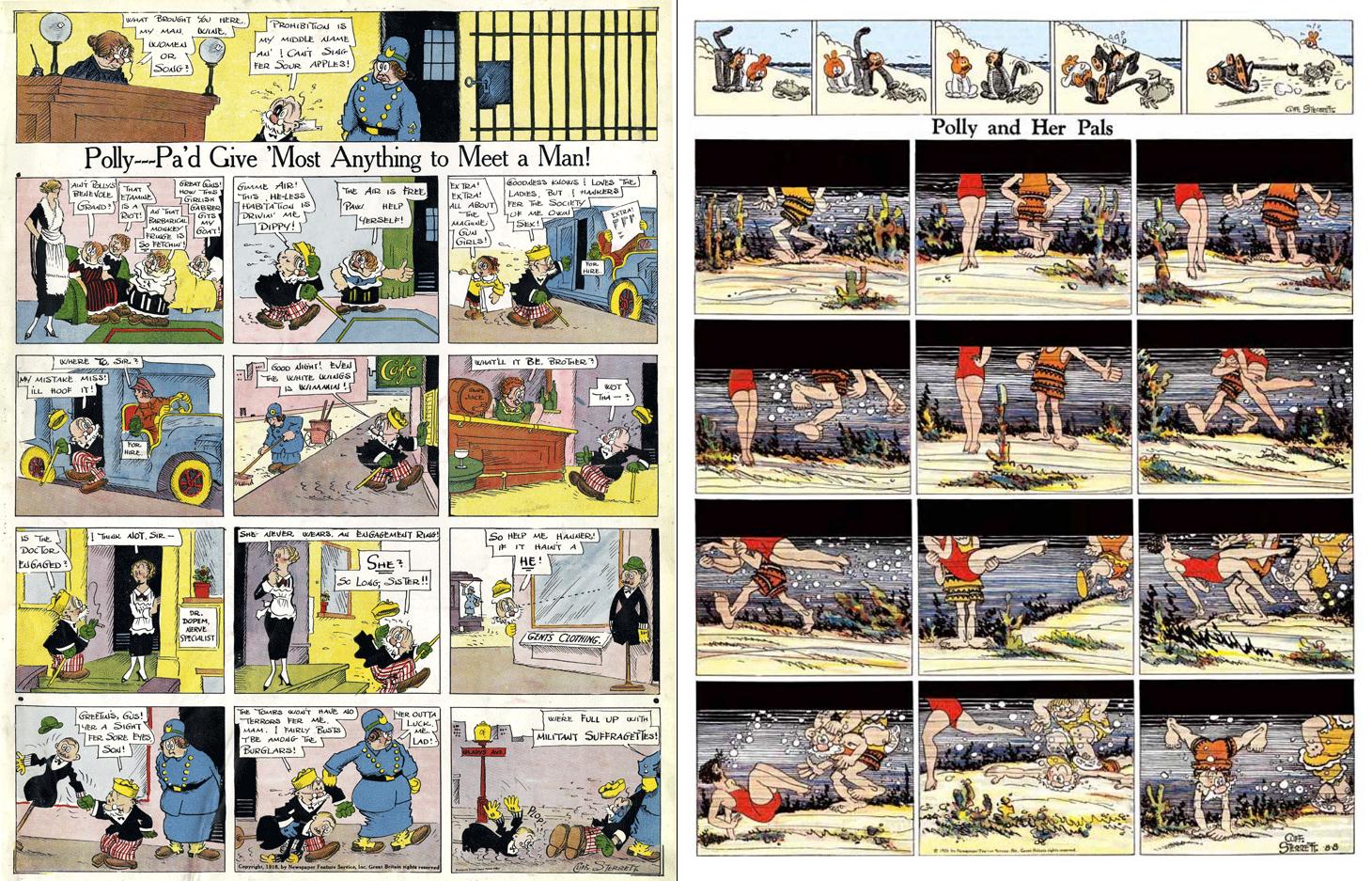
There’s comparatively little biographical information about Sterrett, but what is known is that he took a six month sabbatical from his strip in 1925, and relatively shortly after his return devised a new approach. Instead of being content with producing good examples of the era’s stylised cartooning he began incorporating forms of modern art, then little known to readers outside the East Coast artistic elite. The pages abound with eye-catching decorative style raising the slapstick strips to an artform.
A slightly misleading title suggests this volume is all-encompassing. It isn’t. Two strips per year going forward from 1913 serve as samples, while Sterrett’s pre and post sabbatical Sunday pages from 1925 onwards are comprehensively supplied. It’s the right choice. As the 1918 sample art shows, the earlier pages feature many jokes either uninspired or of their time perfectly well drawn, but rarely any more, although it’s not as clear-cut as the sabbatical being all-important. Already beforehand there are bolder page compositions, strange art deco lamps, Sam’l Perkins’ loud suit and an increasingly stylised cat. And let’s be grateful for 26 pages of good art that’s not been seen in over a century in some cases and almost that time for the remainder, while earlier pages from 1925 haven’t previously been reprinted either.
What the later work does, though, is reconcile the contrasting aesthetic that’s always been present between slim fashion peg Polly and her dumpy cartoon parents. Throw them into surrealism or absurdity and the awkward meshing of two styles evaporates.
Despite being the title character, Polly is largely irrelevant to the Sunday pages, her presence merely a conduit for a succession of boyfriends to annoy Pa Perkins in his own home. He’s the star of this work, a bumbling vehicle for slapstick mishaps and embarrassments drawn in an ever more creative fashion. A trademark borrowed by the underground cartoonists of the 1960s is the soles of his shoes shown at a 45 degree angle when walking, and they also looked closely at the energy and movement. He’s placed in ever more surreal situations as his surroundings almost curve and bend around him, while windows constantly feature as eccentrically criss-crossed.
The jokes are increasingly well constructed, many around the subject of potential social shame, the art is phenomenal, and this oversized collection presents it to its best advantage. Material from 1926 and 1927 was previously available in a slimmer edition, but reproduction and restoration techniques have progressed considerably since 1990, and the pages here are approximately three inches taller and 1.5 inches wider. Also featuring 15 pages of contextualisation and biographical information along with additional art from Sterrett, this is the go-to version for the strips to 1927, although matters aren’t quite as clear cut when it comes to next volume 1928-1930.