Review by Ian Keogh
As One Small Break opens, Peter Parker is mourning the death of his wife, and the creative team of Paul Jenkins and Mark Buckingham are really kicking into high gear.
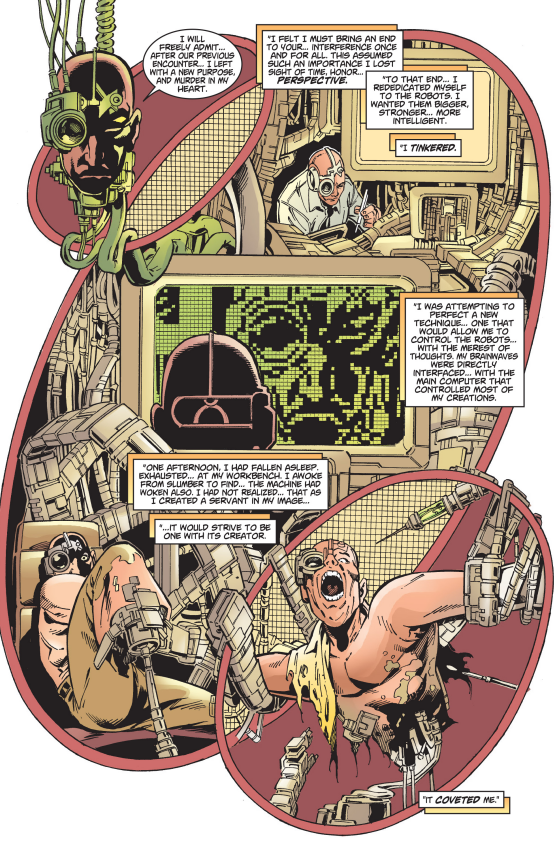
Throughout his writing on Spider-Man over several titles Jenkins seems to have adopted a pattern of featuring classic villains one by one and taking a look to see what makes them tick. Only the single chapter was required for Sandman in A Day in the Life, so it may surprise that two are required to assess Professor Mendel Stromm, creator of bespoke robots in 1960s stories, but long considered redundant. Jenkins, though, has found a way of making him relevant again in a story beginning with wild electrical surges. Stromm’s connection is sinister, unpredictable and brilliantly drawn by Buckingham as per the sample art, while providing Spider-Man with a disturbing ethical problem in what’s quite a prescient story given later real world technological developments.
The captions Jenkins supplies for Peter’s own thoughts zap all over the place, but continually entertain. It’s a gradual revelation how good an ear he has for supplying realistic thoughts. Jenkins does tend toward downbeat introspection, but then that’s Spider-Man’s life.
New villain Fusion occupies Spider-Man’s attention over the longest story. The intention is to show him completely outclassed by a villain able to draw on pretty well any super power from other Marvel characters, but over the first two chapters the improbable genie’s wish list of powers without a credible explanation undermines the drama. The final chapter, though, succeeds in transmitting uncomfortable brutality and a clever explanation.
It’s followed by Peter commemorating the death of his Uncle Ben by taking a trip to a Mets baseball game and recalling visits there as a child accompanied by his Uncle. It’s unashamedly sentimental, yet avoids being cloying, although as Spider-Man doesn’t feature it may not appeal to everyone.
Jenkins and Buckingham conclude with a whimsical story of a super powered child raised by monks and Peter on a date that goes inventively wrong. This time Spider-Man’s not to blame. It starts well, but rather drifts away, largely due to a derivative threat.
Buckingham’s art throughout is magnificent, with some innovative page designs. In the light of his later acclaim it’s worth looking back here for that alone, never mind the clever plots. With this collection long out of print, it’s perhaps worth heading to Light in the Darkness for these fine Jenkins and Buckingham collaborations. Be warned, it does feature the work of other creators.