Review by Karl Verhoven
Mind vs. Machine is an accounting of chess master Garry Kasparov’s 1997 games against IBM’s Deep Blue computer programmed to play chess. Although well publicised at the time, the initial consideration is of this being rather a niche topic for a graphic novel, yet co-writers Maurice Ashley, himself a chess grandmaster, and Steve Sheinkin ensure that’s not the case. They contextualise the encounter not just via the sensationalism of man against machine, but via historical precedent and Kasparov’s single-mindedness. Interviewed before the games he noted fears of computers controlling human lives in the future and claimed “I want to be the man who saves our pride”.
Even although everything occurred within living memory for anyone over forty, it now seems rather quaint, both as an ideal and in underestimating how quickly AI would evolve, although Kasparov was hardly alone in that. “I never lose”, he claimed. Ashley part in proceedings is as the match commentator, a role is given greater prominence here by virtue of his narration explaining moves and problems as they occur.
For anyone not familiar with competitive chess Ashley and Sheinkin provide an instructional text, such as explaining how players have a timed two hours to make their first forty moves. Rather than become bogged down in moves, precedents and consequences, though, the story spreads far and wide. Kasparov and his extraordinarily analytic mind is seen competing in the Soviet Union, then later Russia where competitive chess is a respected sport. Along the way we learn the history of chess and some competitor eccentricities, Ashley’s own rise to prominence and the work of primary Deep Blue engineers Murray Campbell and Feng-hsiung Hsu among other topics.
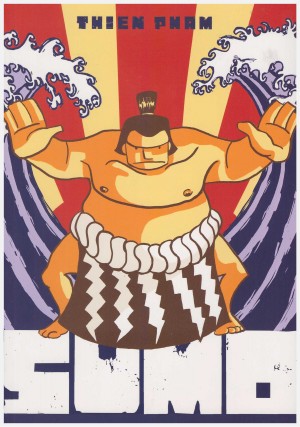
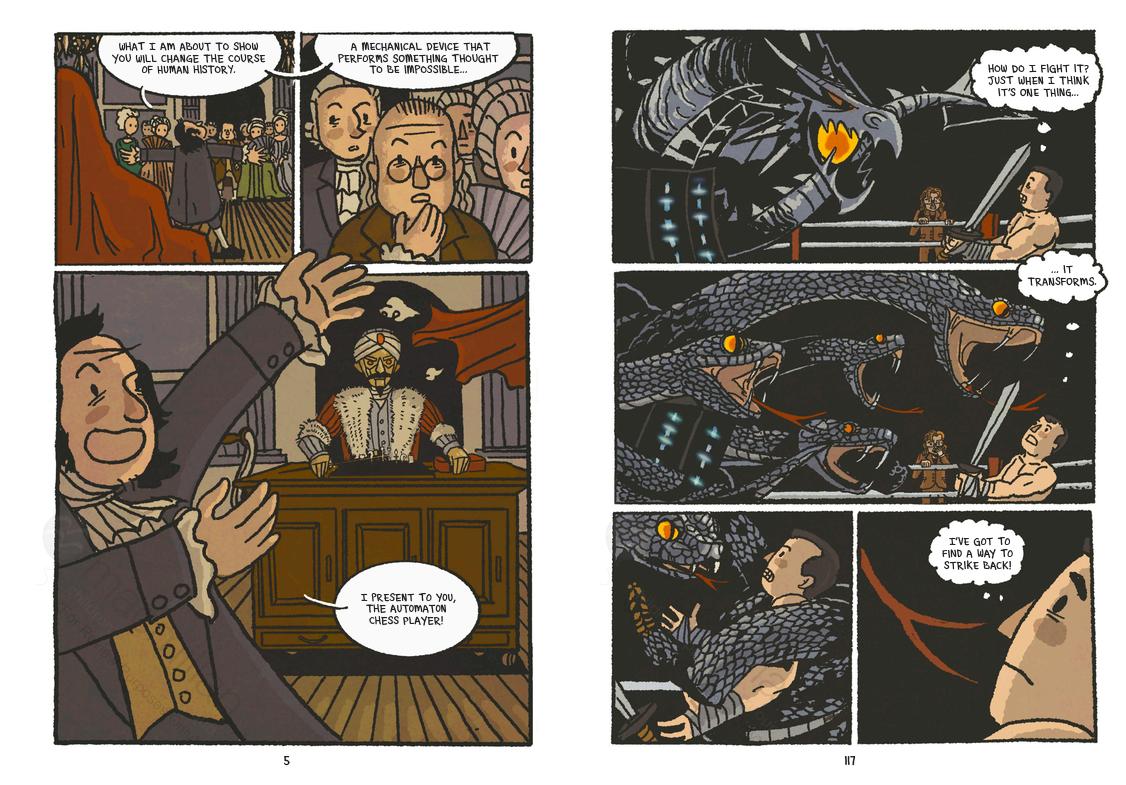
Thien Pham approaches what could be a dry subject with tidy cartoon avatars of everyone involved and places them in fully detailed locations. This neatness overcomes the favouring of brown as a fundamental colour, which is the case both in the present day of the 1990s and visits to the past, such as mention of Alan Turing’s theoretical chess program. On occasion Pham also delivers a memorable symbolic page, and his unsmiling Kasparov under increasing pressure is strong.
The jokey banter of the pseudo-sports commentary wears thin, but it brings readers along by explaining Deep Blue’s capabilities, most importantly how it computes outcomes so much faster than even Kasparov’s mind. Also relevant is a computer never tiring, nor needing breaks.
In a neat comparison the authors note the chess programme on your phone would now defeat a human chess grandmaster, but did that happen in 1997? Readers who don’t know the result are going to be drawn along in wondering if Kasparov did save humanity’s pride, and those who do by his compelling single-minded competitiveness.