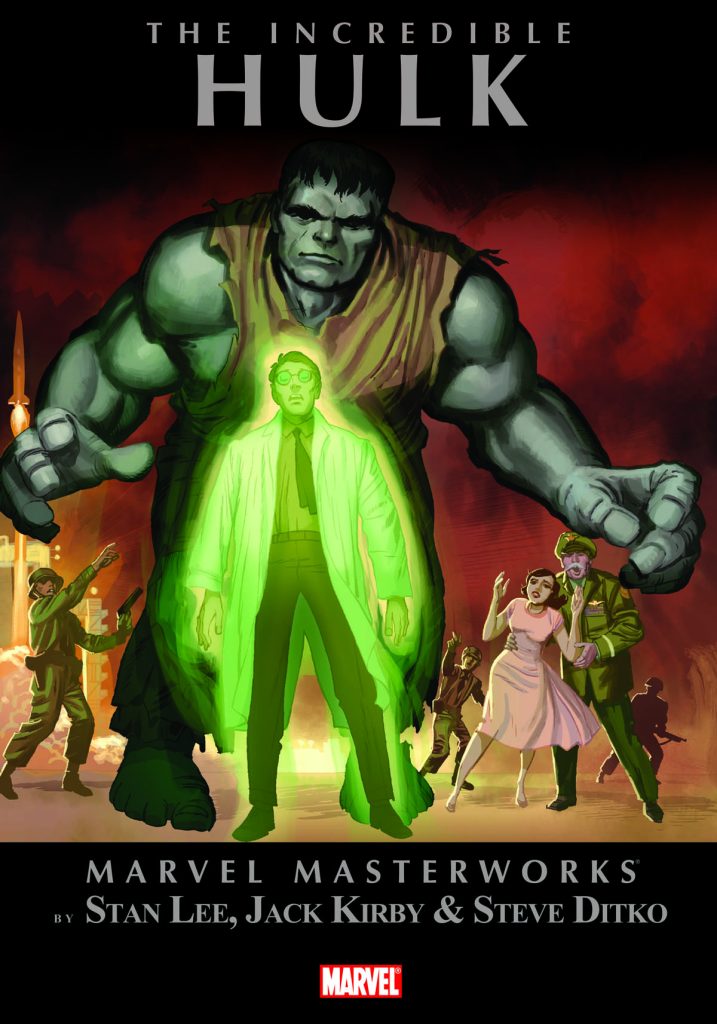


Review by Ian Keogh
The Incredible Hulk is now so widely known, it’s weird to look back to these stories from 1962 and 1963 and realise they were considered failures at the time. While the Fantastic Four, Thor and Spider-Man flourished, the Hulk managed six solo issues before his series was cancelled.
Hindsight reveals flaws, but it’s no better or worse than other early Marvel, so difficult to work out why it failed. Stan Lee and Jack Kirby’s origin connecting dedicated scientist Bruce Banner with flippant teenager Rick Jones via Banner’s gamma radiation-created alter ego the Hulk is supplied in a compact five pages, yet with all core elements of the subsequent series in place. Fashions and slang have dated, but the personalities are readily understood, and it remains a clever updating of the Dr Jeckyll and Mr. Hyde scenario, elevated by Jack Kirby’s character designs and technological noodling.
Thereafter the Hulk faces a series of menaces no less engaging than those seen in other early Marvel titles. There’s Soviet Communist threat the Gargoyle; Earth invaded by Toad Men; The Ringmaster and the Circus of Crime; Alien invader Mongu; subterranean narcissist Tyrannus; Chinese Communist warlord General Fang and the Metal Master, a sort of proto-Magneto. Simultaneously there are attempts to control Banner’s transformations into the Hulk with Jones the only person aware they’re the same person as Thunderbolt Ross rages against the monster threatening his military base unaware it’s the alter ego of the meek scientist he bullies. Ross’ daughter Betty has little personality beyond being the unattainable perfect woman for Banner, but reading these earliest stories again shows how far later creators would mine them for ideas.
A classic art team of Kirby inked by Dick Ayers delivers power for most of the volume, but some may prefer the greater artistic subtlety of Steve Ditko on the final story. His Hulk is more squat and human, although still palpably power-packed, and the surrounding cast aren’t as caricatured as under Kirby.
The greatest clue to the 1963 failure is Lee constantly tinkering around the edges, introducing ideas without considering their limitations. The Hulk’s initial transition is into a grey monster, for instance, which is hardly a way to make him stand out. Lee’s also uncertain about the transformations. Having Banner remain human during the day and only becoming the Hulk at sunset is the initial pattern, but it’s constricting, and a succession of alternatives follow. In rapid succession transformations are controlled, Banner is in charge and then Jones dictates what the Hulk does. It’s messy, but the surrounding elements still work.
Narrative uncertainty and dated aspects detract to a degree, but when everything gels, as in the origin story and the battle with the Metal Master, the power of the Hulk is undeniable. After these stories the Hulk would spend eighteen months as a menace in assorted other titles before Lee and Kirby relaunched his own series in the material collected in Volume 2.
Failures these stories might have once been, but the origin story is now among Marvel’s most reprinted. They’re combined with the Hulk taking on Marvel mainstays in Man or Monster? Everything in the first three Masterworks volumes is combined in the first Incredible Hulk Omnibus, and is available in black and white as the first Essential Incredible Hulk. This Masterworks volume has also seen several variations, the first hardcover just presenting the stories and cover reproductions, while the third printing adds numerous house ads, reproduced pages of original art and additional cover reproductions. The latest edition is in a cheap pocket book format without any extras as Mighty Marvel Masterworks: The Green Goliath.


