Review by Ian Keogh
The Hulk is Bruce Banner, gamma radiation specialist, engaged in constructing bombs for the army when he’s afflicted with a terrible transformation after being caught at ground zero as one of his bombs detonated.
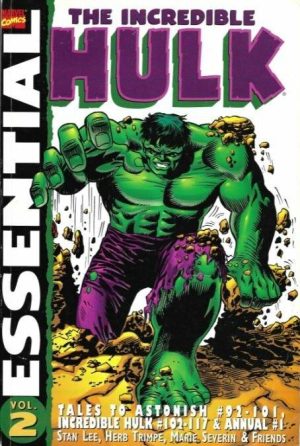
What strikes most about this collection of the Hulk’s earliest adventures, covering 1962-1966, is how many changes occur. One imagines the Hulk was the most stable of characters from the beginning, but the only constant over these early years is that it’s Bruce Banner who becomes the Hulk. In black and white it’s not evident the Hulk was grey over the first couple of stories, but the assorted other changes come thick and fast. At first Banner becomes the Hulk at night and reverts to his human form at daybreak. Then, extremely briefly, the transformations can be controlled, before it’s the Hulk with Banner’s intellect, then guided by Rick Jones. Stan Lee seem to settle on the Hulk transformation occurring when Banner is stressed, but then there’s another period of Banner being in control. It’s all rather eye-opening.
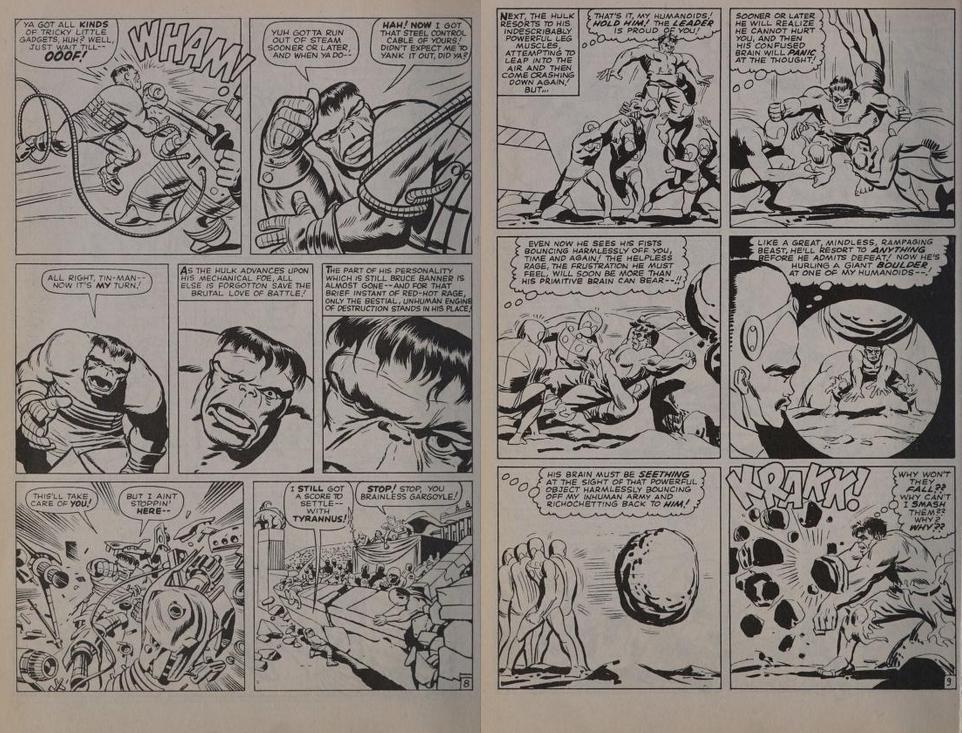
So is the art. As the Hulk’s co-creator the assumption would be that Jack Kirby’s version is definitive in the early days, yet Kirby’s version changes, starting with an especially gruesome Hulk, later slightly refined. Kirby’s certainly better when it comes to technology, but with such a powerful leading character the bombast could have been downplayed elsewhere. While his layouts always work, having Bob Powell and Mike Esposito pencil stories further diminishes Kirby’s finesse, although Bill Everett and John Romita over Kirby layouts work. Late on Gil Kane supplies an appealingly stylised Hulk, but the surprise is how good Steve Ditko’s Hulk is. Primarily using a six panel grid doesn’t constrict the art, and the supporting cast are better portrayed.
The Hulk’s earliest days are extremely episodic. Even before being restricted to ten page episodes Lee deliberately broke down the series into short sharp bursts. The origin story works very well as such, economically encompassing just five pages and a splash page, however the shortcomings of the restricted format are obvious when over forty stories are collected. Lee’s good with the soap opera drama, but the same situations play out in so many consecutive episodes. However, it’s not only the necessity of explanations that’s at fault. When first seen the Leader’s Humanoid robot is a formidable creation able to battle the Hulk to a standstill. The effect is considerably diminished, though, when Lee has variations appear in story after story as the Leader wears out his welcome. However, the end to his activities still shocks. That is until his return in Vol. 2.
Kane’s arrival coincides with another story extended too far, with the threat of Boomerang (in a ridiculous costume) overplayed and the Secret Empire unconvincing. The origin of the Abomination, though, is clever and proves the Hulk with a viable foe for decades to come.
If you’d prefer this material in colour, it’s all found in the first Hulk Omnibus. Alternatively, it’s spread across the first three Marvel Masterworks volumes, but at standard size, which is also the case for Epic Collections Man or Monster? and The Hulk Must Die.