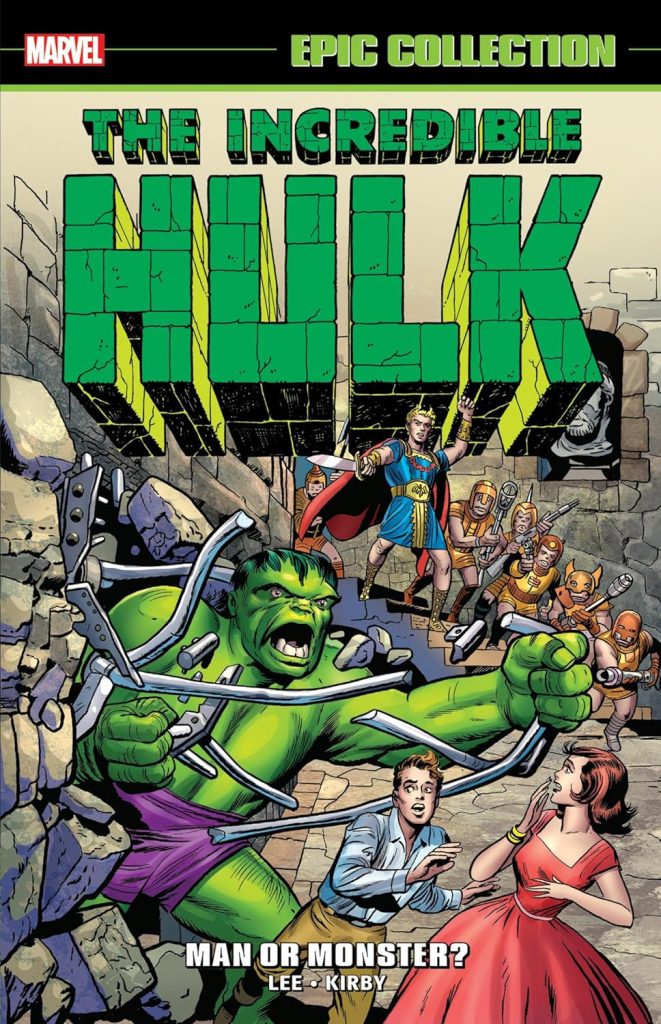

Review by Ian Keogh
The Hulk’s earliest stories have been reprinted so many times, so what’s the point of yet another collection? Well, Man or Monster? does what perhaps earlier collections should have done.
Looking back, your memory of the Hulk’s earliest stories may not coincide with reality. There’s an admirably compact five page origin of Dr Bruce Banner being caught at detonation point of one of the gamma bombs he’s devising, and absorbing the massive dose of radiation that transforms him into the Hulk. Thereafter, though, it’s constant change over the six issues that formed the Hulk’s first series. The Hulk was originally grey, not green, and his transformations occurred at sunset. Sometimes he’s a raging beast, but then Banner can be in control, and so can teenager Rick Jones, the only person aware Banner is the Hulk. It’s apparent Stan Lee didn’t launch the Hulk fully formed, and it’s possible the constant changes were relevant in the series not catching on at first.
More successful is a remote military base setting and those populating it, most prominently the fearsome General Thunderbolt Ross, constantly bullying the timid Banner. His daughter Betty feels sorry for Bruce, and he loves her for it, but his new state means he can’t reveal his attraction to her. Jack Kirby’s bombast sells the angry Hulk in action and the technology surrounding him, but also extends to the supporting cast who’re too dramatically posed. Steve Ditko’s art on the final issue of the Hulk’s original series has greater subtlety, yet is equally dynamic.
It’s after those six issues that this collection departs from colour printings as Marvel Masterworks and The Incredible Hulk Omnibus, and the black and white Essential Incredible Hulk. Lee retained faith in the duality of the brutal monster and the timid scientist, and kept him in the eye of the reading public by constantly guest starring him in other titles. A more consistent character was honed in these appearances, and there was the additional thrill of pitting the Hulk against the other powerhouses of the early Marvel universe. Chronologically the first of these occurs before the Hulk’s title was cancelled, so that’s where the first Hulk vs. Thing battle is placed.
Despite Kirby selling the power of the encounter, the Hulk’s second meeting with the Fantastic Four is far better despite the inking of George Roussos reducing Kirby’s power. Extended over what at the time was an unheard of two issues, the impact remains. We also see the Hulk taking on Thor, wittily referencing the earliest Avengers issues, also included here, but none of those comes close to matching Kirby’s peaks. There’s only a brief encounter between Spider-Man and the Hulk, but it’s enough to warrant the complete inclusion of a good Spider-Man story by Lee and Ditko introducing the Green Goblin.
Dick Ayers draws the final story before the Hulk would move back into his own regular series (the earliest stories collected in The Hulk Must Die), but it’s perfunctory.
Including the material over an eighteen month period bridging the Hulk’s two solo series gives a perspective on how the character solidified, and his place in the wider Marvel universe. It makes for a better collection that just the Hulk’s regular issues.